Solar Heating and Energy Transport
Electromagnetic & Blackbody Radiation
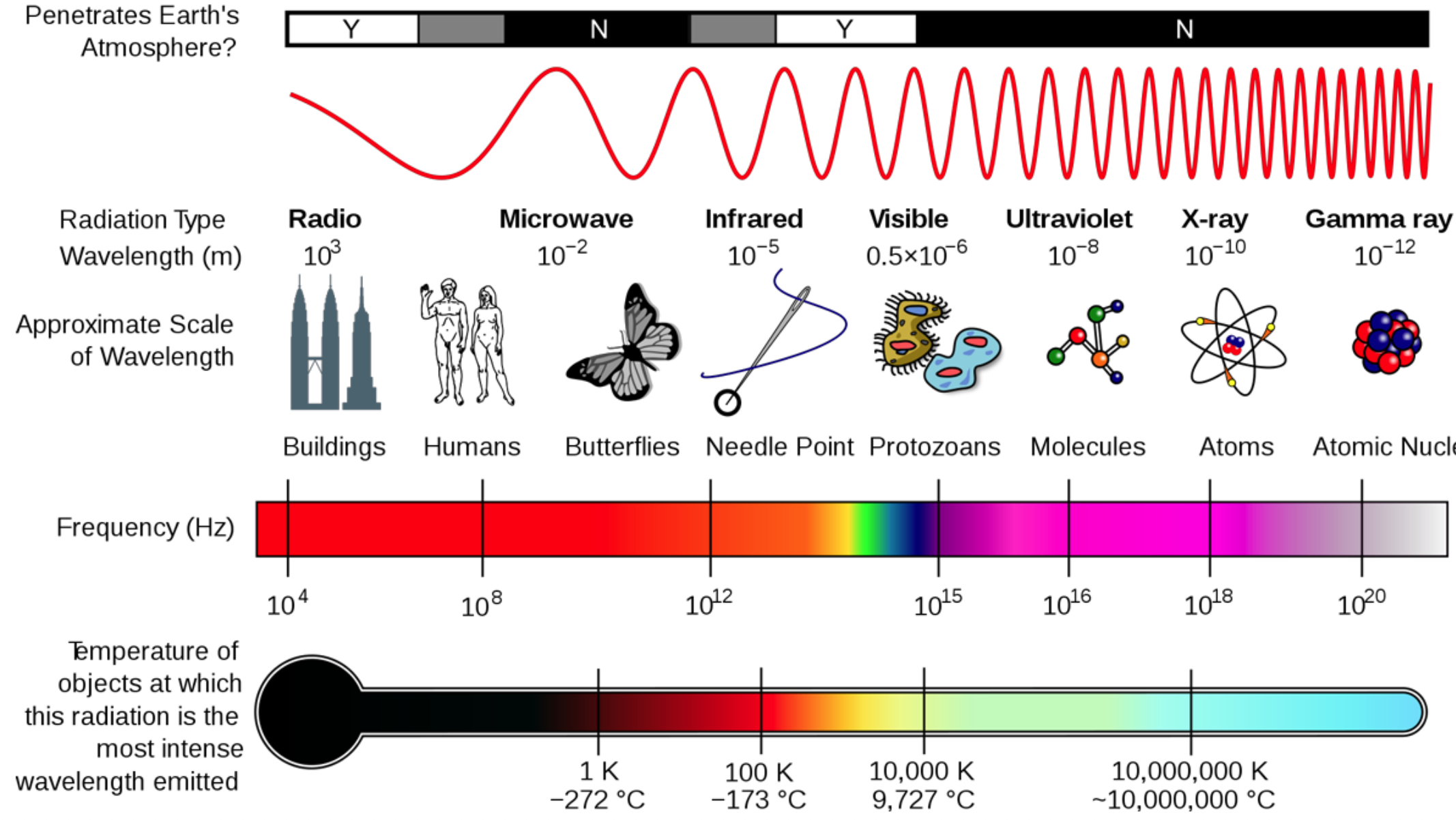
Radio waves, microwaves, infrared radiation, visible light, ultraviolet radiation, and X-rays are all forms of electromagnetic radiation used to observe stars and planets. All objects emit electromagnetic radiation with a spectrum determined by their temperature.
Planck's Law
The specific intensity (
= Planck's constant = Speed of light = Boltzmann constant = Temperature ( ) = Wavelength ( )
Wien's Displacement Law (Peak Radiation)
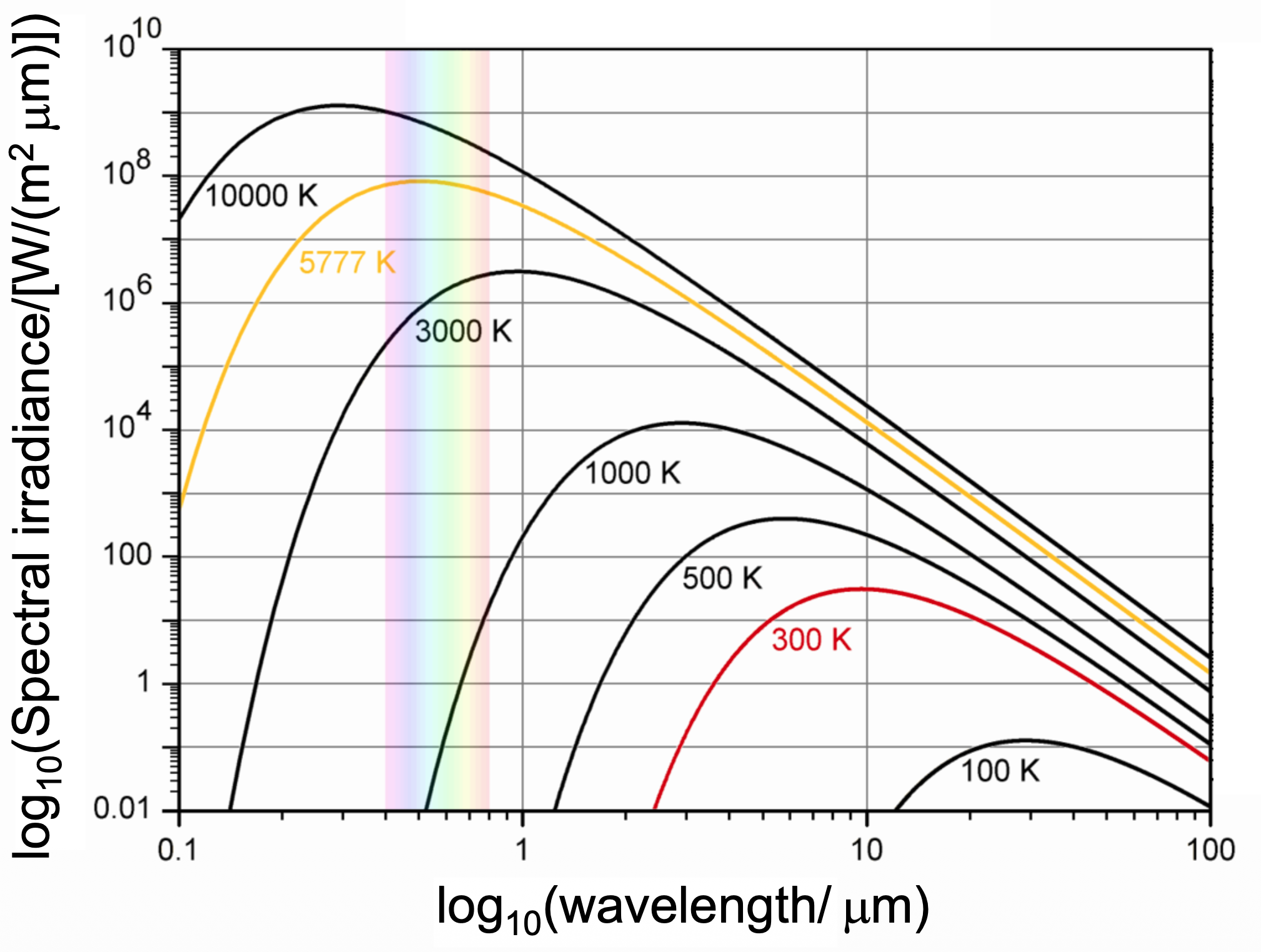
The frequency of peak radiation increases (and peak wavelength decreases) as temperature increases. By differentiating Planck's law to find the maximum, we obtain:
- Everyday Temperatures (
): Objects emit primarily in the infrared, not the visible spectrum. We see them via reflected sunlight rather than thermal emission. - Solar Surface Temperature (
): Peak emission occurs in yellow visible light. - Planetary Observation: Both reflected sunlight and thermally emitted radiation are useful; emitted infrared radiation is used to determine a planet's surface temperature.
Stefan-Boltzmann Law (Total Emissive Power)
Integrating Planck's law over all frequencies for a fixed temperature yields the total emissive power per unit surface area (
= Stefan-Boltzmann constant. - Because emissive power scales with the fourth power of temperature (
), small changes in temperature result in large changes in radiated power.
Solar Constant & Planetary Energy Receipt
Luminosity and the Solar Constant
The total power radiated by the Sun—its luminosity (
By conservation of energy, at a distance
At Earth's orbital distance (
For any other planet at a distance
Average Power Received by a Planet
- Interception: A spherical planet of radius
intercepts incoming parallel solar rays across its circular cross-sectional disk area ( ). The total solar power intercepted is: - Distribution: Due to the angle of incidence, equatorial regions receive more direct energy than polar regions. However, for a rapidly rotating planet (especially one with an atmosphere), this energy is redistributed over the entire spherical surface area (
). - Average Flux: Dividing the total intercepted power by the total surface area of the sphere gives the average solar power received per unit surface area:
(One-fourth of the local solar constant).
Absorption, Reflection, and Albedo
When incident solar radiation reaches a planet, it interacts with both the atmosphere and the surface:
- Atmosphere: Absorbs specific frequencies of electromagnetic radiation while transmitting others (e.g., Earth's atmosphere transmits visible light and parts of the infrared spectrum). Clouds and atmospheric aerosols also reflect incoming light (e.g., Venus and Titan have dense atmospheres/hazes that reflect most visible light, making them appear as opaque spheres).
- Surface: Absorbs a portion of the radiation that reaches it and reflects the remainder, depending on the radiation's frequency and angle of incidence.
- Albedo (
): The fraction of incident energy that is reflected or scattered back into space by the atmosphere and surface combined. - The fraction of incident energy absorbed is
. - Monochromatic Albedo (
): Reflectivity at a specific frequency . - Bond Albedo (
): Total reflectivity averaged over all frequencies of the incident solar spectrum. - Typical values:
overall. Rocky airless bodies like the Moon and Mercury have very low albedos ( ) due to dark surface silicates, whereas cloud-shrouded Venus has a very high albedo ( ).
- The fraction of incident energy absorbed is
Equilibrium Temperature of a Planet or Moon
Derivation of Equilibrium Temperature (
In radiative equilibrium, the heat absorbed from the Sun (
- Heat Input (
): The solar flux at distance intercepted by the planet's cross-section ( ), multiplied by the absorbed fraction : - Heat Output (
): Assuming a rapidly rotating planet with a uniform surface temperature, thermal radiation is emitted across the entire spherical surface ( ) with emissivity ( ): - Solving for
: Equating and cancels out the planetary radius : Expressed in terms of Earth's Solar Constant ( ) and heliocentric distance in Astronomical Units ( ):
The equilibrium temperature of a planet is independent of the planet's size (
Comparison: Calculated vs. Observed Temperatures
| Object | Distance | Albedo ( | Calculated | Observed | Primary Cause of Discrepancy |
|---|---|---|---|---|---|
| Mercury | Slow rotation + no atmosphere (extreme day/night swing) | ||||
| Venus | Extreme greenhouse effect ( | ||||
| Earth | Moderate greenhouse effect ( | ||||
| Moon | Slow rotation + no atmosphere | ||||
| Mars | Thin atmosphere ( | ||||
| Jupiter | Internal heat source | ||||
| Saturn | Internal heat source | ||||
| Uranus | Negligible internal heat | ||||
| Neptune | Internal heat source | ||||
| Pluto | In radiative equilibrium |
Causes of Temperature Discrepancies
- Large Day-Night Temperature Variations (Rotation & Lack of Atmosphere):
- The baseline model assumes rapid rotation and uniform global temperature.
- Airless, slowly rotating bodies (Mercury and the Moon) cannot redistribute heat efficiently. The night side cools drastically over long periods, while the day side reaches peak temperatures much higher than
. - Conversely, a thick atmosphere buffers and redistributes thermal energy (Venus maintains a nearly uniform surface temperature despite very slow rotation). Mars is an intermediate case (rapid
rotation, but a very thin atmosphere).
- The Greenhouse Effect:
- Atmospheres on Earth and Venus transmit incoming visible sunlight to the surface but absorb outgoing infrared thermal radiation emitted by the surface.
- In these cases,
corresponds to the upper atmospheric layer where infrared radiation can finally escape to space, while the surface below is kept much warmer (raising Venus's surface temperature by above ).
- Internal Heat Sources:
- Several giant planets (Jupiter, Saturn, and Neptune) radiate more heat than they receive from the Sun (
) due to internal heat generation from planetary formation and differentiation.
- Several giant planets (Jupiter, Saturn, and Neptune) radiate more heat than they receive from the Sun (
Heat Transport Mechanisms
Heat is transported across planetary interiors, oceans, atmospheres, and space via three primary physical mechanisms:
- Conduction (Thermal Diffusion):
- The transfer of heat through direct microscopic interactions: lattice vibrations of atoms in solids or intermolecular collisions in gases.
- Higher temperatures correspond to more vigorous atomic/molecular motion, which spreads to adjacent cooler regions through bonds or collisions to equalize temperature.
- Radiation:
- The transfer of energy via electromagnetic waves (photons), requiring no physical medium (e.g., solar heating travelling through the vacuum of space to a planetary surface).
- Convection:
- The macroscopic transfer of heat via bulk fluid motion driven by gravity and buoyancy.
- Heated material expands, becomes less dense, and rises; cooler material contracts, becomes denser, and sinks.
- Convecting layers are typically bounded at the top and bottom by conductive boundary layers where heat enters or leaves the system.
- Planetary Significance: Drives dynamics in the Sun's outer layer (creating its granular surface appearance), planetary atmospheres, oceans, silicate mantles, and liquid metallic cores (where convection in electrically conducting iron generates planetary magnetic fields, such as Earth's geodynamo).