Planetary Atmospheres
Overview & Composition
Types of Planetary Atmospheres
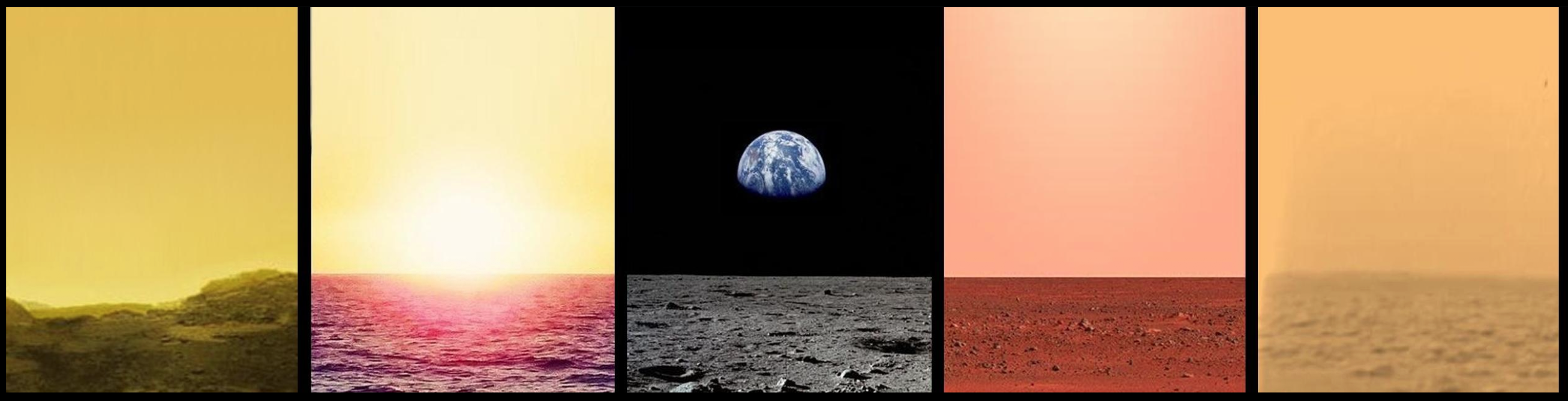
Substantial Terrestrial Atmospheres (Venus, Earth, Mars, Titan)
-
Possess distinct, dense gas envelopes above a solid surface, all hosting clouds of some type.
-
Secondary Atmospheres: Unlike the primordial envelopes of gas giants, terrestrial atmospheres were mostly outgassed from planetary interiors after accretion and subsequently modified by distinct evolutionary paths.
| Body | Surface Pressure ( | Primary Composition | Trace / Minor Species | Key Characteristics |
|---|---|---|---|---|
| Venus | Opaque in visible & IR; thick | |||
| Earth | Total mass | |||
| Mars | Thin atmosphere ( | |||
| Titan | Too cold for gaseous | |||
 |
Giant Planets (Jupiter, Saturn, Uranus, Neptune)
-
Lack a solid surface; atmospheric density increases continuously with depth until the gas behaves like a liquid.
-
Primordial Composition: Massive enough to gravitationally retain light gases (
and ) in proportions similar to the Sun. -
Jupiter & Saturn: Dominated by
( and ) and ( and ), with condensable gases ( ), noble gases ( ), disequilibrium species ( ), and photochemical hydrocarbons. -
Uranus & Neptune:
and , with a strong enhancement in ( , giving them their blue/green color) and almost no gaseous in the upper atmosphere (likely dissolved in deep interior water/ionic oceans). Neptune also contains significant and .
-
-
Circulation & Banded Structure:
-
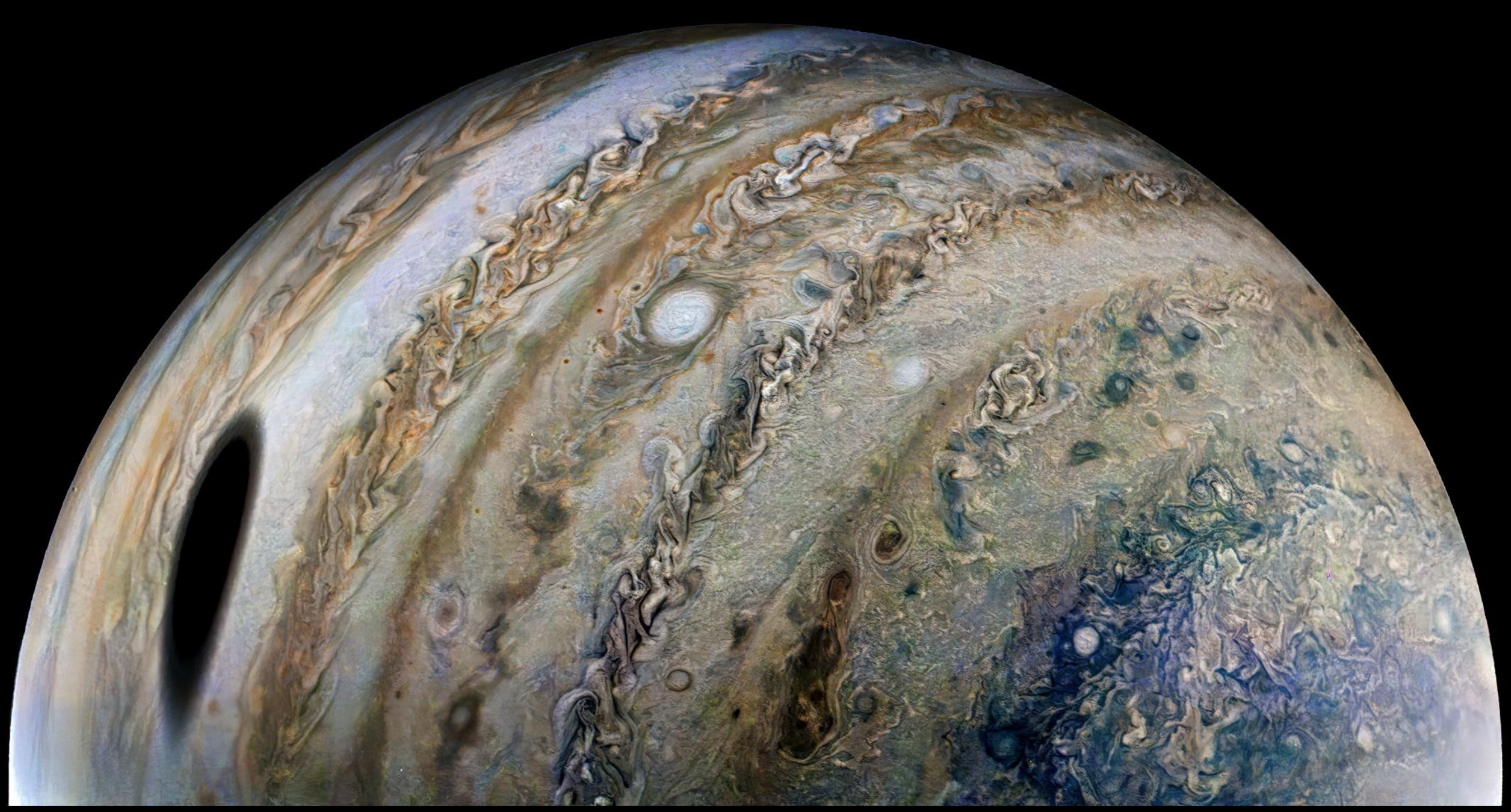
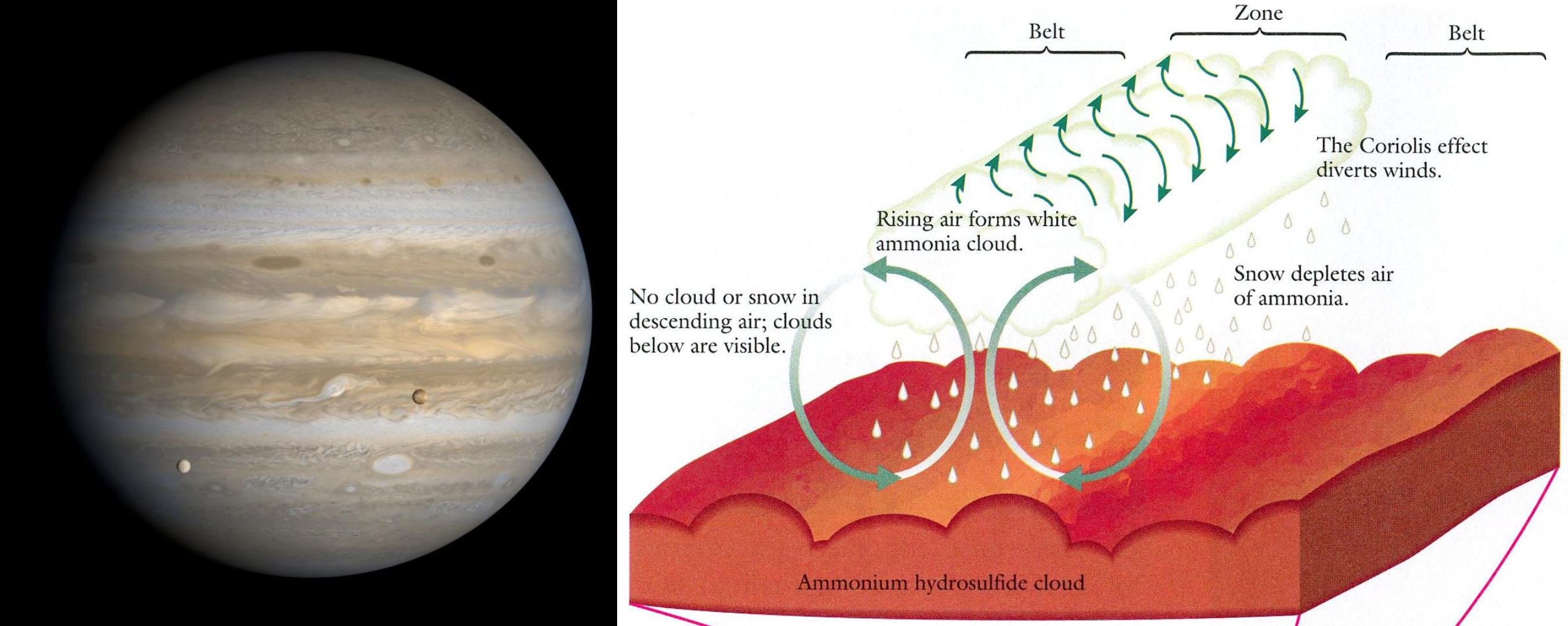
Jupiter: Dynamic alternating zonal bands, eddies, and vortices (e.g., the Great Red Spot). Radio observations (Juno) show atmospheric features extend several hundred kilometers deep (down to
). -
Zones: Light-colored, cool, high-altitude white ammonia (
) clouds formed by atmospheric upwelling (appear dark in thermal infrared because they are cold and block deeper heat). -
Belts: Dark-colored, warm, low-altitude reddish clouds (
) visible at sites of atmospheric downwelling where dry descending air clears the upper ammonia clouds (appear bright in thermal infrared).
-
-
Saturn: Subdued cloud coloring compared to Jupiter, but features similar zonal bands, periodic storms, and a prominent polar Hexagon jet stream at its North Pole.
-
Uranus & Neptune: Appear to have a 2-banded structure per hemisphere. Uranus has an extreme axial tilt (
) over its orbit, forcing extreme seasonal changes (shifting from featureless during the 1986 solstice flyby to showing banded clouds and dark spots near the 2007 equinox). Neptune exhibits active clouds, transient vortices (Great Dark Spot), and the highest wind velocities in the Solar System.
-
Tenuous Atmospheres (Exospheres)
-
Extremely low surface pressures comparable to laboratory vacuums; atoms/molecules rarely collide.
-
Mercury (
; total mass ): ; forms a comet-like sodium tail pushed by solar radiation pressure. -
Moon (
): . -
Io (
): . -
Europa (
): . -
Triton & Pluto (
): with trace and .
-
-
Origins of Tenuous Atmospheres: Surface sputtering by micrometeorites/ions (Mercury, Moon), solar wind capture (Mercury), active volcanism (Io), ice sublimation (Triton, Pluto, Europa), and geysers/cryovolcanism (Triton).
Remote Sensing & Planetary Spectra
Information about atmospheric composition and thermal structure is obtained via electromagnetic spectra, which consist of two distinct components:
-
Reflected Sunlight: Peaks in the visible spectrum (corresponding to the Sun's
blackbody curve). -
Emitted Thermal Radiation: Peaks in the infrared spectrum (corresponding to planetary temperatures of a few hundred
).
-
Absorption & Emission Lines: Atoms and molecules absorb and emit photons at specific quantized frequencies, superimposing narrow troughs (absorption lines) or peaks (emission lines) onto the smooth blackbody curve (after correcting for solar and terrestrial atmospheric lines).
-
Probing Depth vs. Wavelength: Atmospheric opacity varies strongly with wavelength:
-
Transparent wavelengths ("Atmospheric Windows"): Allow radiation to pass through with little absorption (e.g., visible light, radio waves, and specific IR bands on Earth), sampling deeper, hotter layers or the planetary surface.
-
Opaque / Strong absorption wavelengths: Radiation is absorbed high in the atmosphere (e.g.,
at or at ), sampling higher, typically colder layers (resulting in lower brightness temperatures in thermal IR spectra).
-
Heat Transport & Atmospheric Vertical Structure
Ideal Gas Law, Hydrostatic Equilibrium, and Scale Height
Equation of State (Ideal Gas Law)
-
= Pressure ( ), = Volume ( ), = Temperature ( ) -
= Number of molecules, = Number of moles ( = Avogadro's number) -
(Boltzmann constant), (Universal gas constant) -
= Density ( ), where is the average molar mass ( , e.g., for ).
Hydrostatic Equilibrium
When vertical acceleration is negligible compared to gravity and pressure gradients, the upward pressure force on a gas parcel balances the downward pressure force plus the weight of the gas column above it (
Pressure Scale Height (
Substituting
Integrating from the surface (
-
Physical Meaning: The scale height (
) is the vertical distance over which atmospheric pressure decreases by a factor of . -
is constant only in an isothermal atmosphere. In Earth's lower atmosphere, ranges from (at ) to (at ).
Adiabatic Lapse Rate & Convective Stability
Derivation of the Dry Adiabatic Lapse Rate
In convective regions, gas parcels rise and expand (or sink and compress) rapidly without exchanging heat with their surroundings (adiabatic process,
-
First Law of Thermodynamics (per unit mass):
(where
is specific volume, and is specific heat capacity at constant volume; for an ideal gas, ). -
Differentiating the Ideal Gas Law (
): -
Eliminating
: -
Applying Hydrostatic Equilibrium (
): (where
for diatomic air). On Earth, the dry adiabatic lapse rate is .
Wet (Moist) Adiabatic Lapse Rate
When rising air contains condensable vapor (like water on Earth), cooling causes condensation, which releases latent heat (
- On Earth, the wet adiabatic lapse rate is
.
Schwarzschild Criterion for Convective Stability
Whether an atmospheric layer convects depends on the background temperature gradient
-
Stable (Radiative Equilibrium):
(sub-adiabatic). A displaced rising air parcel cools faster than its surroundings, becomes denser ( ), and sinks back down. -
Unstable (Convection Dominates):
(super-adiabatic). A displaced rising air parcel remains warmer and less dense than its surroundings ( ) and continues to rise. Vigorous convection mixes the layer and rapidly reduces the temperature gradient back toward the adiabat.
Radiative Transfer, Optical Depth, and the Greenhouse Effect
Optical Depth (
As radiation of intensity
-
Optical Depth (
): Measured downward from the top of the atmosphere. Intensity drops by a factor of when . -
: Optically thin (transparent). -
: Optically thick (opaque).
-
-
Grey Atmosphere Approximation: A simplified first-order model assuming the absorption coefficient
is constant across all wavelengths, independent of temperature and pressure.
Greenhouse Effect & Two-Stream Radiative Profile
Incoming visible sunlight passes through the atmosphere with low opacity and heats the planetary surface. The warm surface emits thermal infrared radiation, which is strongly absorbed by greenhouse gases (
In a simplified radiative grey atmosphere with infrared optical depth
-
Temperature Profile at Optical Depth
: -
Skin Temperature (
or ): At the top of the atmosphere ( ), an optically thin layer absorbs upward IR flux from below ( ) and emits both upward and downward ( ): -
Effective Emission Level: The planet's equilibrium temperature
corresponds to the altitude where the optical depth is (the level from which photons effectively escape to space). -
Surface Temperature with Greenhouse Effect (
): Accounting for the radiative boundary discontinuity right at the ground ( ), the surface temperature is: -
Because the radiative temperature gradient near an optically thick surface is extremely steep (exceeding the adiabatic gradient), convection takes over in the lower atmosphere, creating a radiative-convective structure.
Vertical Layering of Planetary Atmospheres
Atmospheres are divided into vertical layers based on their temperature gradients, heat transport mechanisms, and chemical mixing:
-
Troposphere (Surface to Tropopause):
-
Heated from below by the surface; dominated by convection (Greek tropē = overturn).
-
Temperature decreases linearly with altitude along the adiabatic lapse rate.
-
On Earth, it spans
(poles) to (equator), contains of the total atmospheric mass, is uniformly mixed, and hosts weather and water clouds. -
Bounded at the top by the Tropopause, a temperature minimum where convection ceases and radiative transfer takes over.
-
-
Stratosphere (Tropopause to Stratopause, ~12–50 km on Earth):
-
Temperature increases with altitude due to direct absorption of solar UV radiation (by the ozone (
) layer at on Earth, and by hydrocarbon haze/smog on Titan). -
This inverted temperature gradient (
) strongly inhibits vertical convection. Mixing is strictly horizontal (driven by jet streams and gravity waves), meaning pollutants ( , CFCs) remain trapped for . -
The troposphere and stratosphere together contain
of Earth's atmospheric mass. -
(Note: Venus and Mars lack a distinct stratosphere because they lack a strong middle-atmosphere UV absorber like an ozone layer).
-
-
Mesosphere (Stratopause to Mesopause, ~50–85 km on Earth):
-
Dominated by radiation; temperature decreases with altitude due to low UV absorption and efficient radiative cooling/emission by
. -
The Mesopause (
) is the coldest region of Earth's atmosphere ( ), where trace water vapor freezes into noctilucent clouds and most incoming meteors vaporize.
-
-
Thermosphere (Above Mesopause, ~85–500 km on Earth):
-
Extremely low gas density; temperature increases sharply with altitude (up to
on Earth, varying strongly with solar activity) due to absorption of high-energy solar X-ray and extreme UV ( ) radiation. -
On Venus, the nightside upper atmosphere cools so efficiently via
emission that it forms a cold cryosphere ( ) instead of a hot thermosphere. -
Overlaps with the Ionosphere, where solar radiation photoionizes gas atoms and molecules, and where auroras occur.
-
-
Exosphere (Above Exobase / Barosphere, >250–500 km):
- Outermost tenuous layer where the mean free path exceeds the scale height; particles rarely collide and fast-moving atoms can escape into space.
-
Homosphere (Surface up to ~85–100 km): Turbulent eddy mixing keeps the bulk chemical composition homogeneous (uniform molecular weight
). -
Homopause (Turbopause): Boundary near the mesopause where turbulent mixing gives way to molecular diffusion.
-
Heterosphere (Thermosphere & Exosphere): Above the homopause, collisions and turbulence are too weak to mix gases; constituents separate gravitationally according to their individual molecular masses (lighter gases like
and dominate at higher altitudes).
Clouds & Atmospheric Chemistry
-
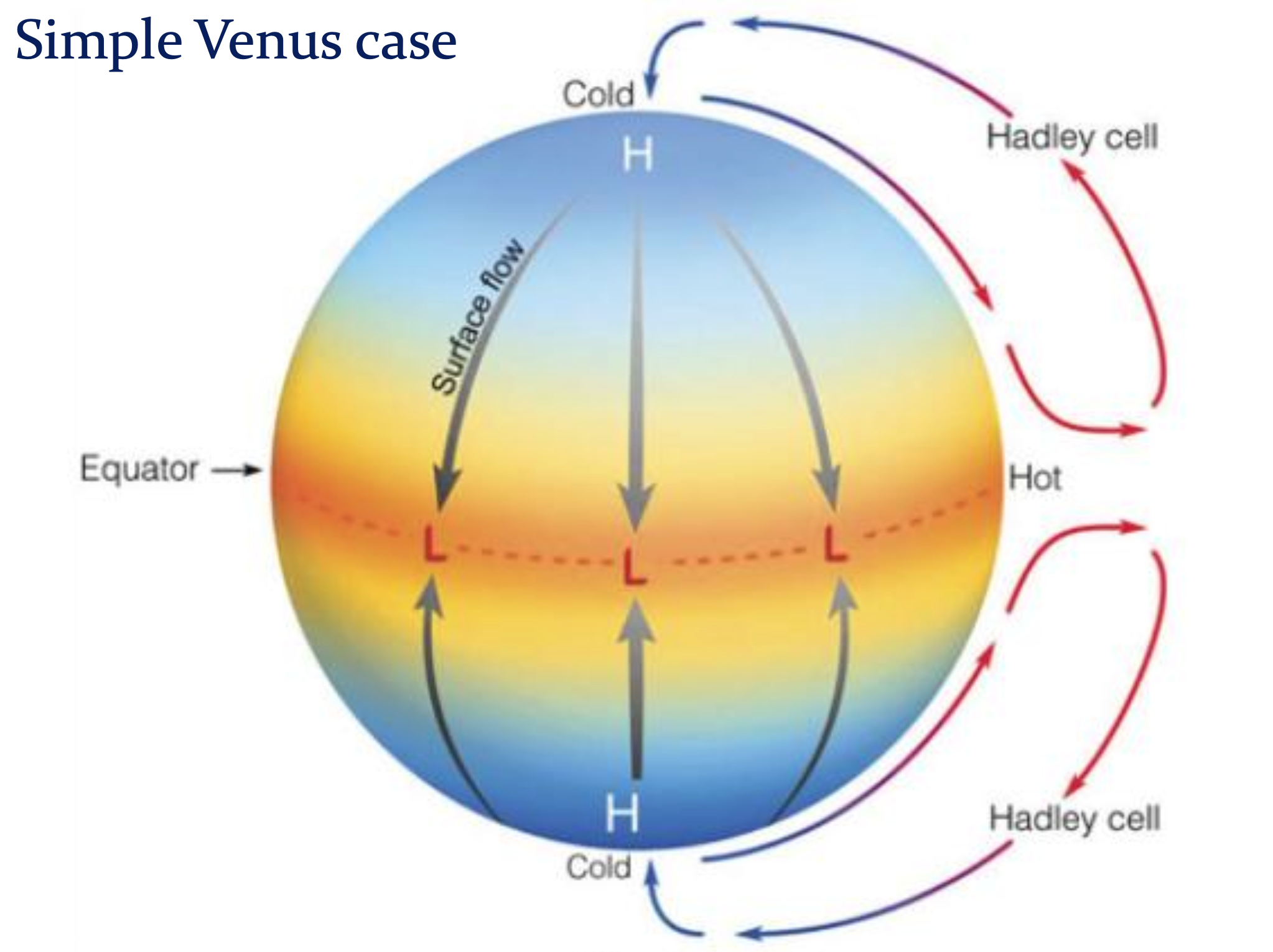
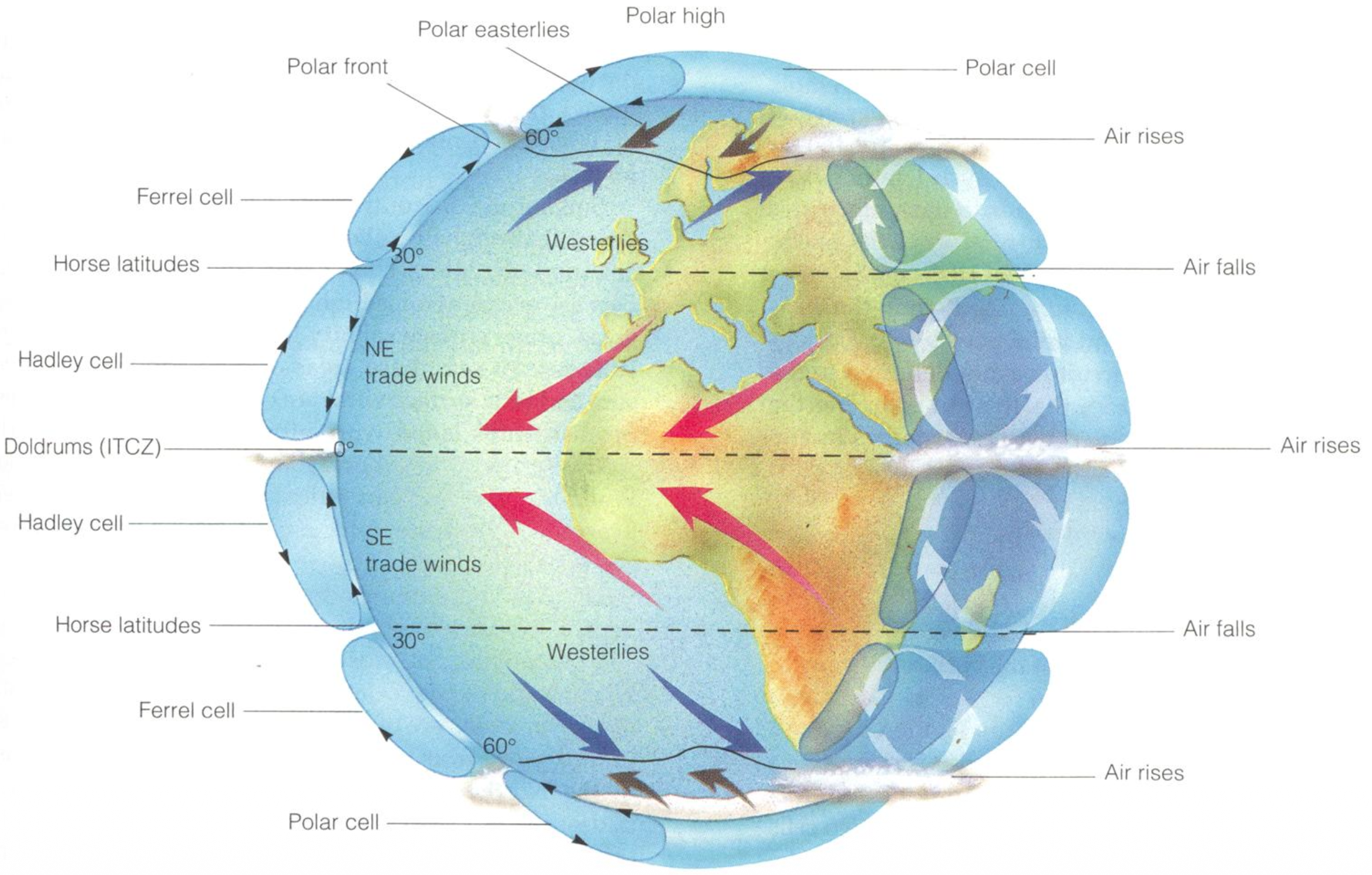
Rapid Rotators (Earth, Giant Planets): The Coriolis force deflects north-south winds into east-west (zonal) flows, breaking the circulation into multiple latitudinal cells:
- Earth (
): Hadley cell ( , trade winds), Ferrel cell ( , mid-latitude westerlies), and Polar cell ( , polar easterlies). - Jupiter & Saturn: Broken into
or more alternating zonal bands per hemisphere.
- Earth (
-
Mars: Exhibits a single cross-equatorial Hadley cell flowing from the summer hemisphere tropics to the winter hemisphere subtropics.
-
-
Thermal Tides (Day-Night Heating Gradient):
-
Diurnal and semidiurnal global-scale pressure waves driven by the temperature contrast between the solar-heated dayside and cooling nightside.
-
Very strong on Mars (thin atmosphere) and Venus (where thermal tides in the upper atmosphere torque the atmosphere and may have influenced the planet's retrograde rotation rate); weak on Earth.
-
-
Condensation Flows (Seasonal Phase Changes):
-
Driven by the seasonal freezing (resublimation) of a major atmospheric constituent onto the winter polar cap and its sublimation from the summer polar cap.
-
Mars:
of the entire atmosphere freezes onto the winter pole, driving strong pole-to-pole condensation winds and causing global surface pressure to oscillate seasonally between and (measured by Viking Landers). Also important for on Triton and Pluto.
-
Equations of Motion: Navier-Stokes & Shallow Water Approximation
The motion of an air parcel with velocity
-
= Material derivative (following the flow) -
= Coriolis acceleration (deflects moving parcels to the right in the Northern Hemisphere and to the left in the Southern Hemisphere) -
= Pressure-gradient acceleration -
= Effective gravitational acceleration (incorporating centrifugal acceleration, ) -
= Viscous friction term ( = kinematic viscosity)
Dimensionless Numbers
-
Ekman Number (
): Measures the ratio of viscous forces to Coriolis forces over characteristic length scale : Small
rotation dominates over viscosity (e.g., planetary atmospheres ; liquid iron cores ; solid silicate mantles where viscosity dominates). -
Rossby Number (
): Measures the ratio of inertial (momentum/centripetal) forces to Coriolis forces: (where
is the Coriolis parameter/factor at latitude ). -
Small
: Rotation/Coriolis force dominates (Geostrophic balance). -
Large
: Momentum/centripetal force dominates (Cyclostrophic balance).
-
Shallow Water & Natural Coordinate Formalism
Because atmospheric vertical thickness is tiny compared to planetary radii, the Shallow Water Approximation assumes purely horizontal flow, negligible viscosity, and vertical hydrostatic balance (
Projecting this horizontal motion along natural path coordinates—where
-
Along the flow (
): -
Perpendicular to the flow (
):
Steady Horizontal Flow Regimes & Eddies
1. Geostrophic Balance (
When planetary rotation is fast and length scales
-
Direction of Geostrophic Wind: Because the Coriolis force acts perpendicular to velocity and must oppose the pressure gradient (which points perpendicular to isobars, from high to low pressure), geostrophic winds blow parallel to isobars rather than directly from high to low pressure.
-
Cyclones & Anticyclones: Air circulates around pressure centers—counterclockwise around Low pressure (cyclones/typhoons) and clockwise around High pressure in the Northern Hemisphere (reversed in the Southern Hemisphere).
2. Cyclostrophic Balance (
When the Coriolis parameter
-
Applications:
-
Atmospheric Superrotation on Venus & Titan: On Venus, the cloud-top atmosphere circles the planet once every
( ), whereas the solid planet rotates once every . -
Small-scale, high-velocity vortices on Earth such as tornadoes, dust devils, and waterspouts.
-
3. Atmospheric Eddies
-
Baroclinic Eddies: Transient, rotating weather systems generated by latitudinal temperature gradients in mid-latitudes (irregular in both hemispheres on Earth; quasi-periodic in the winter hemisphere on Mars).
-
Stationary Eddies: Persistent wave patterns forced by zonal winds flowing over surface topography ("A" eddies on Venus, Earth, and Mars) or by land-ocean thermal contrasts ("B" eddies on Earth). On Venus, stationary topographic gravity waves propagate up to
into the cloud deck. -
Shear Eddies on Giant Planets: Long-lived anticyclonic/cyclonic vortices (such as Jupiter's Great Red Spot) rolled up between alternating bands of high-speed zonal jets.