Power
Common Power Sources
| Feature | Solar Photovoltaic | Radioisotope Thermoelectric Generator (RTG) | Fuel Cell |
|---|---|---|---|
| Power range (kW) | 0.2-300 | 0.2-10 | 0.2-50 |
| Specific power (W/kg) | 25-200 | 5-20 | 275 |
| Specific cost ($/kg) | 800-3000 | 16K-200K | 50K-100K |
| Power storage required for eclipse | Yes | No | No |
| Principal applications | Earth-orbiting spacecrafts and missions as far as Mars | Interplanetary | Interplanetary, short missions |
| Concept | Convert solar radiation into electrical energy | Radioactive source emits heat as it decays. Temperature difference between hot source and cold radiators converted into electricity. | Hydrogen + oxygen flow into cell, creating an oxidation reaction, which generates a current. |
| Examples | OneWeb | Viking 1 Lander | Space Shuttle |
Energy Budget
- Define the components power consumption
- Estimate the total spacecraft power consumption for each activity
- Size the solar arrays
- Size the battery
- Size the PCDU
- Create an energy budget with the selected components
- Simulate different mission phase and specific scenarios
- Iterate!
Components Power Consumption
Get the power requirement from the selected component, this can be different for different modes the component is in (example: Radio receives or transmits).
| Mode | Power consumption |
|---|---|
| Off | 0 W |
| Receiving | 2 W |
| Receiving + Transmitting | 8 W |
Set the margin on the power requirement based on the maturity level of the component:
- Commercial Off The Shelf (COTS) -> 5%
- COTS with minor modifications -> 10%
- New design or major modifications -> 20%
Component Duty Cycle
This is the percent that the component is in a certain mode. This needs to be included to get an estimation for the average power consumption.
| Camera Mode | Off | Start-up | Picture | Compress |
| :--- | :--- | :--- | :--- | :--- |
| Power consumption | 0 W | 1 W | 3 W | 5 W |
| Duration | 46 sec | 3 sec | 1 sec | 10 sec |
| Duty cycle | 76.7% | 5% | 1.7% | 16.7% |
Estimate total spacecraft power consumption for each activity
Sum over all components for the same activity, for example the radio is not linking down while the camera system is acquiring images, but the captured images have to be compressed by the computing module.
This can give you a power requirement over the full mission timeline, and also estimations for peak power consumptions.
Size the Solar Arrays
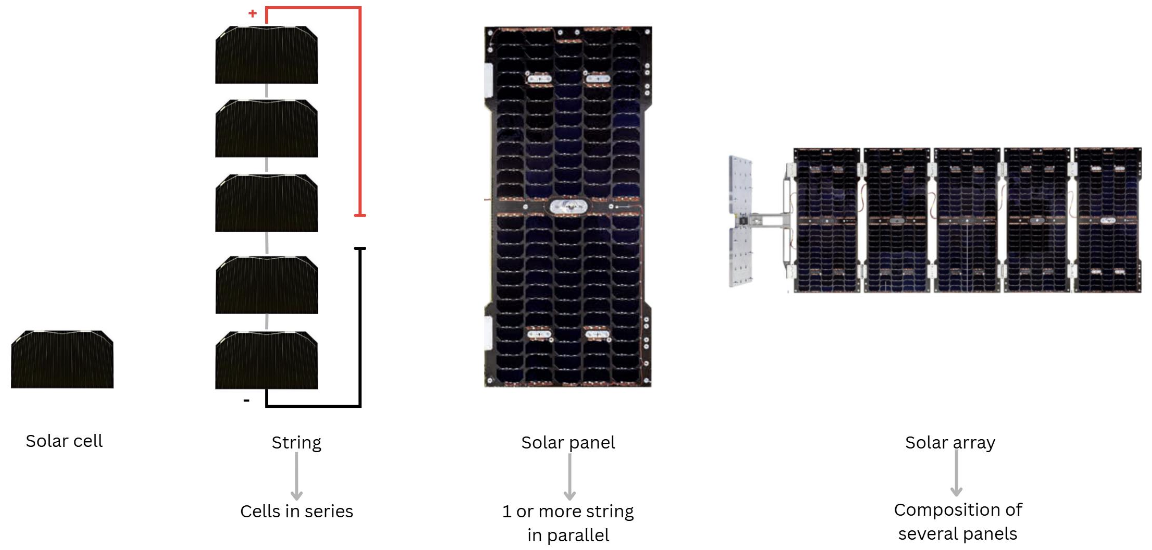
There are multiple kinds of solar panel and also different methods to configurations how there are attached to the spacecraft.
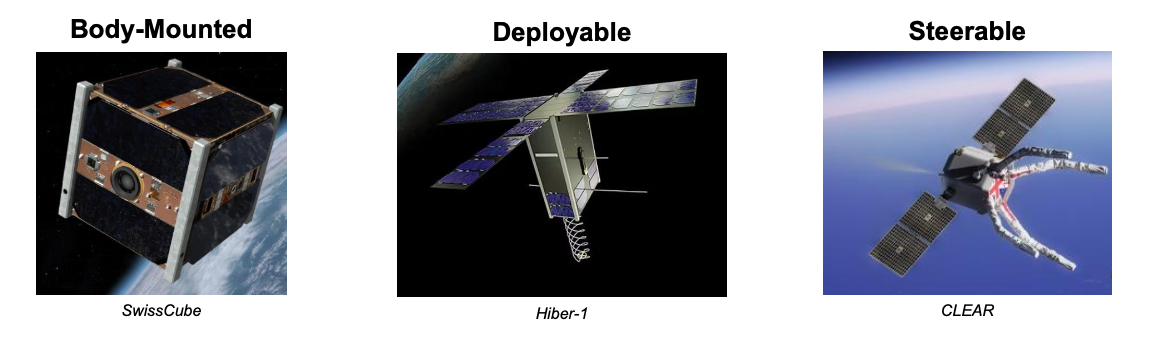
| Feature | Body-Mounted | Deployable | Steerable |
|---|---|---|---|
| Power generation | Low | Medium | High |
| Cost | Low | Medium | High |
| Design complexity & reliability | No mechanism | Deployment mechanism | Deployment + actuating mechanism |
| Cell efficiency | Lower because of s/c high body temperature | Nominal | Nominal |
| Attitude control required torque | + | +++ because of increased external disturbance & inertia |
+++ because of increased external disturbance & inertia |
| Structural stiffness | Good | Potential flexing | Potential flexing |
| Orbital decay | Nominal | Faster because of increased drag area | Faster because of increased drag area |
Efficiency
| Cell Type | Silicon | GaAs | Triple Junction GaAs (most common) | Power plants on Earth |
|---|---|---|---|---|
| Efficiency at 28°C | 22% | 18.5% | 30% | ~ 20-24% |
| Degradation in LEO | 3.75% per year | 2.75% per year | 0.5% per year | - |
| Cost | Low | Medium | High | - |
Calculate Power Generation
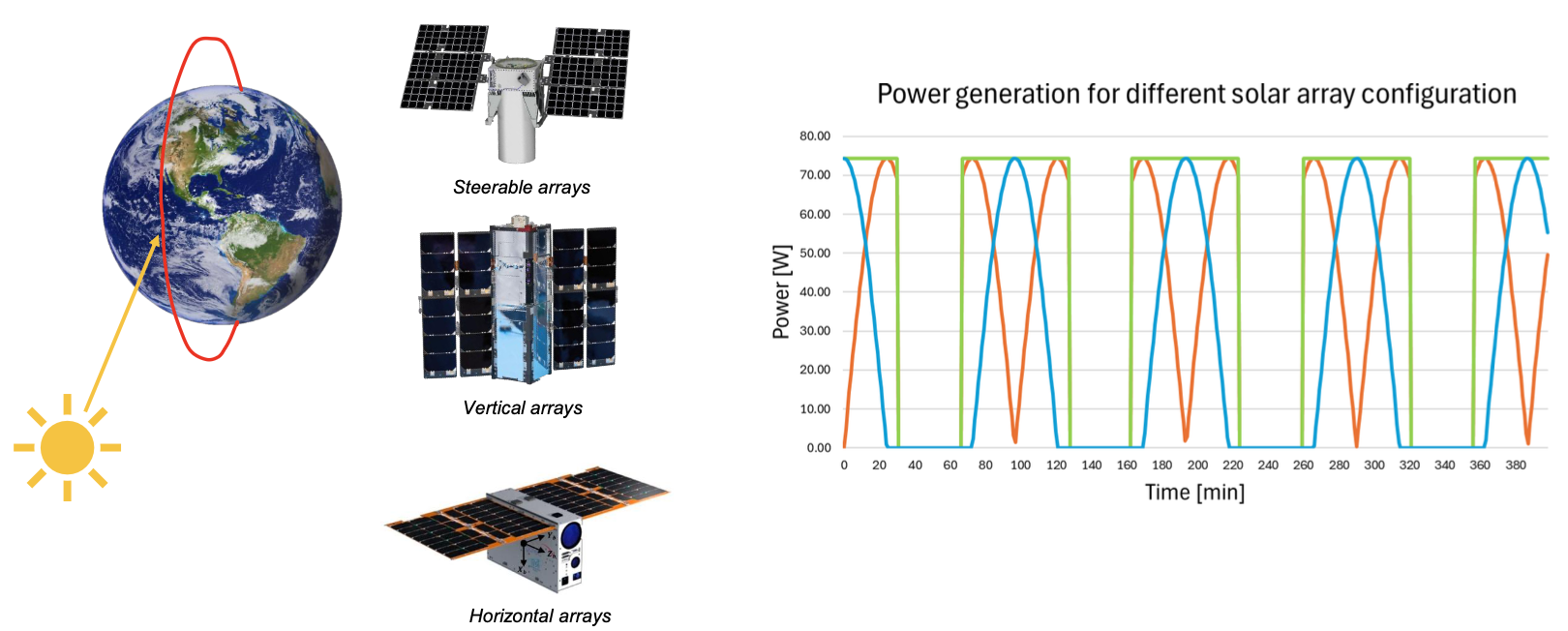
the Sun luminosity (3.83 * 10^26 W) the solar cell efficiency the cell area (the total illuminated area, not the total area) the angle between the solar array normal and the Sun vector the distance between the Sun and the satellite
On average, in one orbit, there should be more energy generated than used.
Calculating
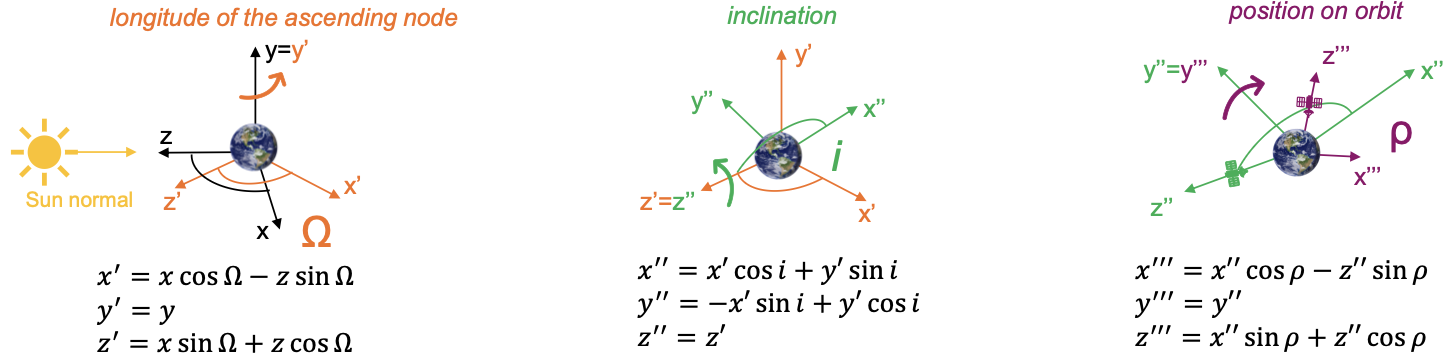
This leads to a formula to
To account for other solar array angles or pointing errors, there can be added more transformations to the coordinate system.
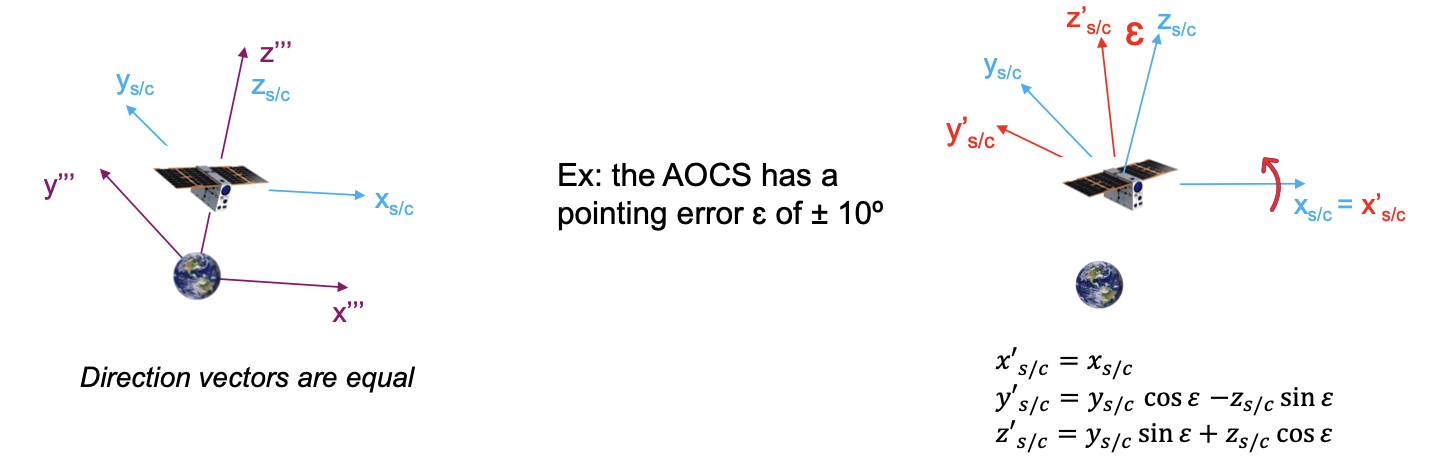
Power generation over one orbit dependent on solar array orientation
Size the battery
Batteries have a rated energy capacity, but if we would use the full capacity all the time the lifetime of battery will be greatly reduced. For this there is an allowed Depth of Discharge (DoD) corresponding to a required amount of charge cycles. With the DoD the energy requirements between phases of power generation (eclipse) have to be covered.
Batteries also loose capacity over time, so they have a limited shelf life.
Size the Power Conditioning and Distribution Unit (PCDU)
A board that regulates, converts and switches power. It interfaces with a lot of the other modules in the power system.
PCDU and Solar Arrays
Solar Arrays have a voltage with peak efficiency, a Peak Power Tracker (PPT) tries to keep the solar array on this peak but it requires some overhead. Direct Energy Transfer (DET) uses the power directly from the solar cells, this means that there is no overhead but the solar cells are maybe not running on peak efficiency.
| DET | PPT | |
|---|---|---|
| Concept | Direct power transfer from solar arrays to the bus | DC-DC converter between the solar array and the bus |
| Voltage | Same as battery -> When the battery has a low voltage, the solar array operates below its capacity | Adjusted to reach Maximum Power Point |
| Excess power | Shunted through resistors -> excess power dissipated as heat | Voltage adjusted to produce less power |
| Pro | Robust and simple. Better conversion efficiency | More power generated |
| Con | Power generation is not maximized | Added weight, complexity and cost. Can become less efficient than DET at EOL |
PCDU and Battery
The Battery has to be charged, managed and balanced. This also requires measuring the battery temperature and limit charge and discharge rates.
PCDU and other Components
- OBC
- Send telemetry (current voltage readings, battery temperature, etc.)
- Command and control
- Umbilical interface
- External interface to supply power during tests
- Can also be used by the launcher to supply power during long trips
- Separation switches
- Detect separation from the launcher
- Triggers spacecraft activation
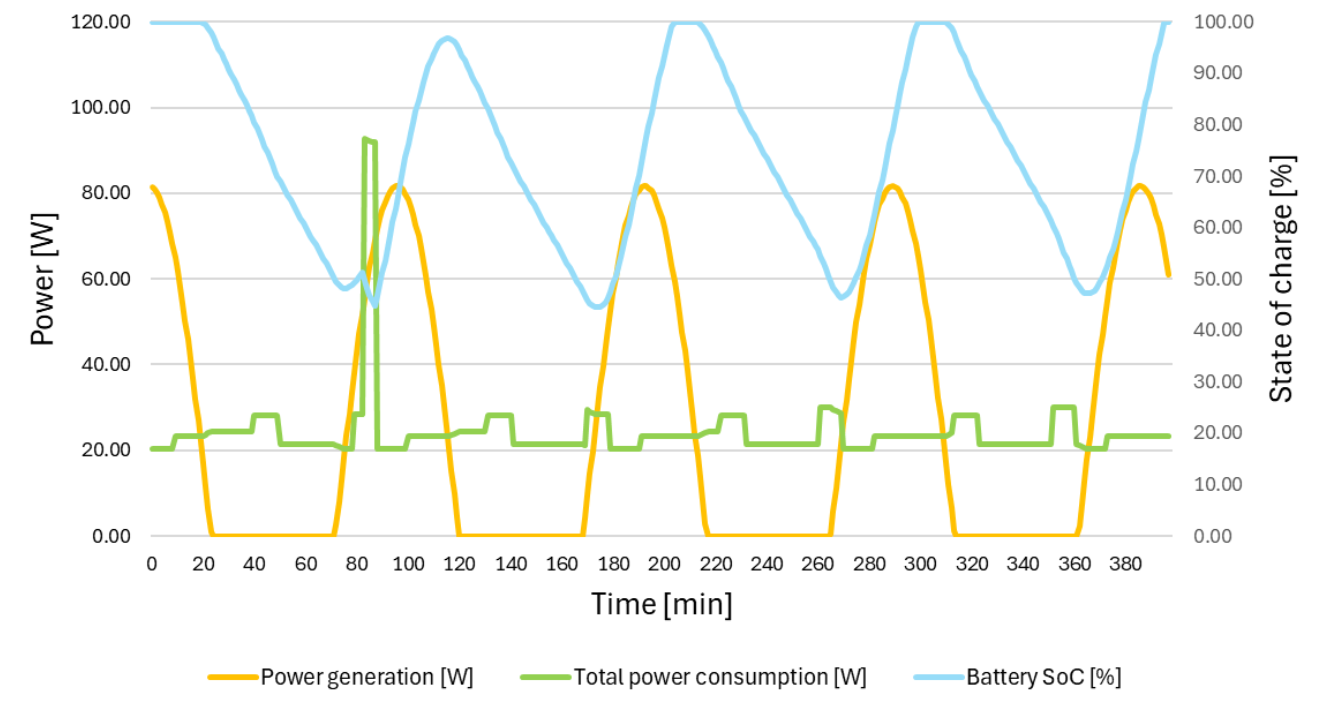
Create an energy budget with the selected components
- For each point in time, compute the power generated
- Remove the solar array harness losses (about 1-3%)
- Remove the PCDU solar power conversion losses
- Define the spacecraft activity
- Assign the corresponding total power consumption
- Add harness losses (about 1-3%)
- Add the PCDU distribution losses
- Add the PCDU consumption
- For each point in time, add the battery losses
- Add the system margin to get the total power need
- Compute the battery energy
- Compute the battery State-of-Charge
Simulate different mission phases and specific scenarios
Different phases to consider are:
- Begin of Life (BoL) vs End of Life (EoL)
- Launch and Early Operations (LEOPS)
- Nominal
- Maneuver and Transfer
- Safe Mode
- Failure Scenarios
Iterate
If something is not correct make some changes and see what happens.