Waves and Electromagnetism
1. Wave Basics
A wave is a disturbance that transfers energy through a medium (or vacuum) without transferring matter.
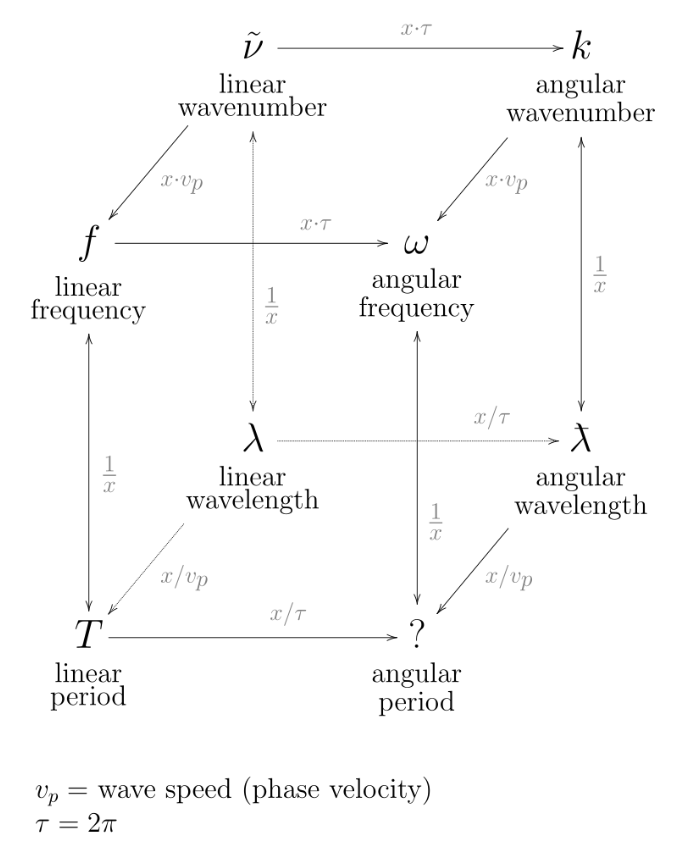
Fundamental Quantities
- Amplitude (
): The maximum displacement from the equilibrium position. - Wavelength (
): The distance between two consecutive identical points (e.g., crest to crest). - Frequency (
): The number of oscillations per second (measured in Hertz, ). - Period (
): The time taken for one complete cycle ( ). - Wave Speed (
): The speed at which the wave propagates:
2. Electromagnetic (EM) Waves
Maxwell’s equations predict that oscillating electric and magnetic fields can propagate through space as a wave.
Key Characteristics
- Transverse Nature: The electric field
and magnetic field are perpendicular to each other and to the direction of propagation. - Speed of Light: In a vacuum, all EM waves travel at the speed
: - Wave Equation: Derived from Maxwell's Equations (in vacuum):
3. Phase vs. Group Velocity
When a signal consists of a "packet" of different frequencies, we must distinguish between two types of speed.
Phase Velocity (
The speed at which the individual peaks (the "phase") of a single-frequency wave move.
(Where
Group Velocity (
The speed at which the overall envelope (the "wave packet" or signal) travels. This is the speed at which information and energy are usually transmitted.
Dispersion
- Non-dispersive media:
(e.g., light in a vacuum). - Dispersive media:
(e.g., light in glass or water waves). The wave packet "spreads out" over time.
Relationship Summary
The general relationship between the two velocities is given by: