Spacecraft Design Overview
Spacecraft Design Process
The spacecraft design begins with clearly defined Space Mission Engineering and payload specifications. It dictates the bus design, which must handle functions like power, data, structural support, and thermal management.
The design process has to be iterative and flexible. Every design decision, from payload configuration to power generation, must be balanced against mission priorities, technical feasibility, and cost constraints.
Often there are trade-offs that have to be balanced, there is no one size fits all solution and often not even the one optimal solution.
Spacecraft Design Drivers
Mass
This is the one key driver for mostly all space missions.
Launch vehicle costs scale with the mass, exceeding specific mass thresholds can push the spacecraft into higher-cost categories.
Stages of Mass Estimation:
- Initial Estimate
- A rough estimate based on payload mass
- Functional Estimate
- Refined based on the spacecraft's design and functions
- Final Mass Budget
- After subsystem designs are complete.
Power
Early power estimates drive the design of the solar array size and overall configuration of the spacecraft. Payloads like communications, radar, or instruments with high energy demands increase power requirements, adding complexity. Larger solar arrays require more structural support and increase the spacecraft's size, influencing thermal control, mass, and cost.
Cost
Mass and Power is directly tied to the spacecraft's cost. An increase in either will raise launch costs and add design complexity.
Cost Drivers:
- Larger Mass
- Higher power demands
Minor changes in mass or power can result in significant budgetary impacts, requiring constant optimization and trade-offs
Schedule
This is all about managing stakeholder expectations, it has to be technical feasible but should be as short as possible because of personnel costs.
- Shorter Schedules
- Limited time for design and testing leads to increased risk and compromises in functionality.
- Tight timelines may limit options, pushing the team to accept more risk in exchange for speed.
- Longer Schedules
- Allow for more thorough testing, optimization, and incorporation of new technologies.
- However, longer development times tend to increase overall costs due to extended team involvement and resources use.
Lifetime
The desired lifetime of the spacecraft influences the quality and redundancy of its components. Shorter missions (< 1 year) can often operate with single-string systems. For some systems, a partial failure leads to reduced performance but doesn't end the mission, allowing for longer lifetimes.
Reliability
-
Single-String
- No backups, used for short or low-risk missions
-
Block Redundancy
- Subsystems can switch entirely to backup
-
Cross-Strapped Redundancy
- Individual components can switch to backups independently, offering more flexibility and reliability.
-
1-3 years
- Select critical components have redundancy
-
3-5 years
- Block redundancy, entire subsystems are duplicated
-
>5 years
- Fully cross-strapped systems, where each component has a backup and can be switched individually.
Total
Total change in velocity a spacecraft needs to perform its mission. Drives propellant mass and propulsion system design, and also which propulsion system is selected.
Orbit Selection
Influences:
- solar arrays
- thermal requirements
- distance to ground stations
- power requirement of communication system
- drag at LEO
- Attitude control
Spacecraft Subsystems
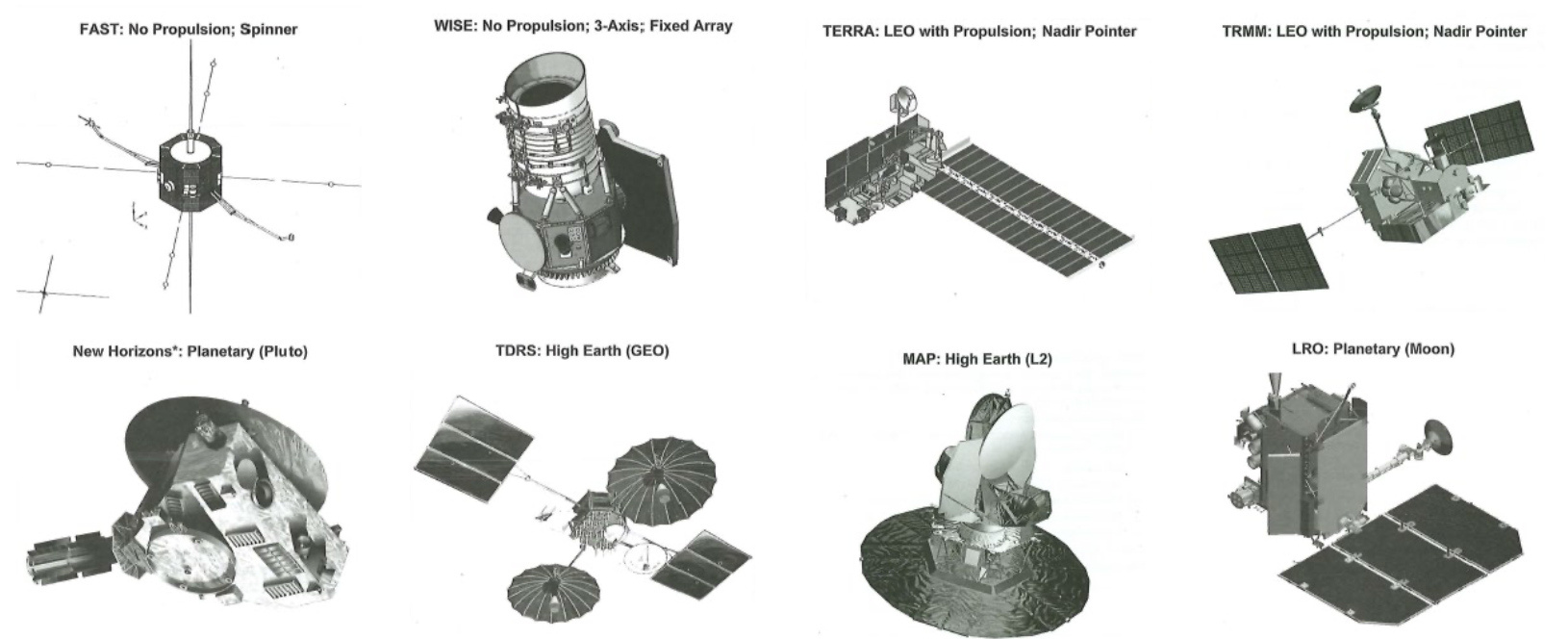
Spacecraft Configuration Alternative
Spacecraft Budgets
- Mass
- Propellant
- Power
- Pointing and Alignment
- Data System Budget