Orbital Dynamics
The base solution of the two body problem are the Keppler's Laws.
All the equations can be found in the formulary:
The 6 orbital elements
2 orbit parameters:
Semi-major axis eccentricity
alternative:Semi-minor axis Semi-parameter Periapsis Apoapsis
3 orientation parameters
Longitude of the ascending node Inclination Argument of periapsis
1 position parameter
True Anomaly
for circular orbits: longitude of the satellite from ascending node
for equatorial orbits: basic angle from vernal equinox
From
True vs Mean vs Eccentric anomaly
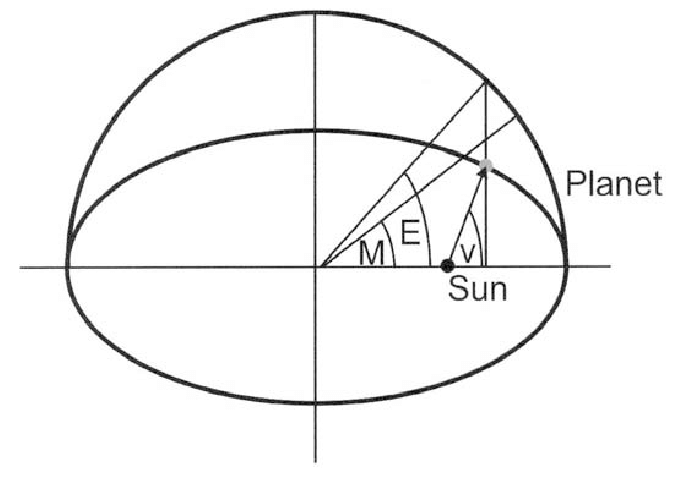
- True Anomaly (v): The effective angle that is formed by the Planet-Focus Point-Periapsis.
- Eccentric Anomaly (E): The Angle between the Periapsis-Center-Projection from the Planet on the surrounding Circle.
- Mean Anomaly (M): The angle between Periapsis-Center-the average point after this time from the periapsis.
Orbit Terminology
Orbit classification by altitude:
- LEO (low-Earth orbit) < 1′000 km
- GEO (geosynchronous orbit) = 35′856 km
- MEO (medium-Earth orbit)
- HEO (highly elliptical orbit)
- Super-Synchronous
- Lunar and Lagrange point orbit ≈ 350 ′000 km
- Interplanetary orbit
- Interstelar orbit
Orbit classification by inclination
- prograde orbit < 90°
- retrograde orbit > 90°
- polar orbit = 90°
- equatorial orbit = 0°
Orbit classification by function
- mission orbit
- transfer orbit
- parking orbit
- graveyard orbit
- phasing orbit
Ballistic trajectory
- elliptic orbit intersecting with Earth's surface
Orbit Perturbations
Small perturbations change the perfect Kepler systems, so the orbital elements are no longer constant in time anymore.
Perturbations can come from:
- asymmetry of the gravitational field, mainly Earth's oblateness
- friction in the upper atmosphere
- gravitational attraction of the Moon or/and the Sun
- other forces (radiation pressure, electromagnetic forces, general relativity) mostly negligible
The perturbations are added as a small force linearly to the equation of motion and then decomposed in the rotating frame of reference. This can then be expanded into the first derivatives in time for the orbital elements, the Lagrange planetary equations.
Asymmetry of the Gravitational Field
The gravitational potential can be represented by a spherical harmonic expansion:
The dominant perturbing term is the oblateness of earth:
: Gravitational potential : Dominant perturbing potential due to Earth's oblateness (J2 effect) : Standard gravitational parameter ( ) : Distance from the center of the Earth : Earth's equatorial radius : Semi-major axis of the orbit : Orbital eccentricity : Orbital inclination : Geocentric latitude : Geocentric longitude : Zonal harmonics (unnormalized) represents the oblateness (Earth: )
: Tesseral and sectorial harmonic coefficients : Legendre polynomials and associated Legendre functions : Rate of nodal regression (precession of the ascending node) : Rate of apsidal precession (rotation of the argument of perigee)
Atmospheric Drag
The drag induces a radius decrease for initially circular orbits.
Orbital Maneuvers
These are moved to Propulsed Dynamics