Launch Vehicles
- The launch vehicle market is fundamentally a national one and driven by several interests:
- Availability and reliability for programs of national importance
- Commercial viability
- Independence
- Technical heritage can run over decades
- In the US, the main genealogy lines are:
- Atlas V, Delta IV, now merged into ULA's Vulcan (Government launches)
- SpaceX Falcon 9 (Commercial, Starling, Government, Human)
- Future: RocketLab Electron (Commercial), Blue Origin New Glenn (Governmental)
- In Europe, only one line currently exists:
- Ariane (Governmental, some commercial)
- In Russia:
- Proton (Governmental, formerly commercial)
- Soyuz (Human Spaceflight)
Launch Vehicle Selection
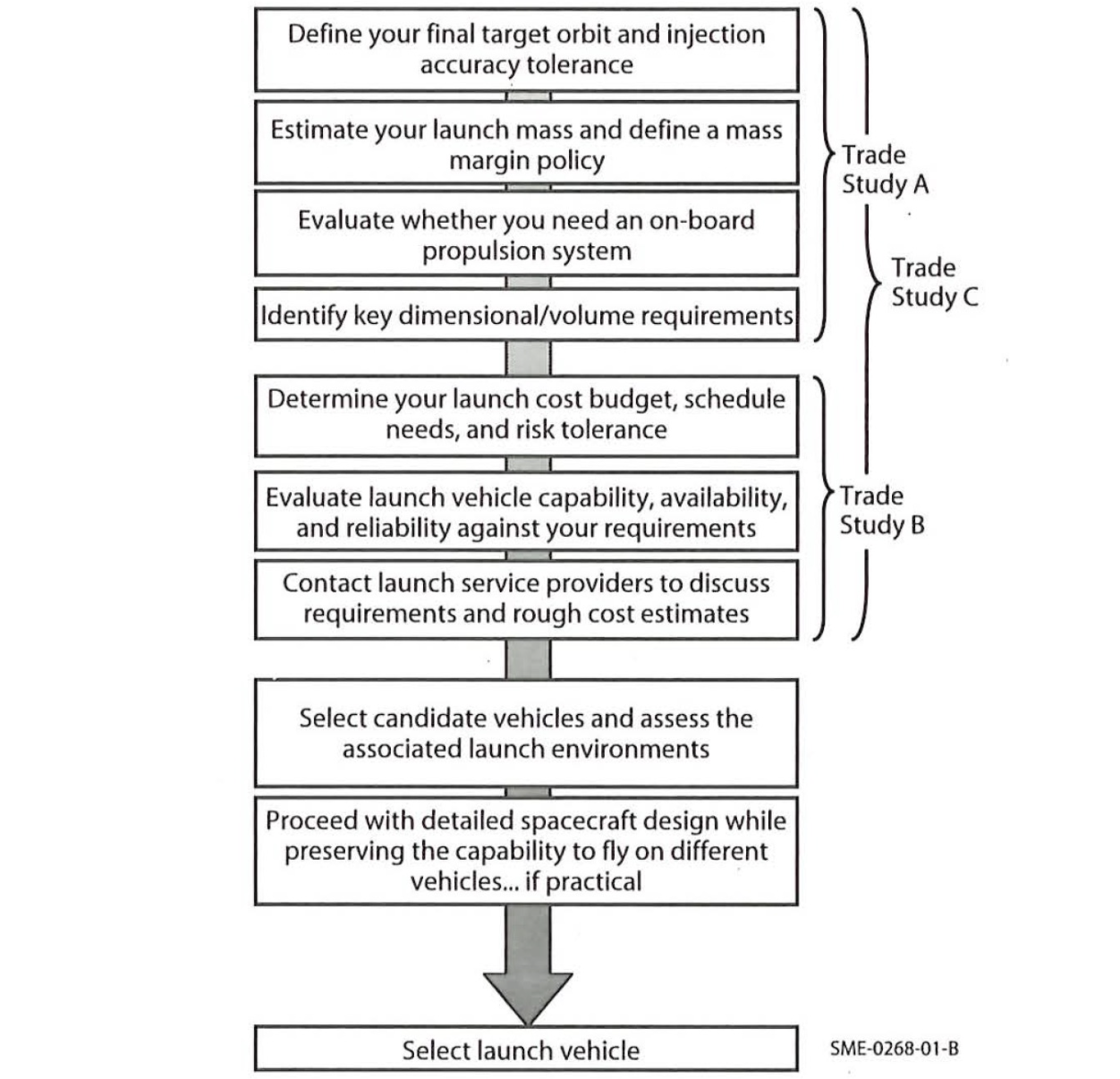
Since 2010 launch costs are now public (for commercial launches).
Define Target Orbit and Desired Accuracy
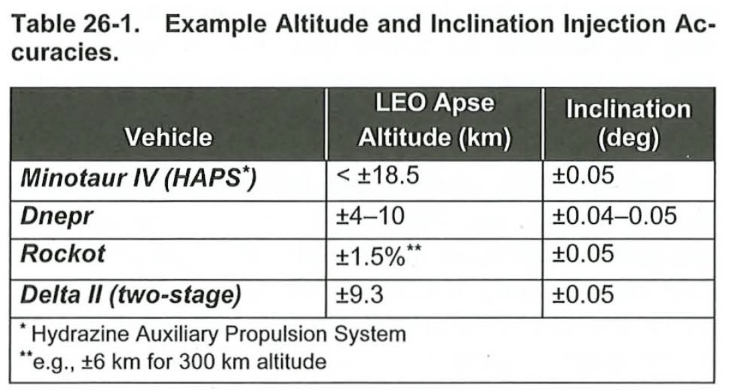
The accuracy of orbit insertion controls the needed fuel reserve on the spacecraft, this accuracy numbers are hard to come by.
- Solid upper stages are less precise than liquid upper stages
- A long-burn upper stage will be less precise than a short burning upper stage
- Smaller engines are more precise than large ones
- Typical satellites have 200-500 m/s
reserve, typical insertion accuracies are 2-10 m/s
Define Launch Mass and Reserve
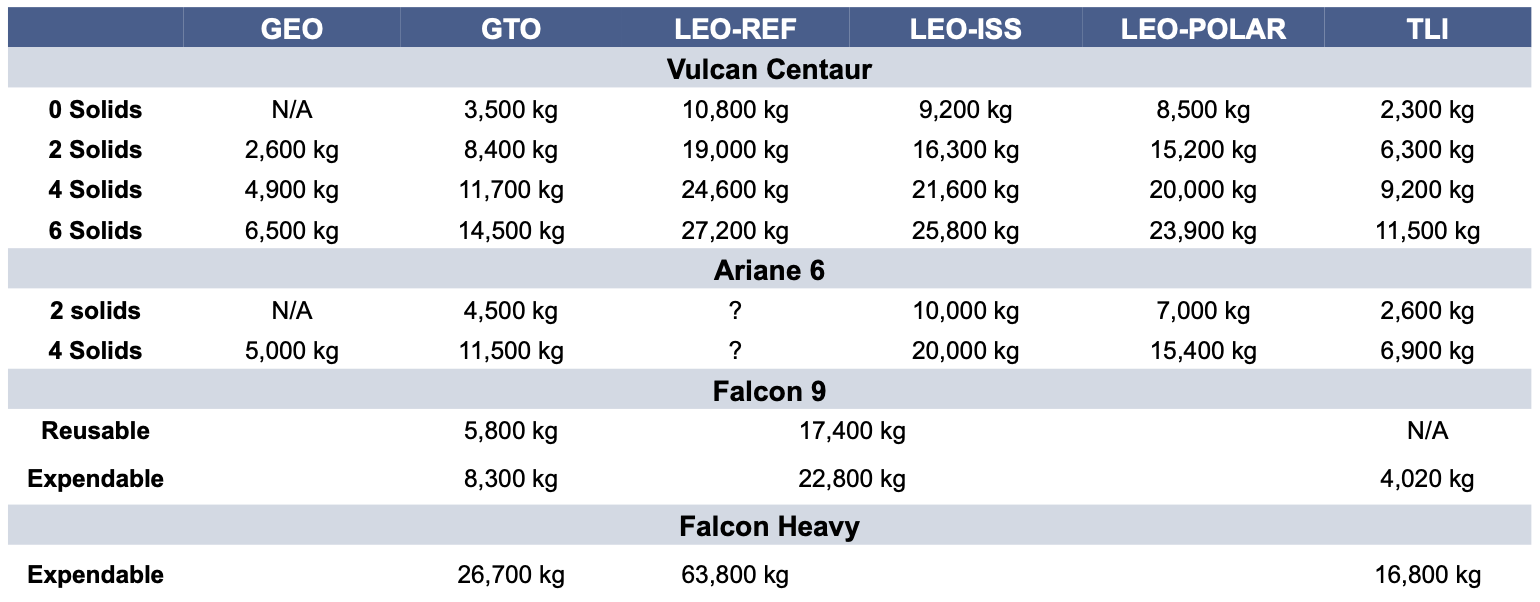
The launch vehicle can either insert the satellite into its final orbit or place it in a transfer orbit.
The Launch Environment
- The payload should not destroy the launch vehicle
- The launch vehicle should not destroy the payload
Mass and Center of Gravity
How big the mass is and the range where the CoG can be located is given by the launch vehicle.
Dynamic (Coupled) Loads
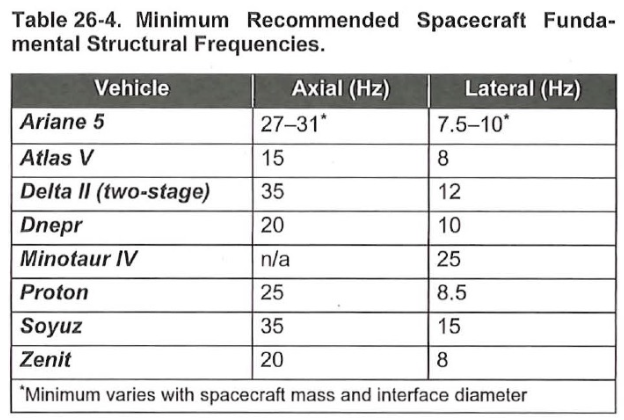
The launch vehicle and spacecraft for one dynamic system. The resonances need to be avoided at all costs. The user manual of the launch vehicle describes the minimum allowed fundamental frequencies of a spacecraft.
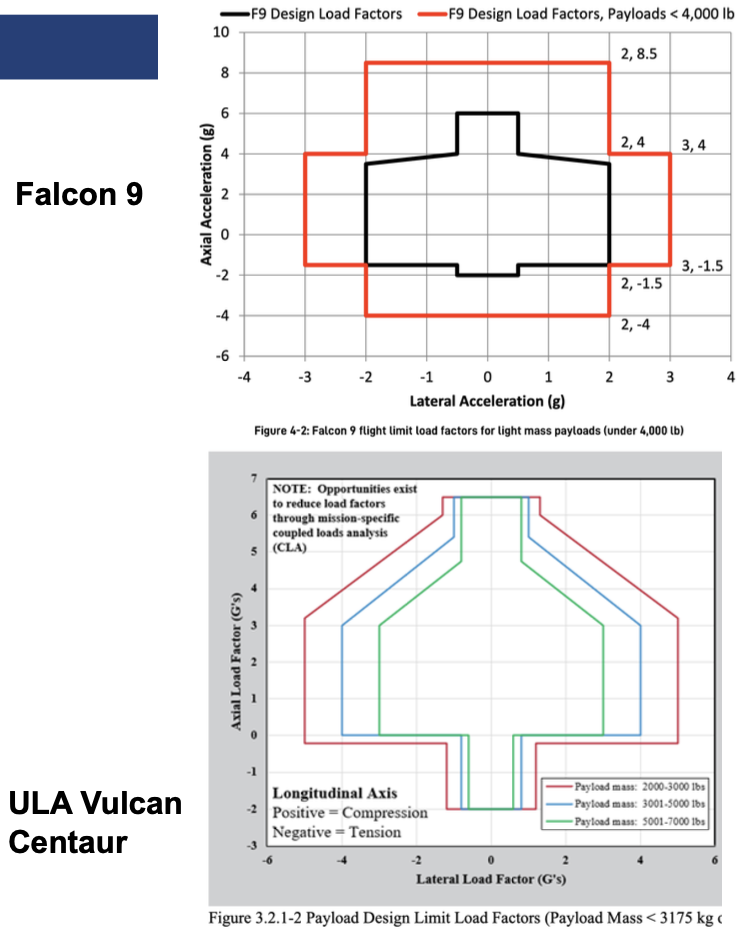
Limit Load Factors (small payloads)
There is an envelope which the launch loads will not surpass, the payload has to be made to withstand those.
- Axial acceleration
- Thrust
- Drag
- Propulsion
- Lateral acceleration
- Wind gusts
- Engine gimbal
- Engine shutdown
Vibrations and Acoustics
- Sinusoidal Vibrations
- Individual narrowband vibration modes
- Engine-structure resonances
- Random vibrations
- Broad excitations
- Airflow
- Engines
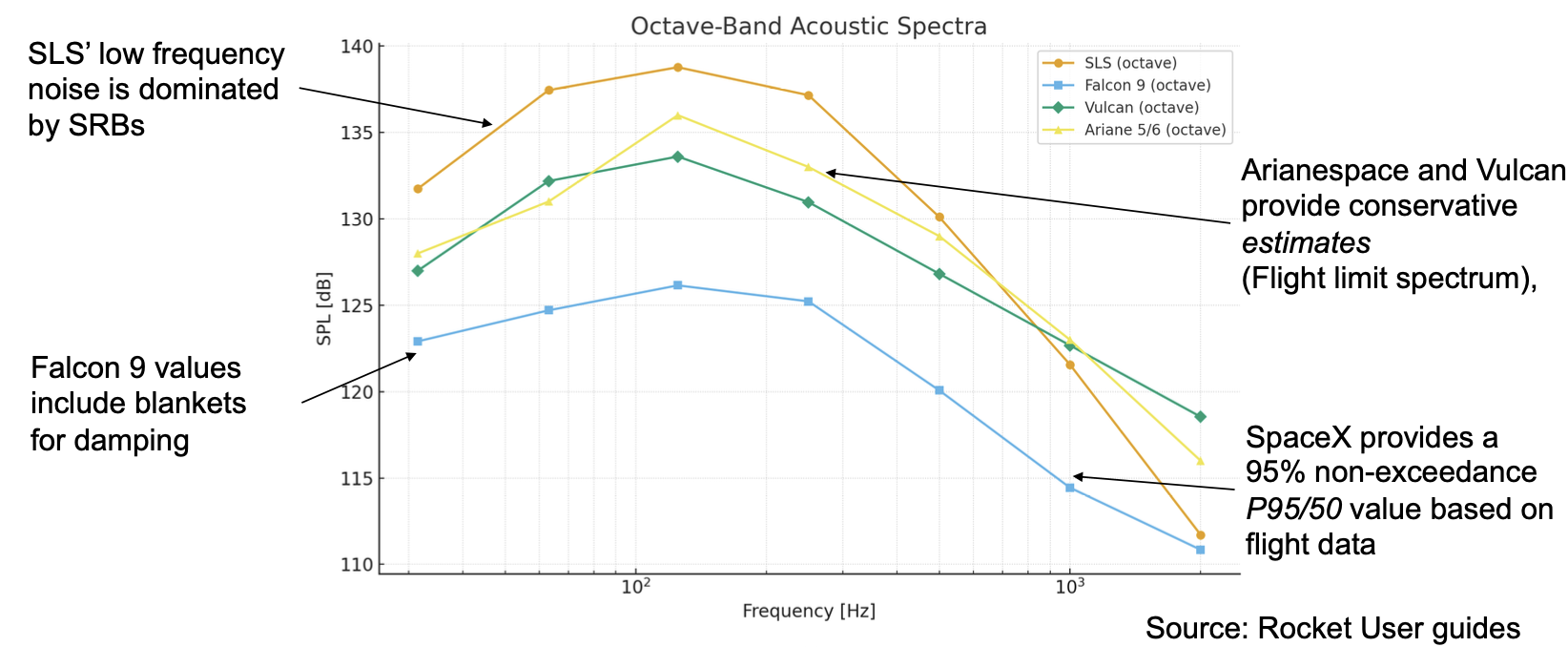
- The ration between the two can differ significantly between rockets.
Acoustic Noise Reduction
Acoustic loads for new rockets are difficult to model and mostly need to be measured in test flights.
Acoustic environment can be reduced by acoustic blankets in payload fairing:
- soft blanket inside fairing
- resonators tuned to peak frequencies
Sensitive Parts of Payloads
- Sinusoidal and static loads (5-100 Hz)
- stowed appendages (solar arrays, reflectors, booms)
- primary load-bearing structure
- Launch vehicle interface and adapter
- Random Vibrations (20-2000 Hz)
- avionics
- mechanisms
- electronics
- propulsion feedlines
- internal mechanical assemblies
- Acoustic Loads (>100 Hz)
- large thin surfaces (radiators panels, solar array skins)
- optical assemblies
- instruments in the forward volume
- CubeSats in dispensers
Shocks
- Release of the launch vehicle hold-down at liftoff
- Booster separation
- Stage separation
- Stage separation
- Fairing deployment
- Spacecraft separation
Electromagnetic Compatibility / Interference
The spacecraft is supposed to be radio silent between countdown and separation of the last stage. But it must tolerate:
- Emissions of the launch vehicle
- Telemetry
- Emission of the launch site
- Tracking radar
- Military radars
- WiFi, etc.
- Typically at 6 dB EMI margin