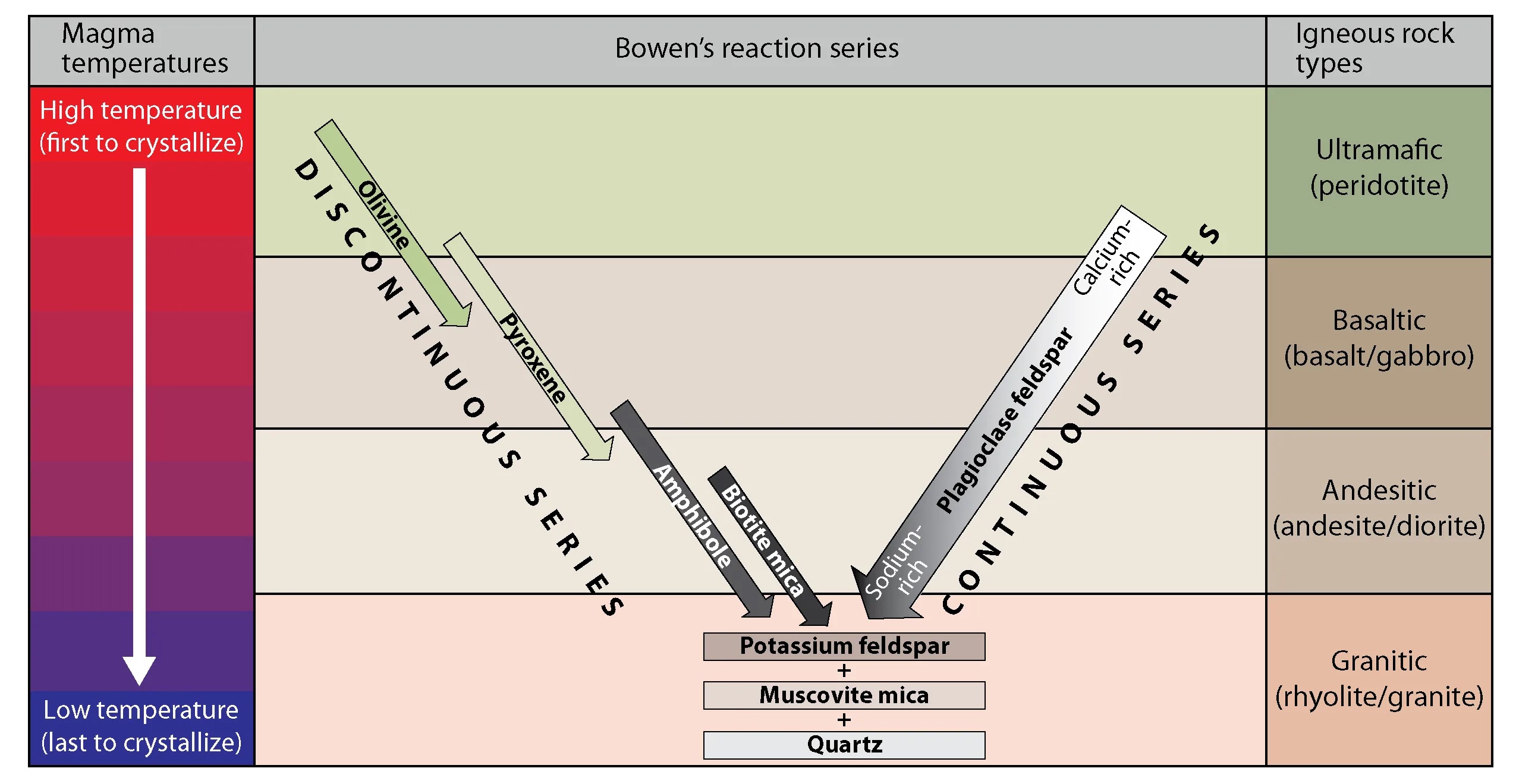
Bowen's Reaction Series
Bowen's Reaction Series is the fundamental "recipe book" of igneous geology. It explains the specific sequence in which silicate minerals crystallize from a cooling magma.
Developed by Norman L. Bowen in the early 20th century, the series demonstrates that as a magma cools, minerals do not all form at once. Instead, they crystallize at specific temperatures. Furthermore, as these minerals form, they remove specific elements (like iron and magnesium) from the liquid magma, continuously changing the chemistry of the remaining melt.
How It Works
The series is divided into two distinct pathways that happen simultaneously as temperature drops:
-
The Discontinuous Series (Iron/Magnesium Minerals): Minerals here form at specific temperatures and then react with the remaining magma to form an entirely new, different mineral structure as it cools further (Olivine →Pyroxene → Amphibole → Biotite Mica).
-
The Continuous Series (Plagioclase Feldspar): The mineral crystal structure remains the same, but its chemical composition smoothly transitions. It starts by incorporating Calcium at high temperatures and continuously swaps it for Sodium as it cools.
Eventually, both branches merge at the lowest temperatures to form the final "felsic" minerals: Potassium Feldspar, Muscovite Mica, and Quartz.