Scientific Instrumentation for Inter-Planetary Remote Sensing
The main types of remote sensing are:
- Passive
- use radiation reflected from or emitted by the target itself.
- Imaging, spectroscopy
- usually photons of various energies
- imaging of energetic neutral atoms is also possible
- neutron spectrometers have been flown on several missions to the moon and Mars
- use radiation reflected from or emitted by the target itself.
- Active
- Use a light source to illuminate the target and receive back reflected or stimulated emission.
- Laser altimetry, radar sounders
- Use a light source to illuminate the target and receive back reflected or stimulated emission.
What do you observe at each wavelength?
- EUV (Extreme Ultra Violet, 50-150 nm)
- Ions and neutral excited through collisional excitation (collision with electrons) in plasmas are a usual target
- UV (Ultra Violet, 120-400 nm)
- Molecular absorption, radicals important in upper atmospheres or comets
- Visible (350-1100 nm)
- Reflected sunlight, broad mineralogical absorptions, radicals in comets
- IR (Infrared, 0.8-5
m) - Molecular gas emissions. Reflected sunlight and associated mineral absorptions
- TIR (Thermal Infrared, 4-25
m) - Molecular emissions, Thermal emission and associated minerals
- THz (0.2-5 GHz)
- High resolution for gas velocities, densities and temperatures
- Low resolution identification of material with known crystal structures
Items to assess
These questions/needs have to be addressed and can help in the definition of the requirements.
Requirements and constraints
- What spatial resolution is required?
- What field of view is sufficient?
- How fast are we moving relative to the target during imaging?
- What (filter) bandpasses are required?
- When can we downlink the data and what is the balance between acquisition and downlink?
- What level of compression can be achieved?
- What dynamic range is required? (i.e. what is the contrast expected?)
- Is stereo required and on what timescales?
System Architecture & Environment
- Mass, power, volume, and data volume
- Choice of detector architecture
- Wavelength range and approach to selecting bandpasses
- Image repetition frequencies
- Radiation environment
- Straylight requirements
- Need for local memory
- Need for onboard processing
- Need for aperture protection
- Approach to (in-flight) calibration
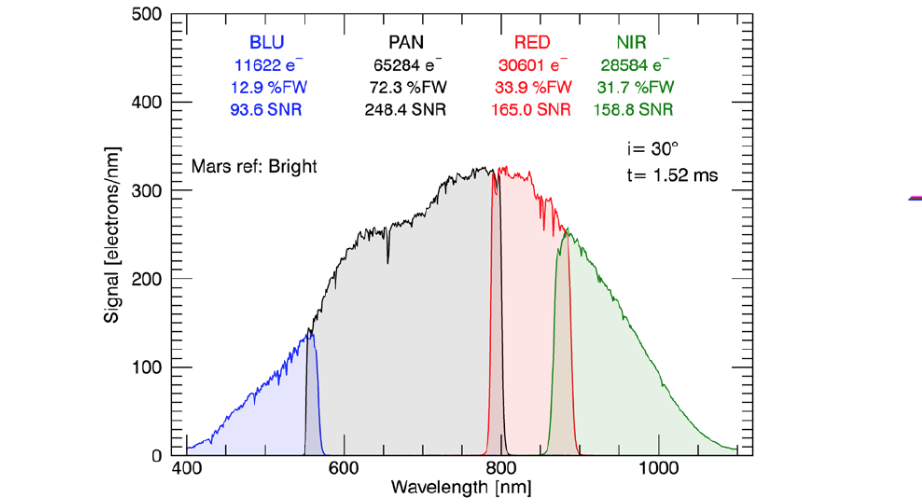
SNR
Total Signal : The cumulative output (often in counts or volts). Aperture Area ( ): The collecting area of the optical system. Solid Angle ( ): The field of view of the sensor. Integration Time ( ): The duration over which the signal is collected. Gain: Electronic or system-specific scaling factor. Spectral Radiance ( ): The intensity of the light source per wavelength. Reflectivity/Throughput: Efficiency of optical surfaces. Quantum Efficiency: Efficiency of converting photons to electrons. Transmission: Filter or atmospheric transmission factor. Photon Energy Conversion: Factor to convert energy into photon counts. Wavelength: The variable being integrated over the spectrum.
Push-Frame Acquisition
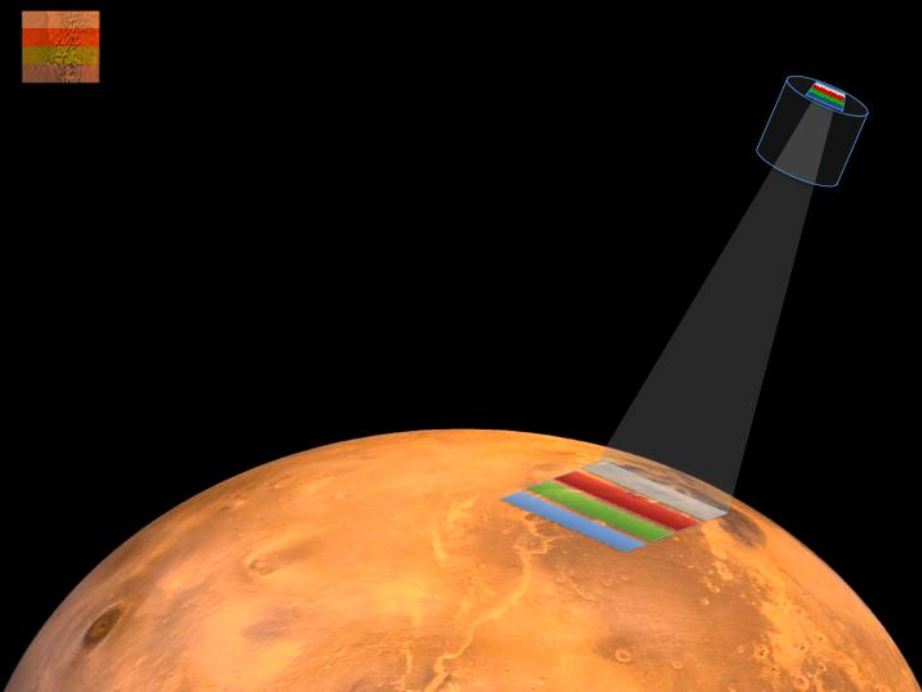
There are horizontal filters in front of the sensor, the satellite moves over the surface and takes pictures in the correct frequency that the pictures move forward the length of the filter height.