Structure
The dilemma of the structural subsystem
"Usually the spacecraft structure is the subsystem for which requirements are available last, but it is the physical element that is needed first when the spacecraft (S/C) has to be assembled"
The mechanical structure is the backbone of the spacecraft. It touches every other subsystem, and has a lot of interfaces.
Typical Requirements
- Performance
- Pointing and stability, orbit parametes
- Enviroment
- Thermal
- Outgassing and radiation
- Loads
- Interface / subsystems
- Alignments
- Mechanical ICD
- GoC (vs. launch vehicle), mass
- Programmatic
Loads
There are different kinds of loads:
- static
- dynamic
- external
- self-contained
On Earth: there is the manufacturing, assembly, ground operations, testing, transportation.
During Launch: flight limit loads, engine thrusts, sound pressure, gusts of wind
In Space: Pulsed thrust to reposition, micro vibrations
Launch Loads
- (Quasi) static acceleration load
- Sine vibration load
- Random vibration load
- Shock load
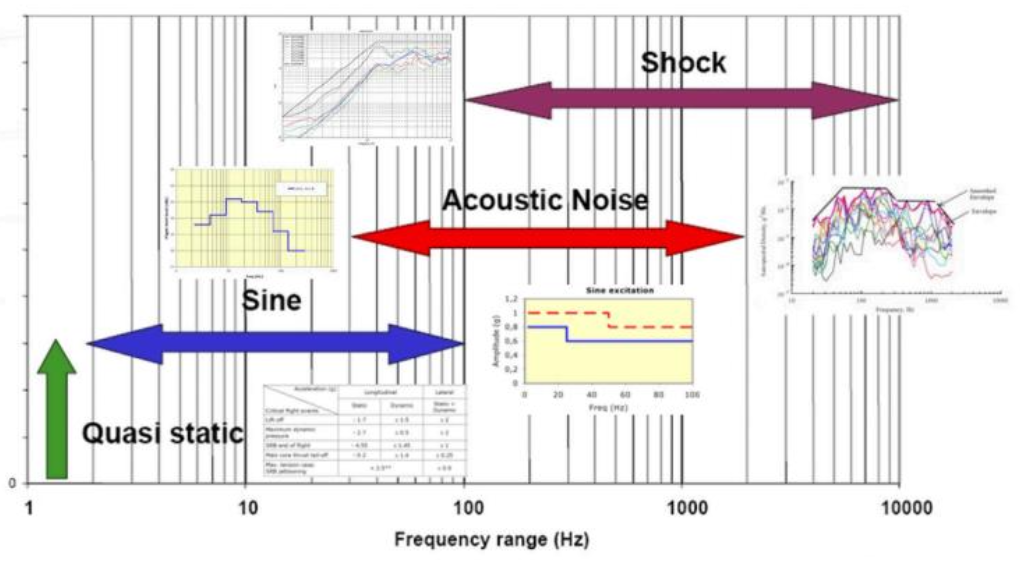
Classification
Primary structures
- Determines whether the mechanical design is compliant with the mechanical requirements of the launcher
- Primary load path between spacecraft and launch vehicle
- Usually designed for stiffness or structural frequency
- Acceleration and transient loading during launch
Secondary structures
- Provide mounting provisions for the payload, units, solar arrays, antennas, etc.
- Often behave like independent substructures when deployed in orbit
- In-orbit sometimes high thermal loads, not as good protected as primary structure
- It transfers load to the primary structure
Tertiary structures
- Often a monolithic design
- High frequency base driven vibration causes the most severe loading
- Stiffness and positional stability are the main driving requirements
- Thermal or damping spacers sometimes mounted underneath
How to design a structural subsystem
Driven by following properties:
- Stiffness
- Dynamic response
- Strength (Load-cases)
Testing
Static Load Testing
- No permanent deformation and failure in strength
- Assess stiffness to correlate with FEA
- Qualifies the primary structure, structural connections, joints, interfaces
- Actuators apply loads and displacements and strains are measured
Sinusoidal modal survey testing (Low level sine sweep)
- Sine sweep (2 octave/min) at constant low acceleration from 20 to 2000 Hz
- Accelerometers capture structural responses vs. input and track any resonance.
- To assess natural frequencies but also damping
- Assess health of the test article by comparing response plots from pre-test and post-test sine sweeps.
Random vibration testing
- ensuring structures can withstand the mechanical stresses induced by acoustic vibration
- Shaker inject vibration at multiple frequencies simultaneously, with randomly varying acceleration
- Random acceleration is not predictable at any point in time.
- Defines the environment by its frequency content
- acceleration spectral density (ASD) or Power spectral density (PSD) as input
Shock testing
- Specified by Shock Respond Spectrum (SRS)
- The shock load environment is dependent on both the total mass of the space vehicle and the connection between the payload and the launch vehicle
Acoustic Testing
- Acoustic loads simulated in a reverberant acoustic chamber
- Frequency range between 20 and 10'000 Hz.
Materials
Factors that influence material selection:
- Mechanical Properties
- Strength-to-Weight Ratio
- E-Modul
- Fatigue Resistance
- Thermal Properties
- Thermal Expansion
- Conductivity
- Environmental Resistance
- Outgassing
- Radiation resistance
- Corrosion Resistance
- Manufacturability
- Ease of processing
- Ability to form complex shapes
- Availability
- Cost-effectiveness
- Lifecycle considerations
- Sustainability
- Recyclability