From Atmosphere to Space
Stratosphere (10-50km)
Positive temperature gradient due to UV absorption in Ozone O_3 -> no weather, over the clouds
Tropopause between 7 km (poles), 10 km (mid-altidues) and 20 km (equator)
Mesosphere (50-85km)
Negative temperature gradient -> no heating mechanism -> Coldest part of the atmosphere (<143 °C)
Tidal forcing and tropospheric eddies lead to mixing (turbospere)
Meteorites typically break apart here
Last zone before space
Thermosphere (85-600km)
EUV and X-ray dissipation breaks apart atoms and create ions -> Ionosphere
Heating from UV -> warmest part of the atmosphere (>2000 °C[1])
Space is over 100 km which is the Karman line
Gases are rarified -> mean free path lenghts > 100 km -> Rarified gases
Above 160 km sound cannot propagate
no mixing
EUV and X-ray flux is variable with Solar activity
Thermospheric density and composition is variable
Most of LEO is in the thermosphere
High presence of atomic oxygen -> strong reaction with surfaces
Exosphere (>600km)
Gravitationally bound helium and hydrogen, so thin atoms are on ballistic trajectories -> no gas
Many celestial bodies have exospheres that touch the surface (Moon, Mercury, Ganymede)
Elements in the layers
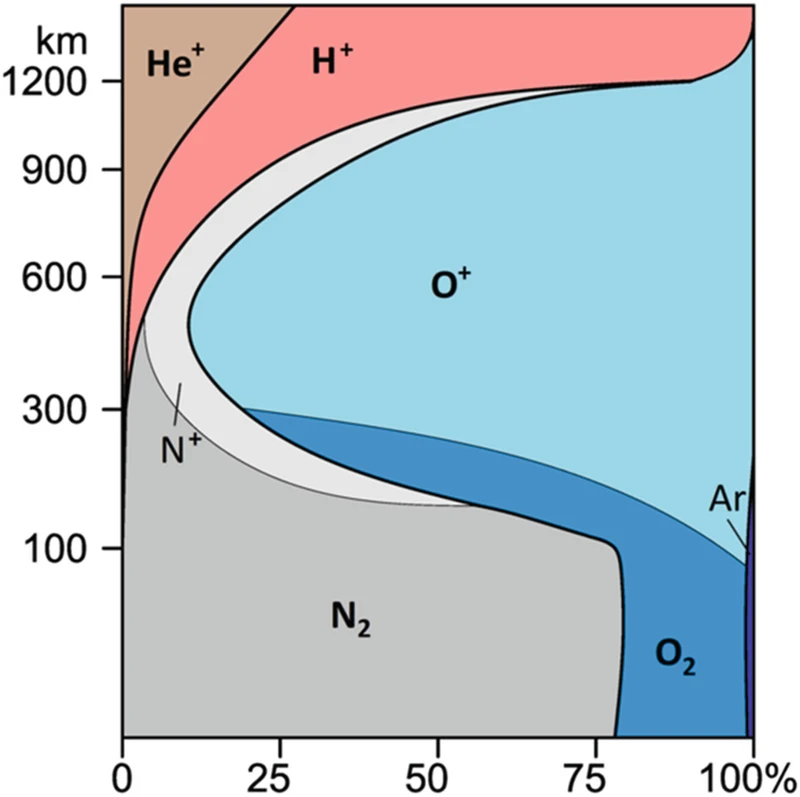
Ionosphere
Is not a layer, it ranges from upper mesosphere to lower exosphere. Significant free electrons.
Day-night effect:
- D-layer only present during day -> Blocks radio waves
- F-layers combine during night
Definition of temperature does not really hold here ↩︎