Comparing the Earth to a Chondrite
The Earth is not a Chondrite, but by comparison between the earth and different meteorite groups we can deduce the violent history of our earth's formation.
The Volatile Trend: Earth is "Dry"
The most obvious difference between the Earth and a CI is that the Earth is severely depleted in Volatile Elements.
- Refractory Elements (
): - Elements: Ai, Ca, Ti, Sc, Rare Earth Elements
- Ratio
1
- Moderately Volatile Elements (
): - Elements: Potassium, Sodium, Manganese, Rubidium
- Ratio < 1: Earth is depleted. For example, we have only about 10%-20% of the Potassium that a CI Chondrite has.
- Highly Volatile Elements (
): - Elements: Hydrogen, Nitrogen, Carbon
- Ration << 1: Earth is extremely dry compared to carbonaceous meteorites.
The material that formed Earth was subject to high temperatures, causing volatiles to boil off into space before the planet finished accreting.
The Isotope Crisis: The Enstatite Chondrite Problem
The isotopes are confusing. Oxygen Isotopes are the ultimate planetary ID card. Every object in the solar system falls on a specific "slope" on this graph.
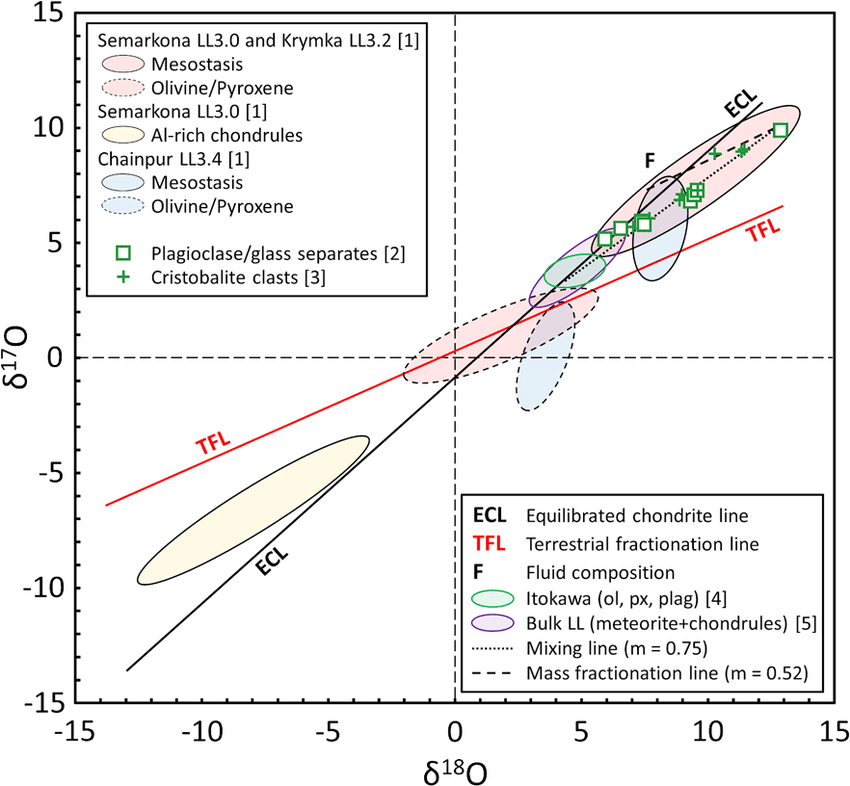
Chemically, the Chondrites are weird. They formed in a reduced (oxygen-poor) environment. If Earth were made entirely of them, our mantle would be chemically very different. Isotopically there are Earth's twin. The current consensus is that Earth likely formed from a mix. The bulk of the material was inner solar system material, but we accreted enough "Carbonaceous-like" (outer solar system material) to bring water and oxidizers.
The Mg/Si Ratio Puzzle
Another major clue lies in the two common cations in the mantle: Magnesium and Silicon.
- CI Chondrites: Have a distinct Mg/Si ratio (by weight ca. 0.9)
- Earth's Upper Mantle: Has a much higher Mg/Si ratio (1.25). It is richer in Olivine (high Mg) than Pyroxene (high Si)
Where did the Silicon go?
- Hidden Reservoirs. Is the Lower mantle richer in Silicon, than the upper mantle?
- Core Uptake. Did Silicon enter the Core?
- Different Building Blocks. Maybe Earth just formed from non-CI rocks that were naturally lower in silica.
The "Late Veneer" Hypothesis
If Earth was hot enough to lose its volatiles and form a core (stripping out all gold/platinum), why do we have oceans and gold in our crust?
- First the Earth formed, differentiated (core closed) and cooled.
- About 0.5%-1% of Earth's weight arrived later, likely via primitive, wet, chondritic asteroids (Carbonaceous Chondrites)
- The result is a "dusting" of meteorites re-delivered the water and other materials to the crust and mantle, where they stayed because the core was already closed off.
Question and Answers
What is the "Volatility Trend" observed when comparing Earth's composition to CI Chondrites?
?
Earth is increasingly depleted in elements as their condensation temperature decreases. (Refractory elements are equal to CI; Volatiles are much lower than CI).
Which group of elements has a ratio of
Which meteorite group has an Oxygen Isotope composition identical to that of the Earth (and Moon)?::Enstatite Chondrites.
Why is the Oxygen Isotope match between Earth and Enstatite Chondrites a "paradox"?
?
Because while the isotopes match, the chemistry does not. Enstatite chondrites are too reduced (oxygen-poor) to explain the Earth's mantle composition on their own.
What is the "Late Veneer" hypothesis?
?
The theory that a small amount of primitive meteoritic material (rich in water and siderophiles) was added to Earth after the Core had formed, re-supplying volatiles and precious metals to the Crust/Mantle.
Why is the Mg/Si ratio of the Earth's Upper Mantle higher than that of CI Chondrites?
?
Either Silicon is hidden in the Lower Mantle, Silicon entered the Core as a light element, or Earth formed from non-CI building blocks.
In the context of the Late Veneer, why is the presence of Gold (