Space System Engineering
Against Space Mission Engineering, Space System Engineering is concerned primarily with the formal requirements definition process and how to validate that all the requirements will be met.
- "Are we building the box right?" and not "Are we building the right box?"
- The focus is on correctness. Does the system inside the box meet its specified technical requirements?
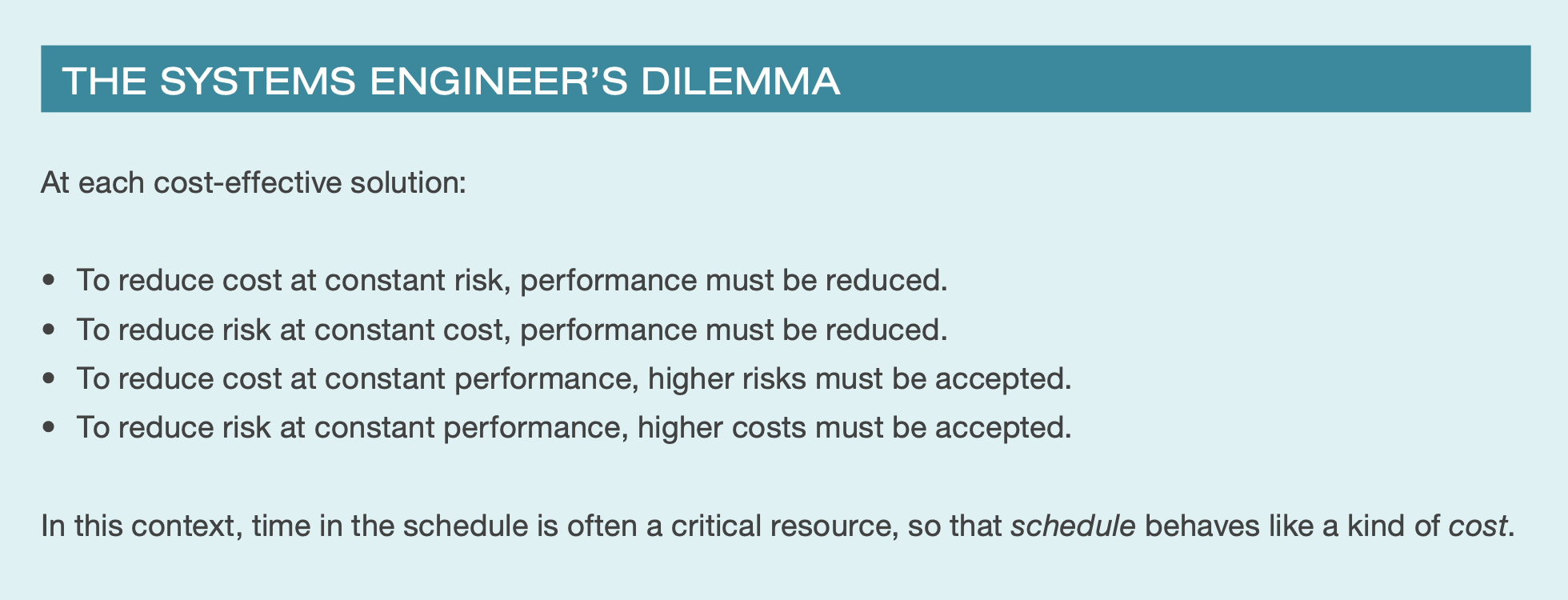
The System Engineer's Dilemma
Source: NASA System Engineering Handbook ed. 2016
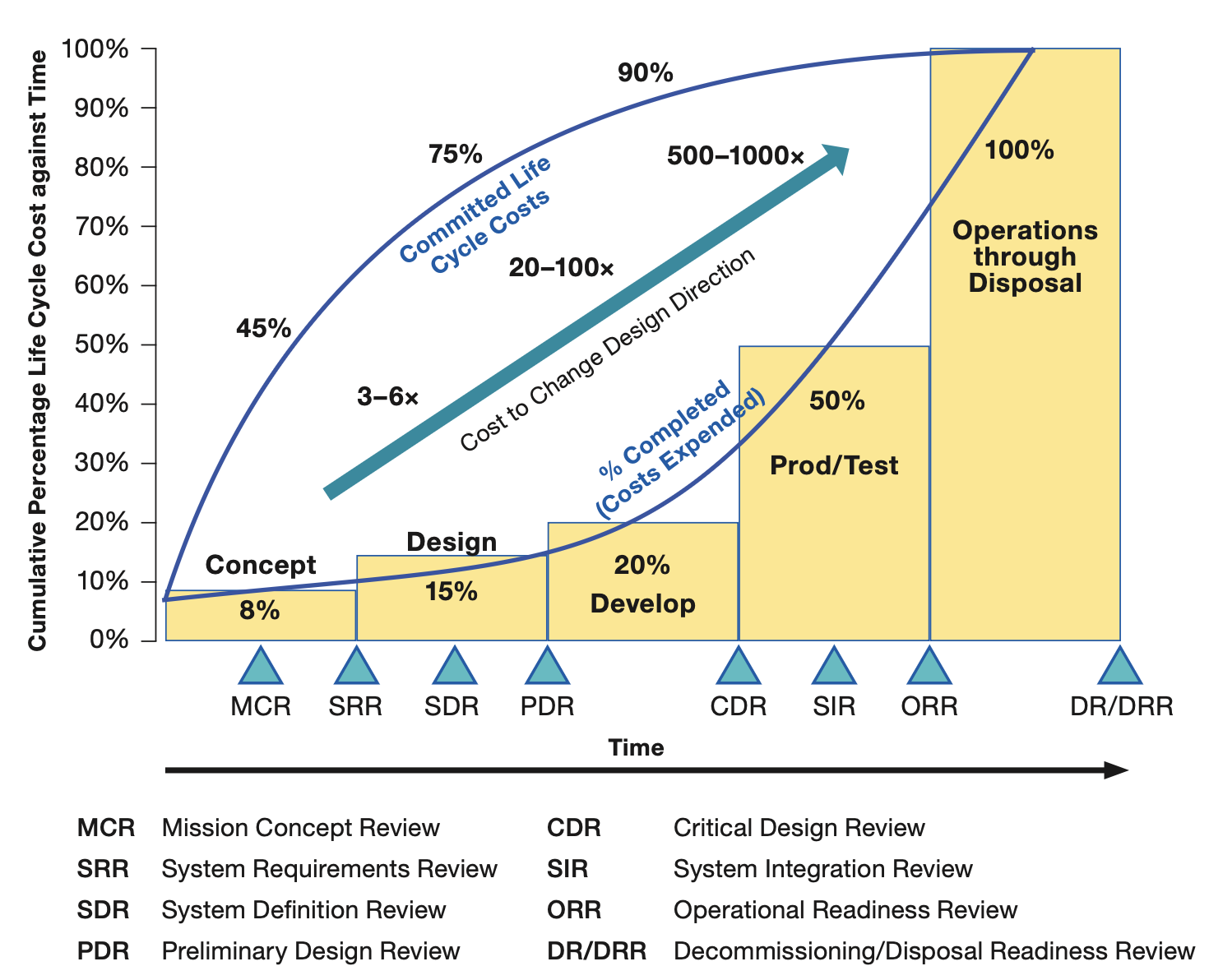
Life-Cycle Cost
In the early phase there will not be a lot of money expended, but a lot of money will be allocated. This means changing the system in later stages is far more expensive than in the beginning.
System Engineering Tasks
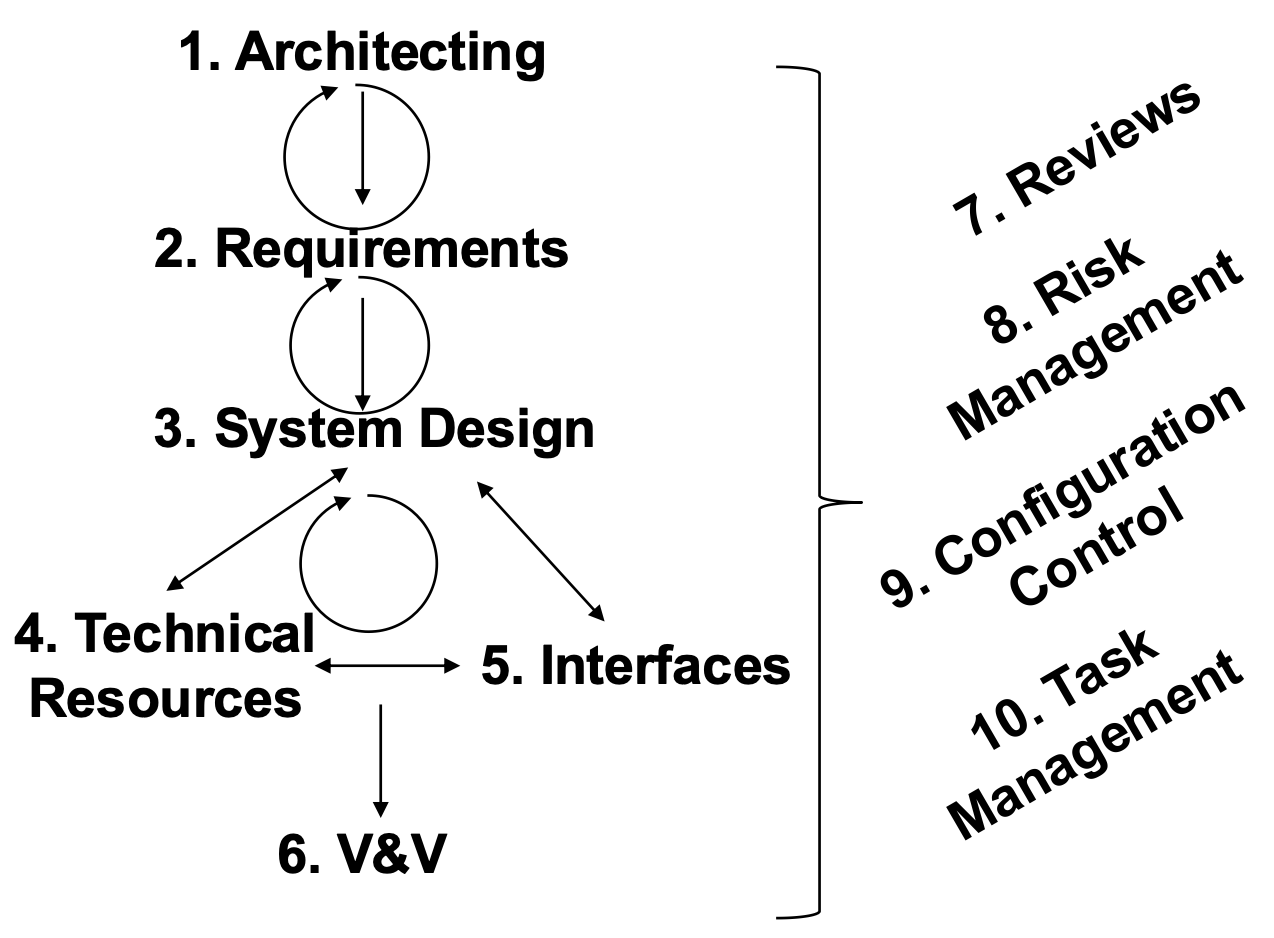
The System Engineering can be split up into different tasks. There are 10 tasks defined on the JPL system, and the 14 Steps of Space Mission Engineering out of the SMAD covers the first two tasks.
10 System Engineering Tasks
- Architecting - Develop the system architecture
- Requirements- Develop and maintain requirements
- System Design - Document, analyze and characterize the system design
- Technical Resources - manage and allocate technical resources
- Interfaces - Develop and maintain interfaces
- V&V - Verify and validate the system requirements and design
- Reviews - Organize technical peer reviews
- Risk Management - Identify, manage and mitigate risks
- manage the Design Process - Manage/control requirements and design (configuration control)
- Task Management - Manage the system engineering task
1. Architecting
This includes the first 12 steps from Space Mission Engineering.
2. Requirements
This includes step 13 and 14 from Space Mission Engineering.
3. System Design
The Design has to be documented, analyzed and characterized. This can be done with for example:
- Block Diagram (Functional System Block Diagram, Autonomy Architecture Block Diagram)
- CAD Models
- Analyze with studies
- Analyze via simulations
Single-Point Failures and Fault Protection has to be studied.
4. Technical Resources
This is mainly budget management. Typical budgets are:
- Mass
- Power
- Thermal
- Data
- etc.
Mass and Power will grow over the development cycle.
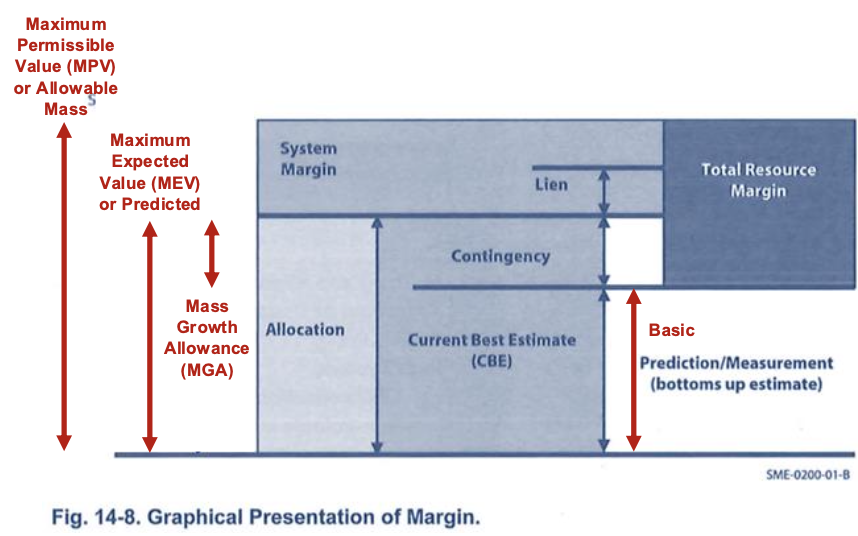
The tricky part here is to balance margins, to little margin, and they are maybe not enough, too much margin and the system is overbuilt. Allocation and Margin can be divided:
- Allocation: The initial resource budget given to each subsystem to perform its functions. This includes the current best estimate (CBE) and contingency to handle minor adjustments.
- Current Best Estimate (CBE): The most accurate prediction of measurement of the resources a subsystem is expected to use, based on the current stage of design.
- Contingency: Extra resources included within the allocation for each subsystem to handle minor uncertainties. It gives subsystem designers flexibility beyond the allocated resources.
- System Margin: Additional margin carried by the overall system to address unforeseen problems, design changes, or subsystem shortfalls. It provides flexibility beyond the allocated resources.
- Lien: A reserved part of the system margin set aside to address a specific, high-risk issue that may arise. It remains system margin but is only available for solving the identified problem, and if the risk is retired, the lien is released.
- Total Resource Margin: The sum of all contingencies across subsystems and the system margin, providing the overall buffer to ensure the spacecraft meets its performance requirements.
Margins
For example, the required mass margin decreases over time, so a typical holding margin in the beginning is 30% that can be reduced over the different Mission Phases.
5. Interfaces
A point of interaction between two system elements (hardware, software, humans, or organizations). It enables functional integration and exchange of energy, data, or forces.
So everyone is on the same page, there are Operational Interface Agreements (OIAs) and Software Interface Specifications (SISs). There is a formal agreement on how elements interact, the Interface Control Documents (ICDs)
Problems with interfaces could be:
- Tolerance mismatches
- Connector incompatibility
- Voltage/ground errors
- Signal integrity issues
- Thermal imbalance
- Fluid leaks
Causes of these could be:
- Unclear ownership
- Late requirement changes
- Different standards
- Poor communication
- Asynchronous schedules
6. Verify and Validate
Verification:
- Are the requirements met?
- Is the system built right?
Validation:
- Does the system/mission meet the intended purpose?
- Did we build the right system?
Types of verification methods
- Inspection: Example: verifying a component is painted black
- Analysis: Example: verifying with a mathematical model a structural element can withstand launch loads
- Demonstration: Example: demonstrating the solar arrays can deploy
- Test: Example: testing a radio's data rate
Requirement Closure
All requirements have to be tested and validated, now there are two ways how a requirement can be closed out
Roll-up: The requirement at Level n is closed when all its children at Level n+1 are closed
Glue Logic: The requirement at Level n is closed when all its children at Level n+1 are closed and an overarching summary analysis (or test) at Level n is completed.
"Test like you fly, fly like you test"
7. Reviews
Technical Peer Reviews are when you show the current project to a peer, and he hopefully tells you all the things you did wrong. It's better to be critiqued among your colleagues ahead of a formal project review than in the formal review itself.
8. Risk Management
A risk is an uncertainty with consequences. There is the Risk Triplet:
- What can go wrong?
- How likely is it?
- What are the consequences?
The process of risk management is:
- Identify: What can go wrong?
- Analyze: Estimate probability and consequence
- Plan (Mitigate): Define strategies
- Track: Monitor risk evolution over time
- Control: Apply corrective actions, update baseline
- Communicate: Share risks across teams and partners
Risk Assessment
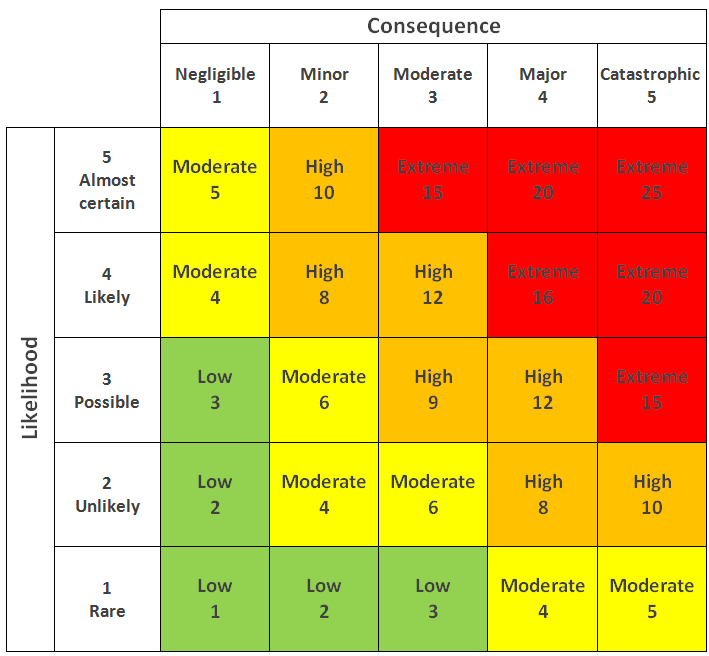
The risk matrix is a good tool to assess different risks. The probability (Likelihood) and the Severity (Consequence) are found/estimated, and then the risk is classified into categories based on the location in the risk matrix.
Risk Mitigations
Design Mitigations:
- Add margins
- Use heritage components with proven reliability
- Simplify design to reduce failure points
Redundancy Strategies: - Cold redundancy: backup only activate if primary fails
- Hot redundancy: parallel active units
- Cross-strapping: interchangeable connections between subsystems
Operational Mitigations: - Safe Modes
- Fault detection, isolation and recovery
- Procedural controls
Mitigation is about balancing risk vs cost/complexity, not every risk can be eliminated.
The analysis can be done in a Failure Modes & Criticality Analysis (FMECA)
9. Configuration Control
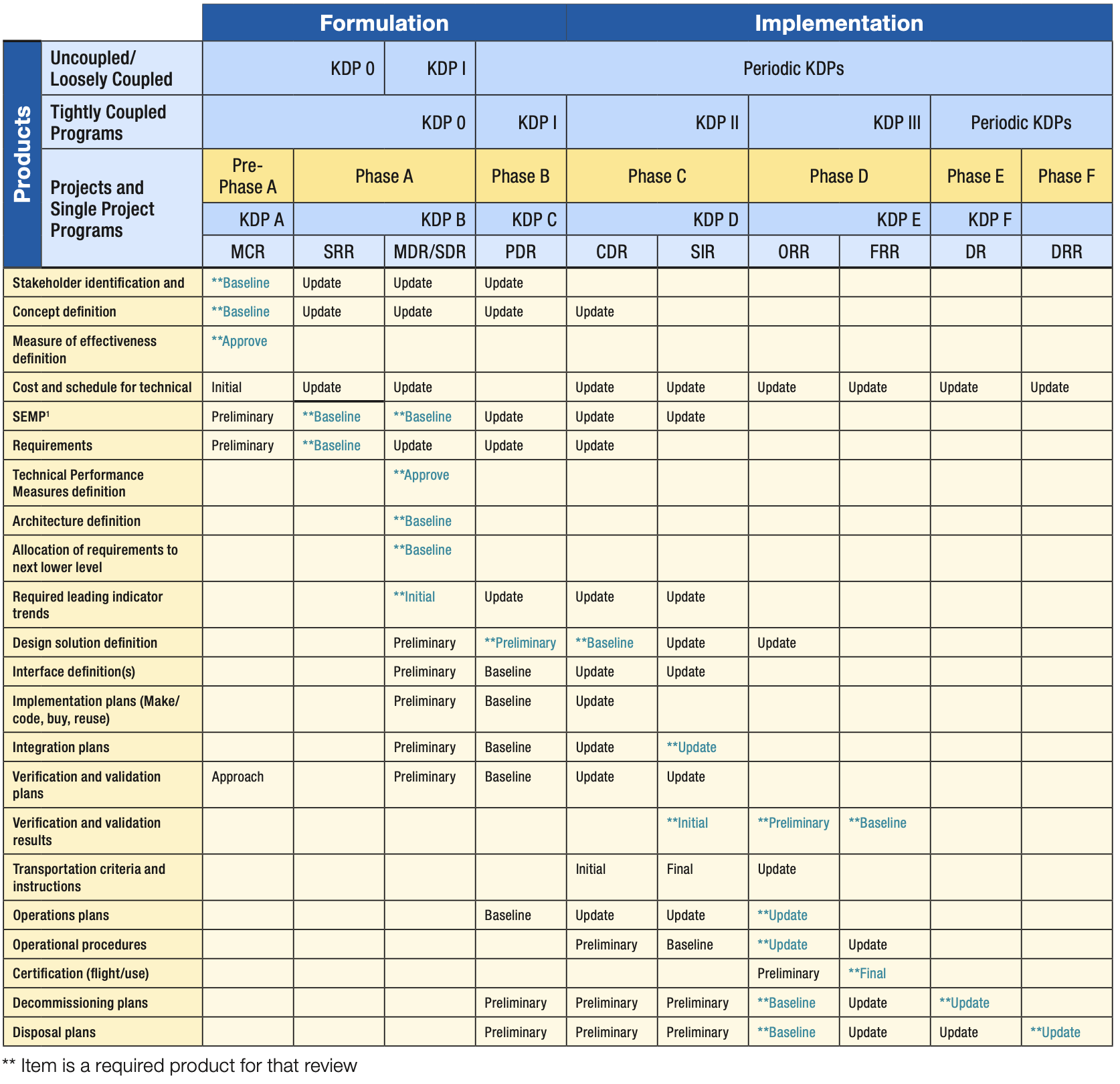
During the all the Mission Phases, some parts have to be set, so the next things can be built upon it. There are set under configuration control and then can not easily be changed, except though an Engineering Change Request or a Waiver.
10. Task Management
All Tasks of the process have to be managed and organized, there are a lot of Reviews over all Mission Phases. The technology used has to be on a certain Technology Readiness Levels.
Component Qualification and Acceptance Testing
Qualification Testing:
If a representative article passes a sequence of qualification tests, all other articles built to the same engineering data should also pass. In other words, the design in qualified.
Acceptance Testing:
Once the design is qualified, subsequent articles built from the same data and controlled manufacturing processes are then subject to less severe acceptance tests that certify the workmanship of these articles.
Types of Hardware
- Breadboard
- Brassboard
- Engineering Unit
- Qualification Unit
- Proto-flight Unit
- Flight Unit
Types of Tests
Integration & Functional Tests
These test the different systems or subsystems, alone or in combination
Environmental Tests
These test the system on different environmental impacts.
- Launch Loads, Acoustic Test
- Vibration Test
- Thermal Vacuum Test
- EMC Test
- etc.