Ekman Boundary Layers (Boundary Fluid Dynamics focus)
How does a Fluid behave inside a rapid spinning sphere?
The starting point
The fluid is liquid iron at extreme pressure, so incompressible. This means any energy that is added to the system needs to move the fluid.
Frames of reference
There are two main frames used:
Mantel Frame: Attached to the solid boundaries, locked to the core mantle boundary itself looking into the liquid. Here the rotation axis of the planet is moving.
Precession Frame: The rotation and precession axis of the planet are stationary, but the boundaries are moving.
Fictitious forces
Because the reference frame are not inertial there will be fictitious forces:
- Coriolis force: Acts perpendicular to the velocity of the fluids. It comes from the conversation of angular momentum, when you move outwards with the same momentum you need to slow down, so there is a force that does that.
- Centrifugal force: It acts outwards from the rotational axis.
- Poincaré force: Is only generated in non uniformly spinning systems. The axis is wobbling or precessing. The change in tilt of the rotation adds forces to the system.
Because the centrifugal force depends only on the distance from the rotation axis, it can be expressed as the gradient of a scalar field, behaving similar to gravity and can there for just be included into the pressure gradient. This leads to the reduced pressure.
Dimensionless Numbers
Ekman number: The ratio between viscous forces to Coriolis forces. For the earths core about
: radius of outer boundary or gap size between the inner core and the outer boundary. : axis of diurnal rotation : kinematic viscosity
Rossby number: The ratio between advection and the Coriolis force. Which is also minuscule for earth, with leads that the nonlinear chaos is rather weak compared to the steady Coriolis force.
: typical velocity
The Flow inside the core
Because the flow is dominated by the Coriolis force, the flow organizes itself into columns. But at the mantle it cannot freely slip, there is friction with the rock of the mantle. This friction shatters the beautiful linear math.
The Boundary Layer
Since the wall is not smooth there is a non-slip condition. At the boundary the fluid has the same velocity as the wall. This creates a transition zone, the boundary layer, where viscosity comes into play again.
The thickness of this boundary layer scales with the square root of the Ekman number. Since the Ekman number is so small, the thickness of the boundary layer is only on the order of centimeters to a meter.
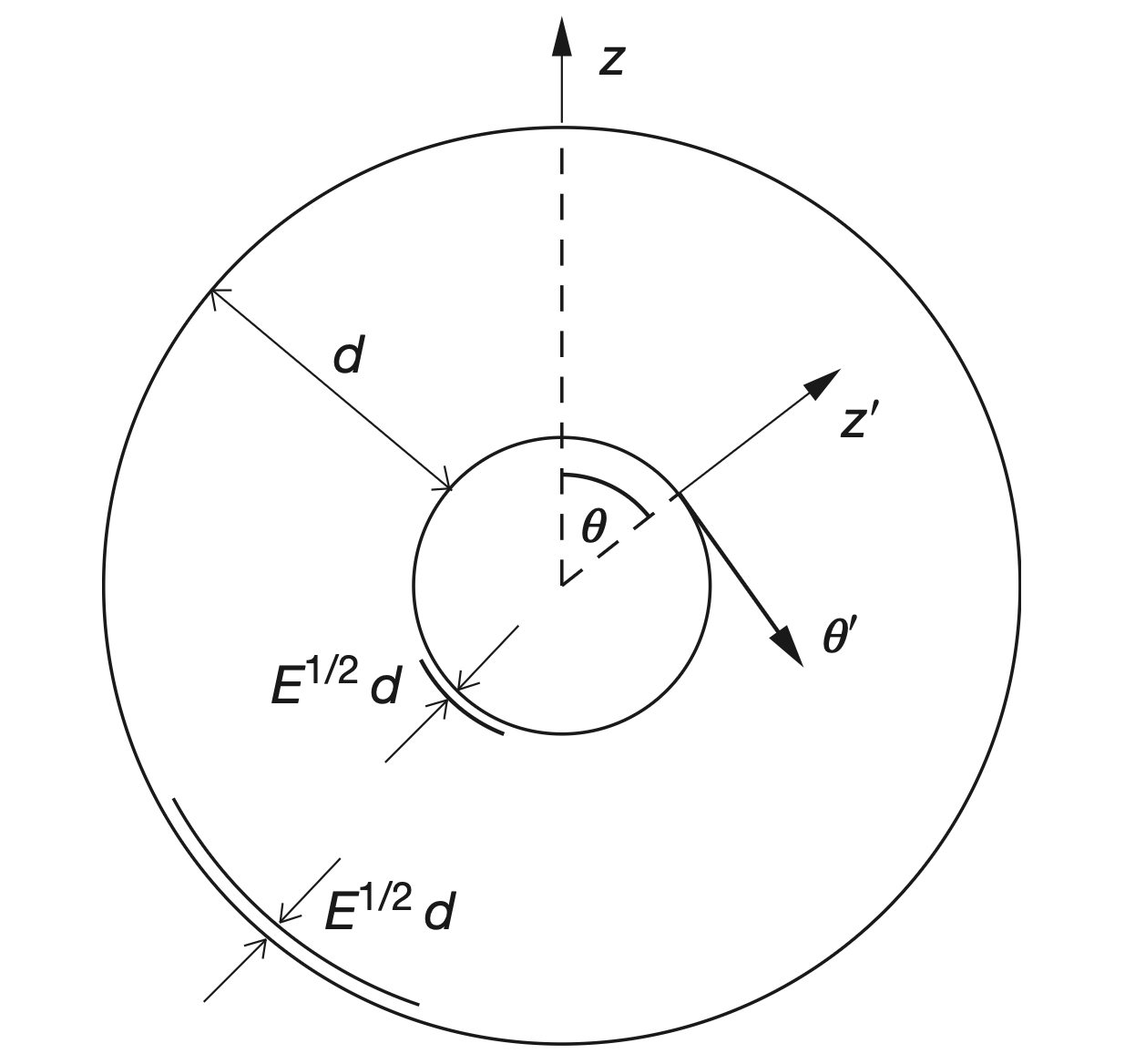
This layer is small, but it interacts with the volume above it, through a system called Ekman pumping.
Ekman pumping
The boundary layer has to take the velocity of the bulk fluid and adjust it just over a few centimeters to math the rock. This motion forces the fluid to move perpendicular with the solid rock. It either shoots fluid straight out into the bulk of the core, or it actively sucks fluid in from the bulk down into the friction layer.
This pumping must happen because the liquid iron is incompressible you cannot squeeze it. And the divergence of the flow must be zero. This generates steep horizontal velocity gradients. The fluid cannot pile up but has to go somewhere, it is pushed vertically upward out of the layer or pulled vertically down into it.
This is similar to when stirred, sediments will gather in the middle of a glass and not at the outsides. The rotating fluid has a pressure gradient that counteracts the centrifugal force. At the bottom, there is also a non-slip condition, which reduces the velocity of the fluid. The centrifugal force outwards is lower, but the pressure gradient from the fluid above is still just as strong. The pressure pushes the fluid towards the center and because it cannot pile up there is pushed up.
The Singularity
The boundary layer approximation relies on the assumption that the vertical pumping action is small in comparison to the horizontal swirling flow. This pumping velocity has the term
These
At these singularities the boundary layer swells and thickens locally. I changes from a scaling with
This affects the whole core, because of the singularity the fluid does not pump energy smoothly. There is a buildup of kinetic energy at these rings, what have to be released. The buildup of energy gets ejected into the bulk of the core. Which generates internal shear layers or jets. They do not dissipate quickly, since the bulk fluid is dominated by the Coriolis force which maintains linear order. The shear layers can transverse the full length of the core, along the cones were also the waves propagate. Then they bounce of the boundary.
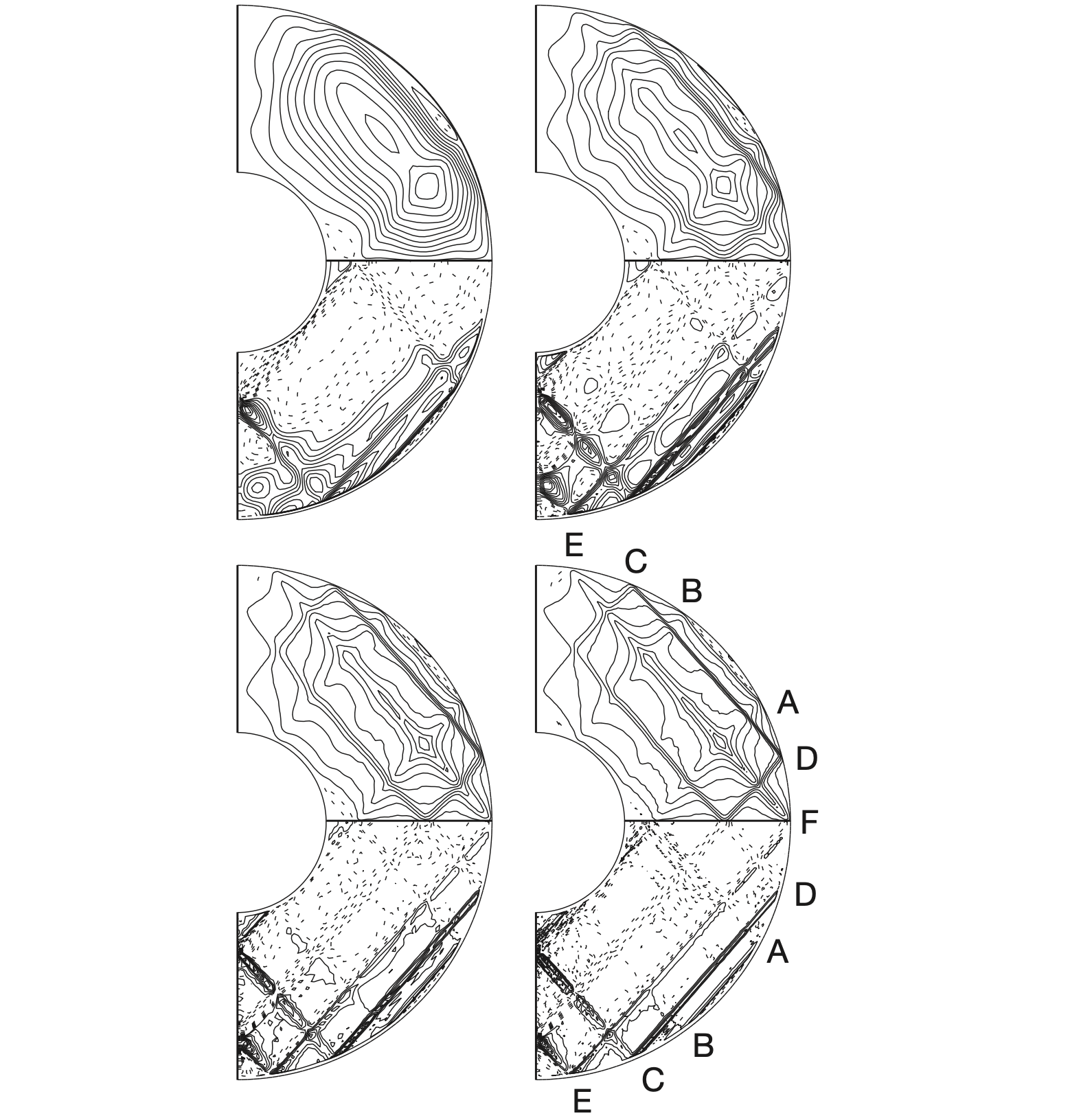
This can cause fluid instabilities.