The Math of Planetary Wobble (Classical Mechanics focus)
Planets are not perfect round spheres, they are squishy and wobble around.
The basis
The main most important concept is the conversation of angular momentum:
: Angular Momentum : external Torque
If a planet would now be a solid ridged sphere, the gravitational pull from other planets and stars would not change the rotation of the planet itself.
Because the planet is spinning it becomes oblate, increasing J2 in the geopotential spherical harmonic model. This bulge is tilted relative to the sun, meaning one side is more attracted to it, therefor a torque is generated trying to pull the planet's axis of rotation perpendicular to the plane of orbit. This torque does introduce precession.
A planet has tree principal axis
and the Euler angles,
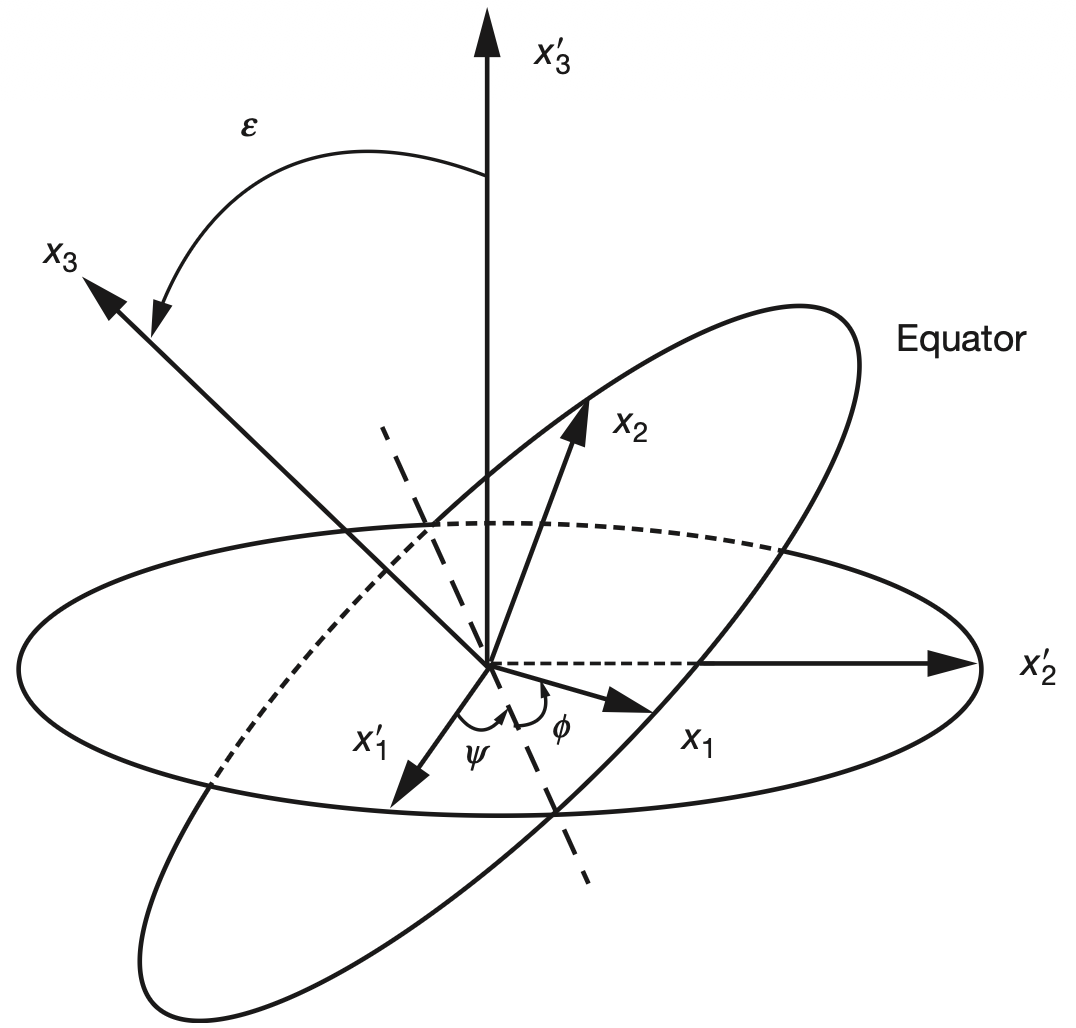
The combination results in the Euler kinematic equations:
The more squishy Truth
Planets are not rigid but have liquid parts to them, so the rigid concept gets abandoned.
In the Louisville framework the concept of what angular momentum is changes and includes the fluid parts of a planet:
: the small relative angular momentum due to relative motion with respect to the corotating frame in the fluid parts of the planet. : small increments of inertia based on mass redistribution and deformation of the planet.
This now leads to the Louisville equations:
These equations separate the wobble connected to
Because one can approximate
This can combine the first two Louisville equations to:
Changes the Wobble and LOD
When the rotation vector shifts (based on the wobble), the centrifugal force shifts with it. This pushes mass, reshapes the planet, what in turn changes the wobble again.
This changes can be determent by the McCullagh's theorem:
Here
Change in the LOD based on Mass Redistribution
So if for example on Mars if the weight of its own atmosphere or ice caps presses down on the crust, it can deform the planet itself and can change the length of a day. On Mars when winter comes the temperature drops so far that a quarter of the atmosphere freezes as dry ice and falls out of the sky, moving a lot of mass away from the equator and bringing it to the pole.
Weather and melting of ice caps can explain really well the variations in LOD, the
Changes in the Wobble based on Core-Mantle-Coupling
Here the outer core comes into play. It is a sloshing ocean of liquid iron, and gets now its own set of moments of inertia
Hough provided mathematical proof of showing that when the rocky mangle changes its rotation or wobbles, if forces the liquid core do two distinct things simultaneously.
- It forces rigid core rotation, the vast majority of liquid tries to spin as one solid uniform block with the rock.
- A sloshing irrotational flow that is one magnitude smaller than the rigid rotation.
The sloshing against the asymmetrical rock (flattened CMB) creates complex wobbles that ripple up to the surface. Mathematical these wobbles can be expressed as normal modes.
One of the more important ones are the Chandler wobble (CW). This consist essentially of a rigid rotation of the mantle about the mantle rotation axis.
The other important one is the free core nutation (FCN). This is mainly a rigid rotation of the fluid core about the mean mantle rotations axis and only exists when the core is liquid and depends on the dynamic polar flattening of the CMB.
Both frequencies can be calculated by:
where:
is the secular Love number is the dynamic polar flattening at the CMB is a compliance that describes the deformation due to the centrifugal effect on the differential wobble of the core is the equatorial flattening is the ratio of the surface centrifugal acceleration to the surface gravity
The FCN can be compared to a behavior of an egg that spins, if it is cooked and solid throughout it spins normally, but if it is uncooked and fluid inside it generates random secondary wobbles while it slows down.
This wobbles can be measured for other planets and then determent if the planet has a liquid or solid core.
Long time predictions
They are precise for short-term prediction, days to maybe decades but are not suitable to longer term calculations.
Andoyer Variables
For long-term evolutions, the secular evolution of a planet, one uses a Hamiltonian framework with looks at the energy states of a system. We assume the planet is in a state of principle rotation, meaning it rotates about its axis of greatest principal inertia (which corresponds to its lowest rotational energy) and its angular momentum axis coincides with that same axis—the system can be simplified from six variables down to four Andoyer variables.
The Andoyer variables are:
- Action Variables (Moments):
- Angular Momentum Amplitude (
): Defined as , where is the polar principal moment of inertia and is the rotation speed of the planet. - Normal Angular Momentum Component (
): The component of the angular momentum vector that is normal (perpendicular) to the planet's orbital plane of date. It is mathematically defined as , where is the planet's obliquity (the angle between its equator and orbital plane).
- Angular Momentum Amplitude (
- Conjugate Angle Variables:
- The Hour Angle (
): The angle measured between the vernal equinox of date and a fixed direction in the planet's equator, such as the axis of minimum moment of inertia. - The Precession Angle (
): The orientation angle tracking the precession of the spin axis (taking into account the shifting motion of the planet's orbit over time).
- The Hour Angle (
So the Hamiltonian equations yield:
where
To track deep time the averaged Hamiltonian is used, all wobbles are considered to average out over time:
Spin-orbit Resonance
There are times when this rule does not apply, for example during spin-orbit resonances. This occurs when the rotational speed and the orbital motion around the sun form a simple mathematical rational fraction. For example Mercury spins exactly three times on its axis for every two times it travels around the sun. The gravitational pull from the sun pulls on the same parts of Mercury.
Dissipative Forces
Longtime changes in the energy itself of a planet comes from dissipative forces, where there are four main ones.
Gravitational Tides
The gravity of the sun makes a tidal bulge in the bedrock itself, because the planet is spinning it shifts the bulge to the side, where the sun now pulls back on it. This acts as an immense frictional drag to the planet's rotation.
The magnitude of this effect is proportional to
Thermal atmospheric Tides
The sun does not just pull on the planets but also is heating them up via radiation. The atmosphere near the sun gets heated up, generating an atmospheric bulge, that positions itself opposite the way the rocky bulge position itself, so the sun is pulling if forward.
Core-Mantle friction
The sloshing from the core generates friction at the CMB. This introduces forces and energy into the core, but this energy has to come from somewhere, which is the rotation of the planet itself.
To fight this friction the planet has to seek the lowest possible energy state for its rotation, which in turn means that the obliquity has to change:
The lowest energy state is when the axial tilt is straight up(
Climate Friction
This connects the climate of a planet to its deep time orbital celestial mechanics. For example a prolonged ice age evaporates water from the oceans and freezes it into ice caps at the poles. This moves massive amounts of mass from the equatorial regions to the poles, nearer to the center of rotation, and alter J2.
The Mantle of a planet is not solid, it moves slowly under the shifted mass and when it melts it need time to relax back. This generates a lag between the change in climate and the change in the shape of the planet.