Precession and Internal Shear (Internal Fluid Dynamics focus)
How does the fluid inside a planet behave?
The inner core is a solid ball of iron and nickel around it a liquid outer core, also iron and nickel. If earth would be sitting still in space the fluid dynamics would be relatively straightforward. The viscous drag of the solid boundaries would eventually just pull the liquid along, until everything would rotate together.
Precession
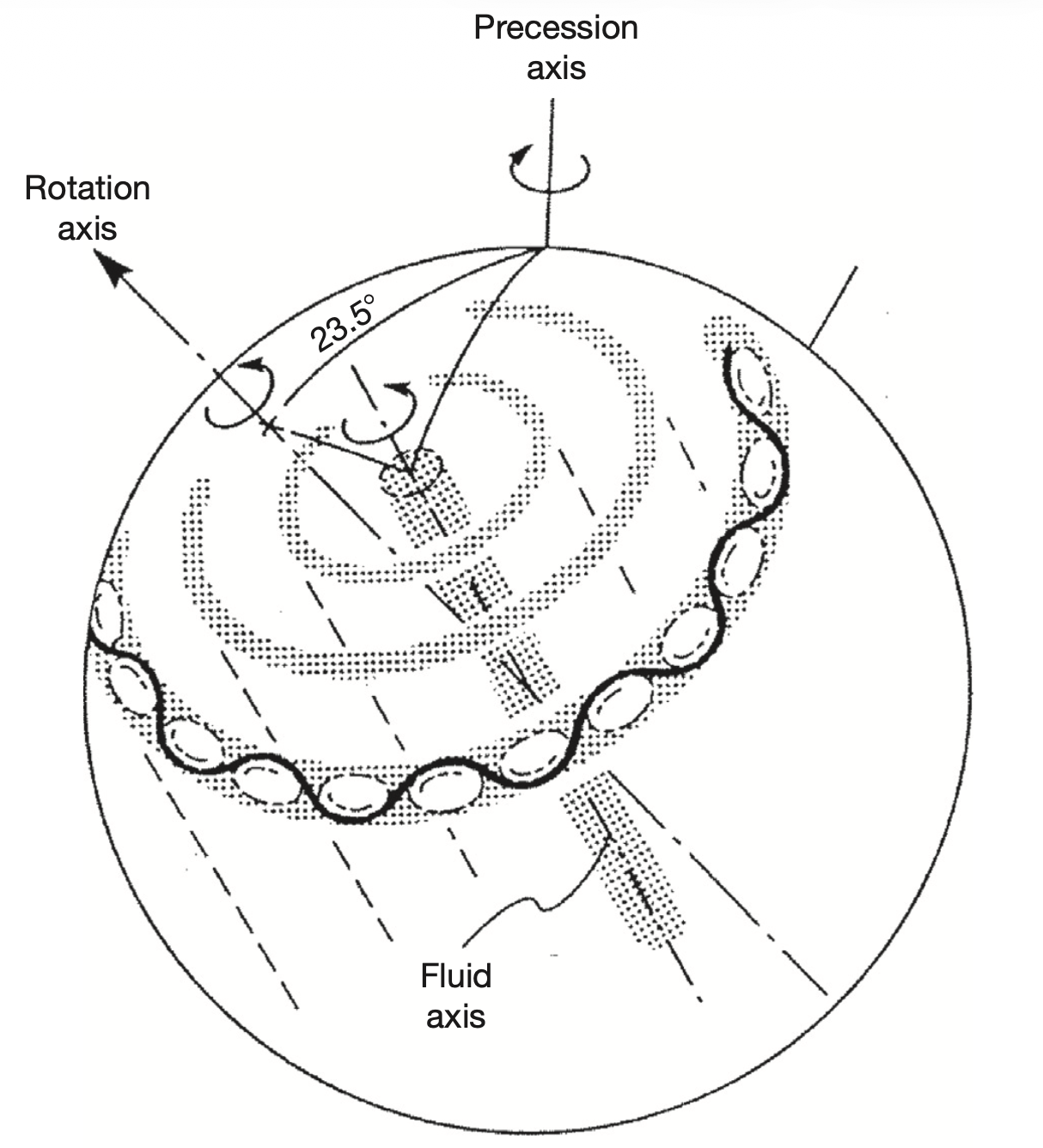
The axis of rotation is tilted at and angle of 23.5 degrees relative to the plane of orbit, and the Earth is not a perfect sphere. This leads a precession based on the pull of the Sun and the Moon. This is also called a wobble.
The movement is retrograde and a full wobble takes around 25'700 years.
For these kinds of calculations the reference frame is really important
Because these frames are not inertial frames there are fictitious forces
The interesting fictitious force for this application is the Poincaré force. The movement of the axis of rotation moves the whole content of earth and the Poincaré force is the reaction to the fluid's inherent inertial resistance.
Movement of the Fluid
The Frictionless Non-Reality
For this the inviscid solution of the equations of motions have to be looked at. The liquid iron has low viscosity, so it's assumed to have no viscosity. This means the vicious influence of the boundary goes to zero and the fluid would ignore the movement or wobble of the mantle.
Now because the CMB is not a perfect sphere but an ellipsoid, the fluid interacts with it geometrically and tries to resist it this way. This leads to the Poincaré flow, the fluids rotation axis is permanently misaligned with the mantle's geographic axis. For the Earth this angle between axis is
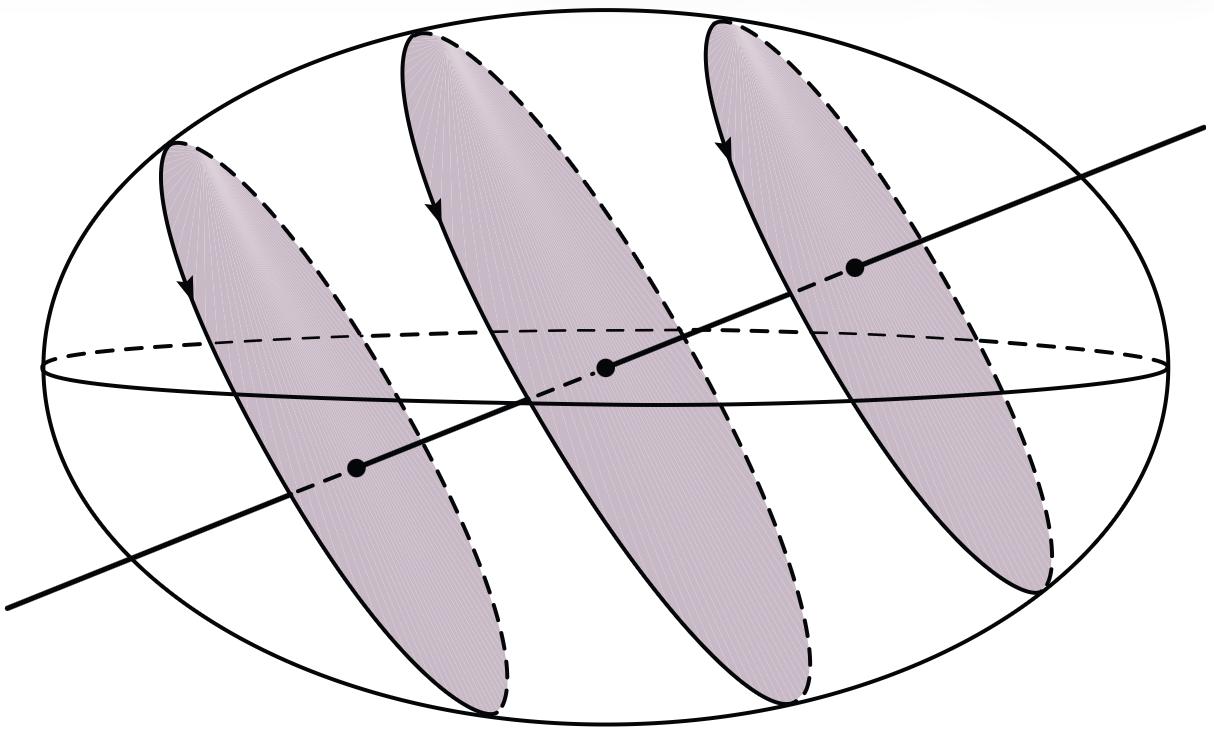
The flow has spacial uniform vorticity, so behaves like a solid body rotation.
The Frictionfull Reality
On the boundary there is a non-slip condition. The transition zone between wall and normal flow is the Ekman layer.
So the liquid core is rolling around inside the mantle, constantly dragging this thin Ekman boundary layer with it in a giant inertial oscillation. This is called the spin-over mode.
Now the Ekman boundary layer breaks down at 30°, the critical latitudes. Here, the Boundary snaps and it pumps fluid back into the core, as inertial waves.
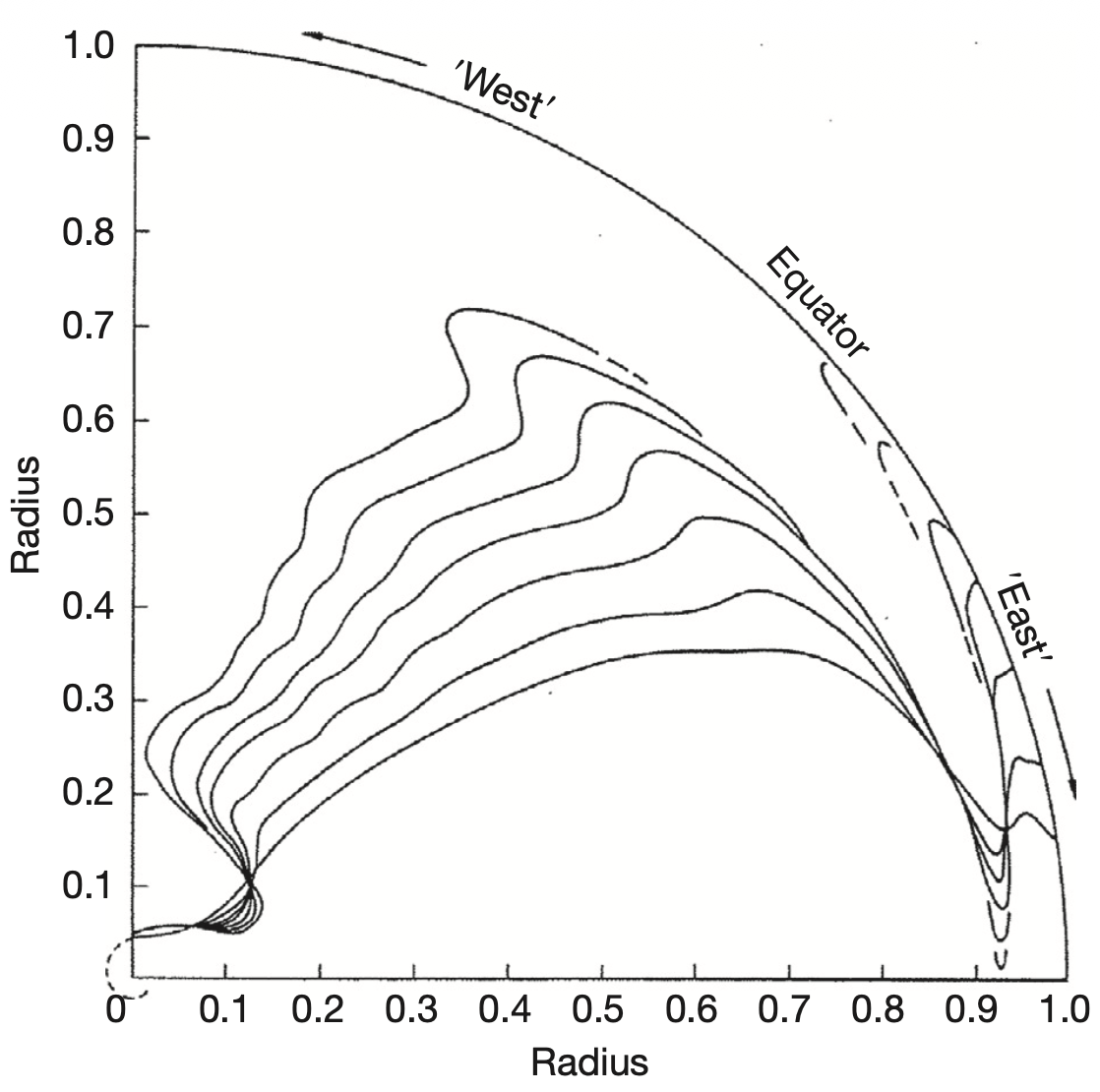
These waves travel through the fluid and reflect at solid walls, but for the reflection ignores the angle of the wall it hits, but conserves the angle relative to the axis of rotation of the earth. This is because it is driven by the conversation of angular momentum.
These reflections does not scatter randomly but converge onto specific mathematical paths and form closed loops, which are called ray attractors.
This generates shear zones with extreme velocity gradients.
The Breaking Point
The core is being pumped full by kinetic energy of the precession. There is the underlying Poincaré flow that is lagging behind the mantle. The triad resonance is a bulk flow instability.
This can occur when the large scale processional flow couples with two distinct inertial modes, two of the bouncing waves. The energy from the precession gets funneled into these inertial waves, which grow larger.
Until the point of resonance collapse is reached.
To calculate the collapse point, this behavior is simulated. In the simulation often a free-slip condition is used on the boundary, essentially turning of the Ekman layer. And even then the Poincaré flow is unstable and will collapse eventually. The big smooth flow decays into small swirling eddies. The energy is dumped into these eddies, and the fluid calms down.
The precession of earth does not stop, so everything just starts up again.
The earths core is estimated to be close to its instability limit currently. This cycle of grow and collapse takes about 20'000 years.
What does this mean for us?
Generally the driving of the geodynamo is done by the heat engine that can me modeled out of the core. The energy budget for heat driven convection is extremely tight.
These rotational dynamics based on the precession of earth can give an alternative engine, mechanical stirring, to drive the fluid in the outer core and with it the geodynamo.
The tidal forces alone do suggest up to 100 gigawatts of dissipation.