Orbits and Tides
The main equations to calculate orbits are the Keppler's Laws. They have the main influence over the Orbital Dynamics.
Planets
| Planet | Symbol | (AU) | (deg) | (deg) | (deg) | (deg) | |
|---|---|---|---|---|---|---|---|
| Mercury | ☿ | 0.387 098 80 | 0.205 631 75 | 7.004 99 | 48.3309 | 77.4561 | 252.2509 |
| Venus | ♀ | 0.723 332 01 | 0.006 771 77 | 3.394 47 | 76.6799 | 131.5637 | 181.9798 |
| Earth | 🜨 | 1.000 000 83 | 0.016 708 617 | 0.0 | 0.0 | 102.9374 | 100.4665 |
| Mars | ♂ | 1.523 689 46 | 0.093 400 62 | 1.849 73 | 49.5581 | 336.6023 | 355.4333 |
| Jupiter | ♃ | 5.202 758 4 | 0.048 495 | 1.303 3 | 100.464 | 14.331 | 34.351 |
| Saturn | ♄ | 9.542 824 4 | 0.055 509 | 2.488 9 | 113.666 | 93.057 | 50.077 |
| Uranus | ⛢ | 19.192 06 | 0.046 30 | 0.773 | 74.01 | 173.01 | 314.06 |
| Neptune | ♆ | 30.068 93 | 0.008 99 | 1.770 | 131.78 | 48.12 | 304.35 |
| Pluto | ♇ | 39.481 7 | 0.248 8 | 17.142 | 110.3 | 224.1 | 238.9 |
Orbital Elements & Constants
: Semi-major axis (in Astronomical Units, AU) : Orbital eccentricity : Orbital inclination relative to the ecliptic plane (in degrees) : Longitude of the ascending node (in degrees) : Longitude of perihelion (in degrees) : Mean longitude (in degrees)
Moons
- Large moons orbit mostly close to the equatorial plane of the planet, with small eccentricities.
- Smaller moons orbit are more irregular, with large inclinations (30° and more) and eccentricities (up to 0.2)
Most orbits are prograde (they orbit in the same direction as their parent body rotates), but some of Jupiter's, Saturn's's and Neptune's satellites have retrograde orbits.
Lagrange Points
In the rotating reference frame of two larger bodies there are five equilibrium points that do not move.
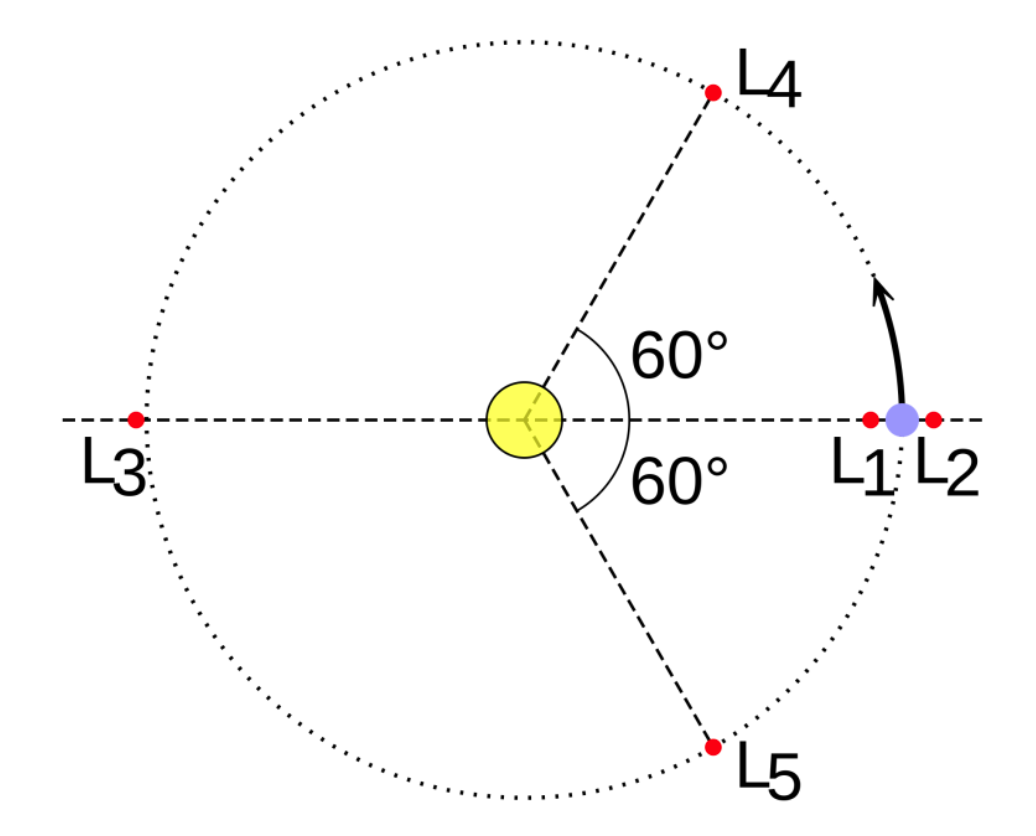
- L1, L2, L3 are unstable points, small perturbations are amplified.
- L4, L5 are stable, small perturbations lead to oscillations around the point.
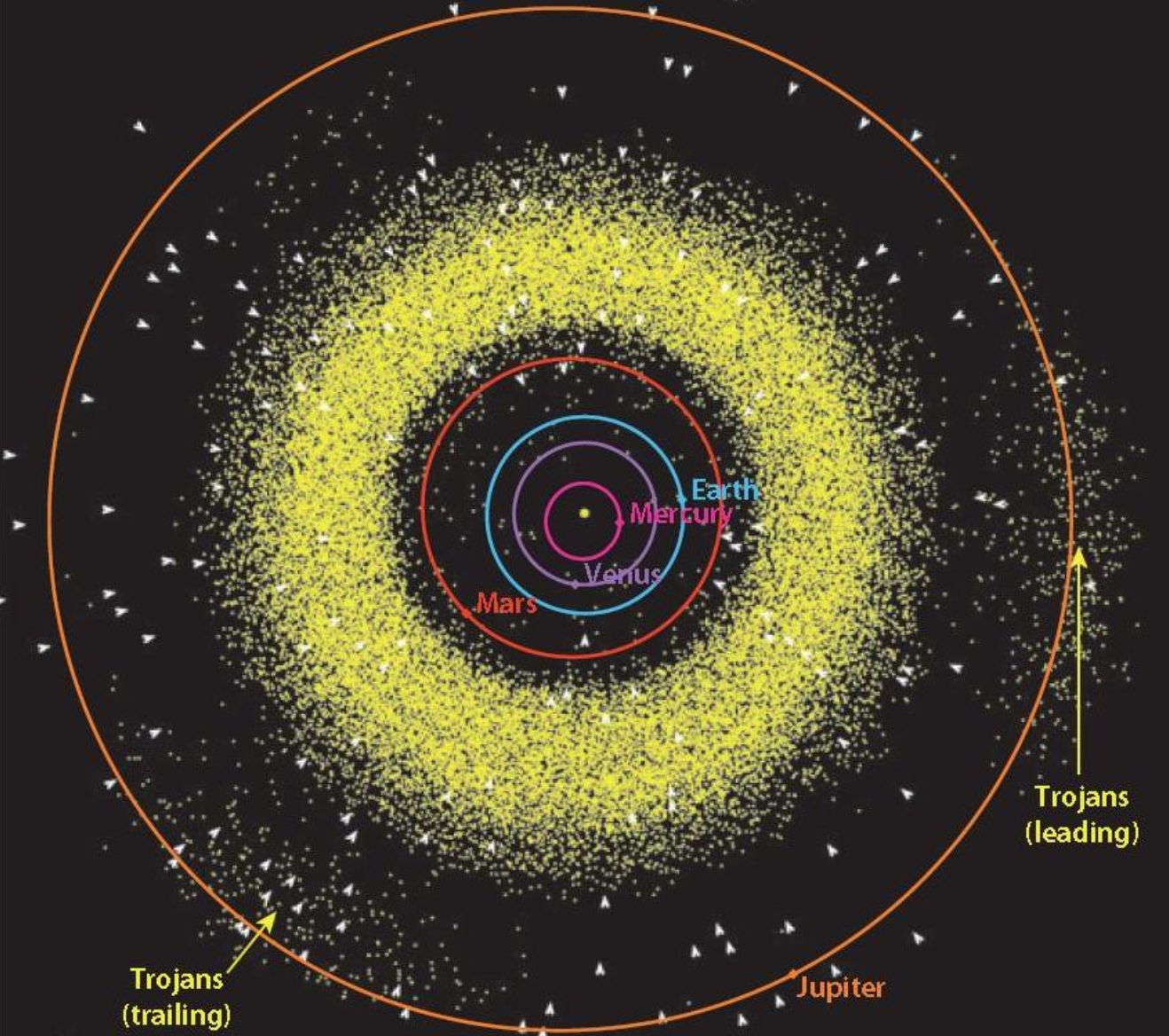
The Trojan asteroids are trapped near L4 and L5 of Jupyter and Sun.
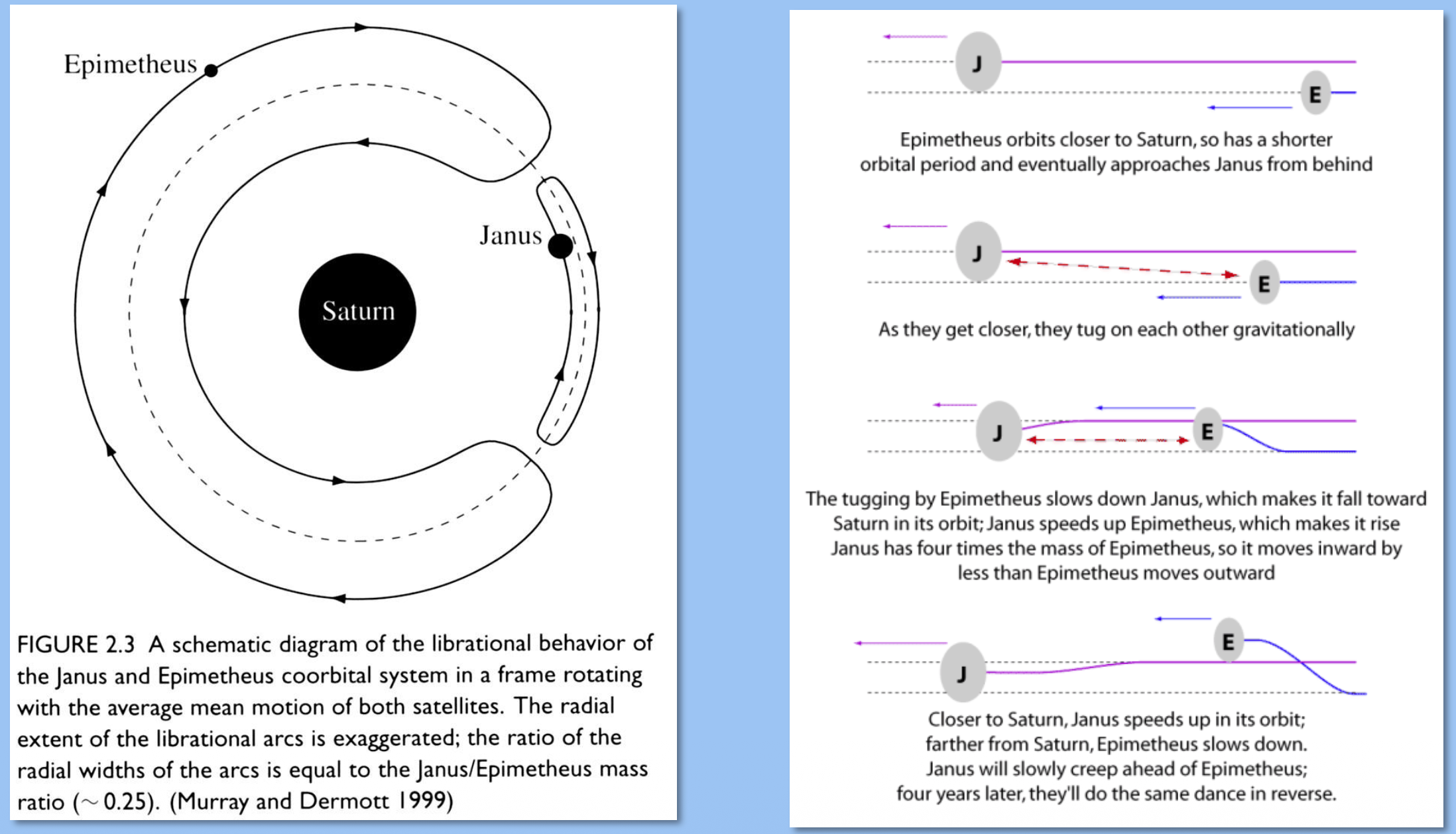
There are also horseshoe orbits, where a satellite never fully revolves around its parent body in certain reference frames.
Hill sphere
This is the sphere where the gravitational force of a planet is particular dominant. It extends to the L1 and L2 point.
: Hill radius (the radius of the gravitational sphere of influence of a celestial body) : Semi-major axis of the planet's orbit : Mass of the planet : Mass of the Sun (or primary host star)
Resonances
Many bodies exhibit an integer ration of orbital parameters:
- Orbital period of Io, Europa, Ganimed is 1:2:3 (Laplace resonance)
- Mercury rotates 3 times for every 2 orbits.
- Moon is in a 1:1 spin orbit resonance.
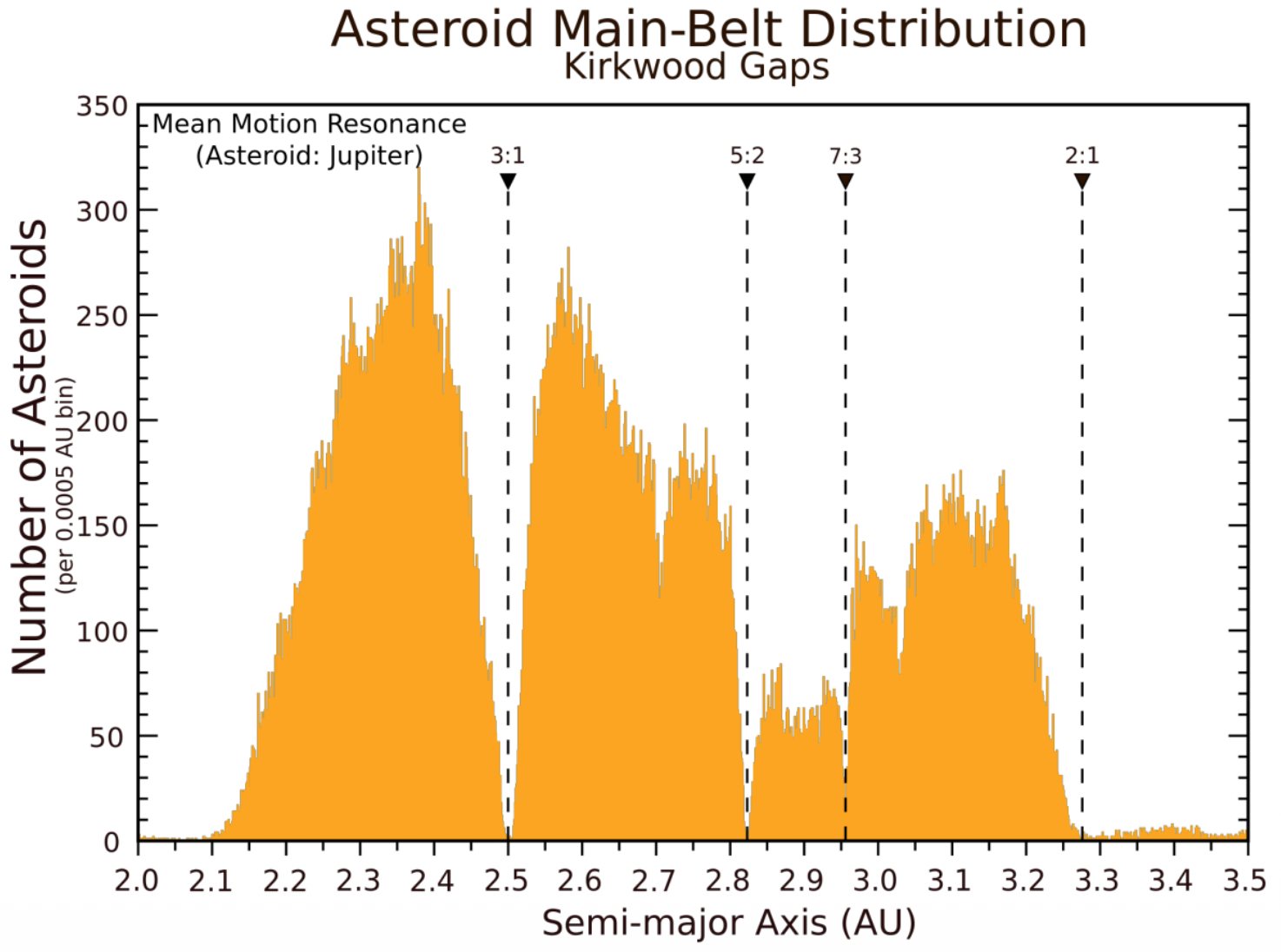
In the asteroid belt there are gaps in the corresponding orbits that have an integer ratio with Jupiter's orbit.