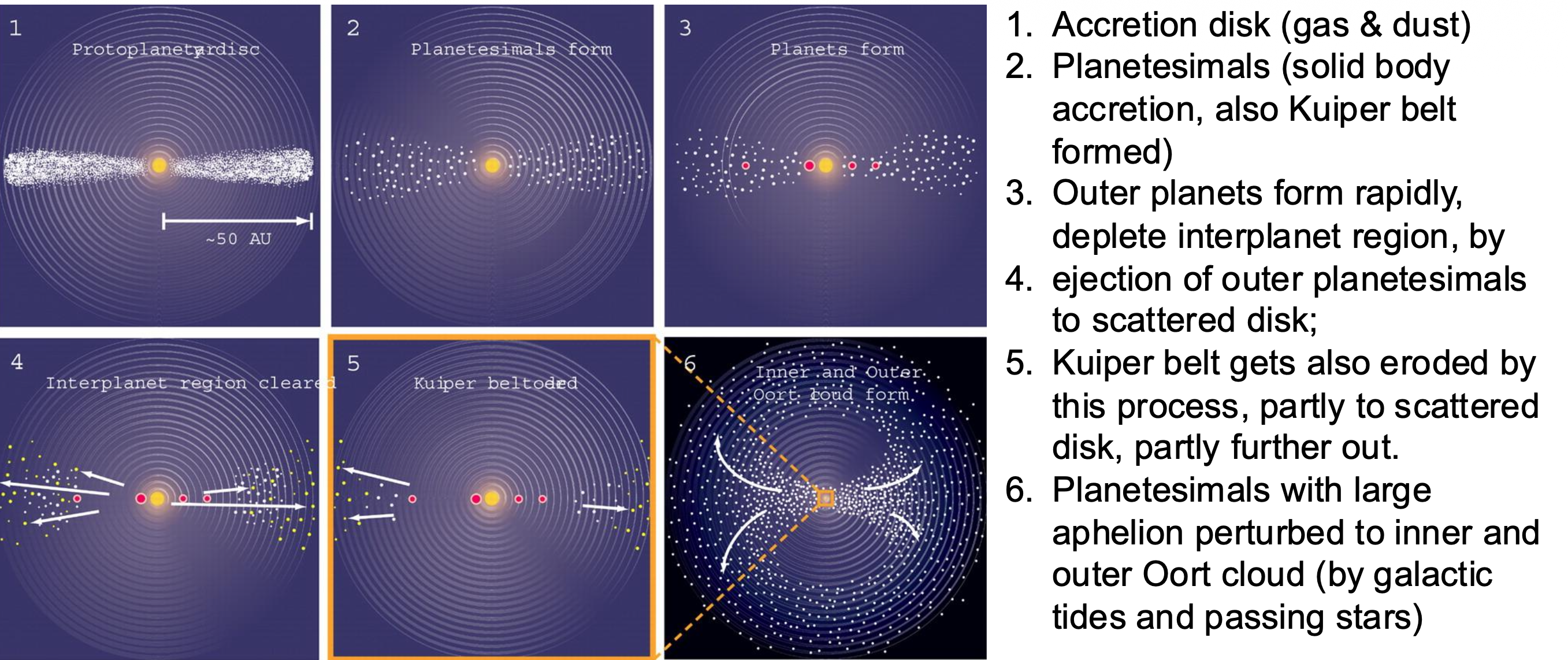
Formation of the Solar System
Observations
- Planets all orbit near a plane, in a prograde revolution with a mostly prograde rotation on mostly circular orbits.
- The angular momentum mostly in the planets and not the sun.
- Chemical composition is terrestrial vs giant planets
- Cometary reservoirs in the Kuiper belt and Oort cloud.
- See Sonnensystem
- Evidence from meteorites:
- Most meteorites are very old 4560+ Ma
- Abundance of chemical elements in meteorites
- Some phases in meteorites formed at around 2000K, some at low Temperatures
- Astronomical observations
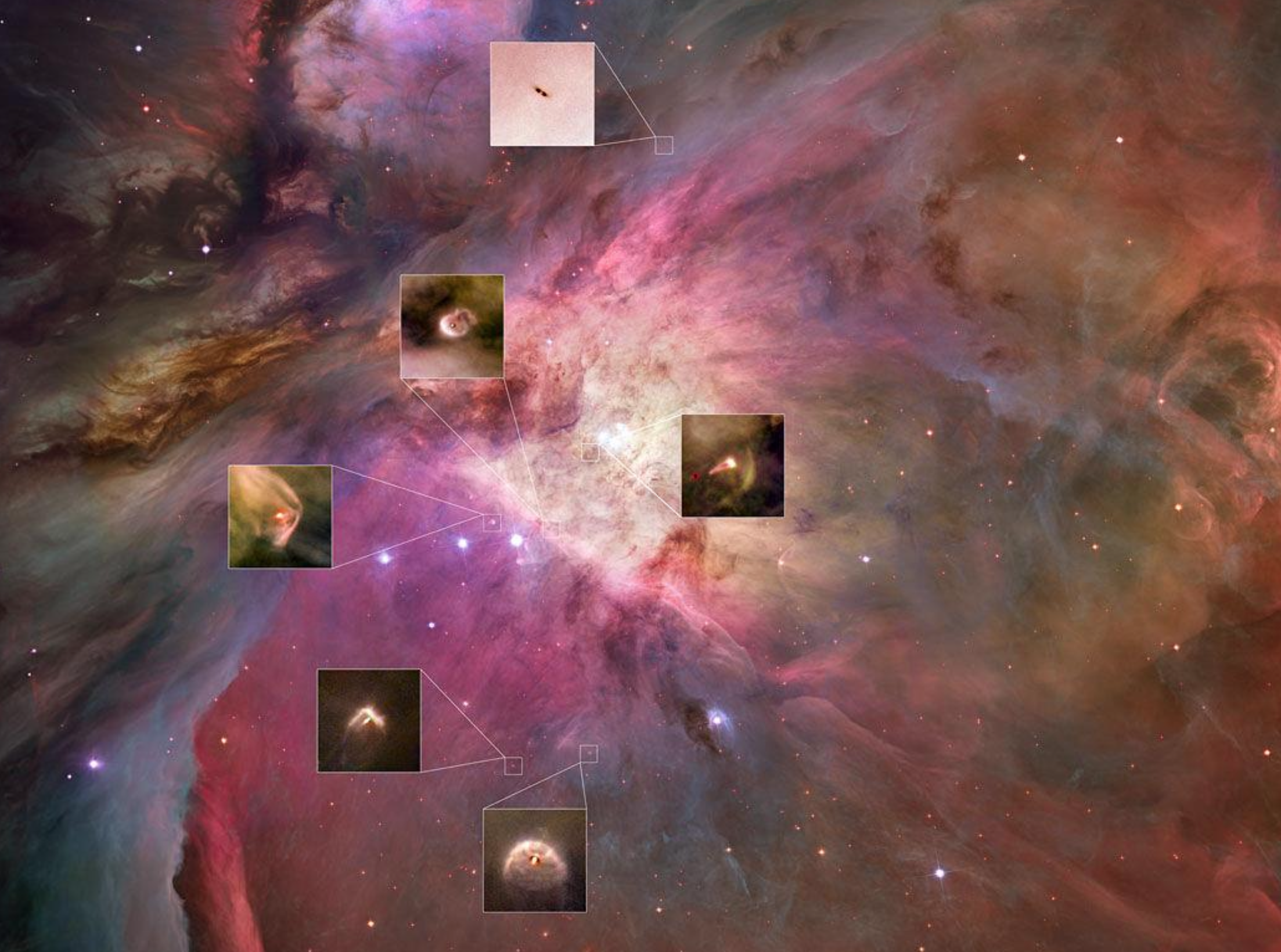
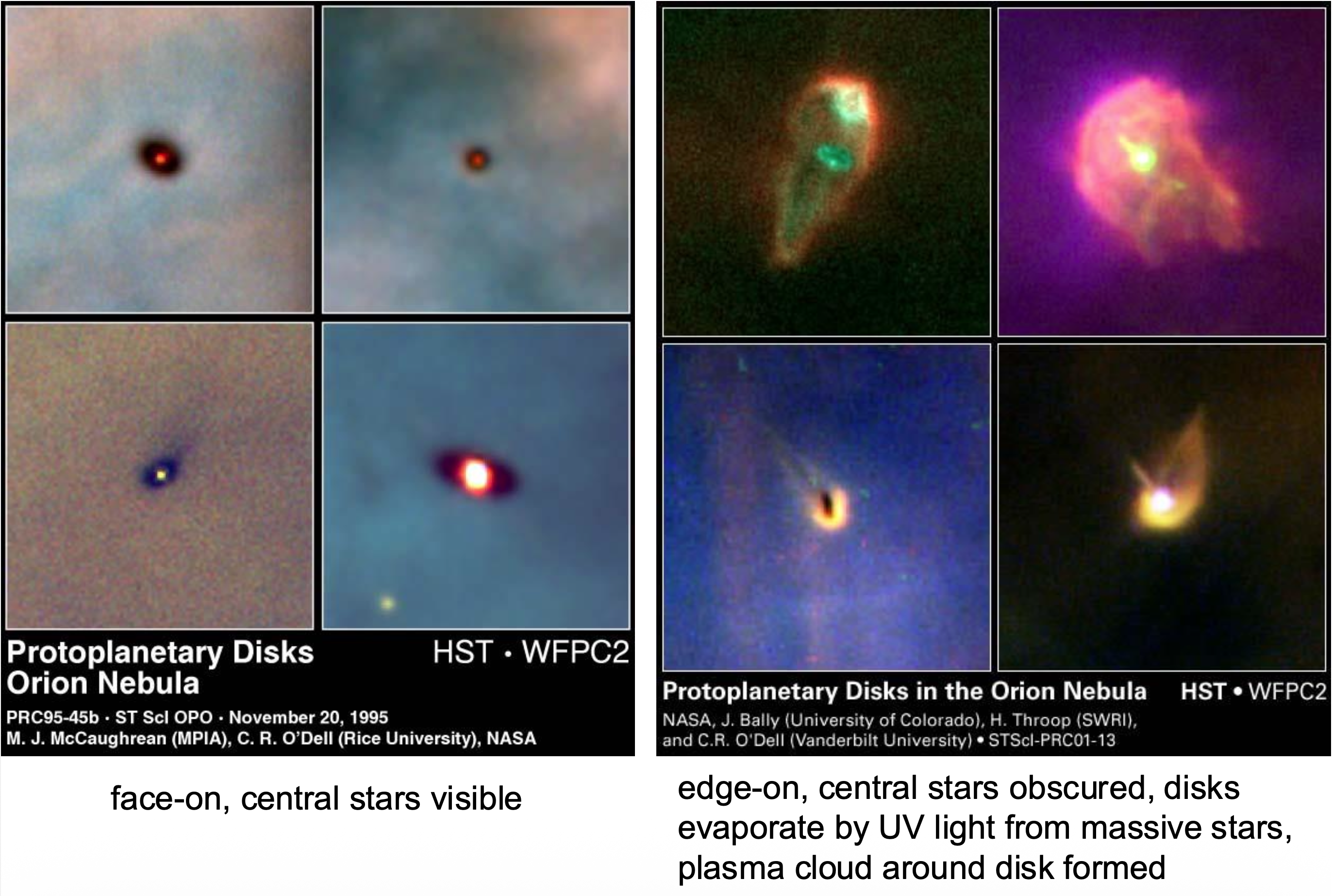
There accretion discs can be observed in different nebulas.
Constructing a Model
This can also be seen here Sternentstehung and here Planetenentstehung
Accretion disk formation
A cloud forms collapses together and builds up a rotating disc, because of the conservation of angular momentum. The material becomes more and more dense and therefore also optically more opaque. So the material is heated more and more. After enough material has collected in the middle the ProtoSun can ignite. Material is heated and dust evaporates, this means that the nebula becomes more transparent and thus cools again. This now means condensation occurs and dust grains grow.
The mass accretion is largely through the accretion disc. The angular momentum on the other hand has to flow outwards, because if it would be collected by the star it would rip it apart. The momentum transport is done via turbulence inside the disc.

Formation of planets
There is a hiracial accretion of material based on the different sizes.
Phase 1: Dust -> Planetesimals (10 km)
Dust is pushed towards the midplane from the pressure gradient. Here it begins sticking together potentially of different reasons:
- organic coating
- mechanical locking
- ice freezing
- van der Waals forces
- inelastic collisions of porous material
They can not be gravitational locked because the relative velocities between particles is on the order of 10 m/s. Only objects of about 10 km have an escape velocity of about 12.2 m/s and can therefore gravitationally grow.
Phase 2: Planetesimals (10 km) -> Planetary embryos
Here gravitation dominates. Bodies collide if they move close enough into each other gravitational fields. They get larger and attract even more other bodies, which can lead to a runaway growth if one body begins to dominate.
Phase 3: Embryos -> Planets
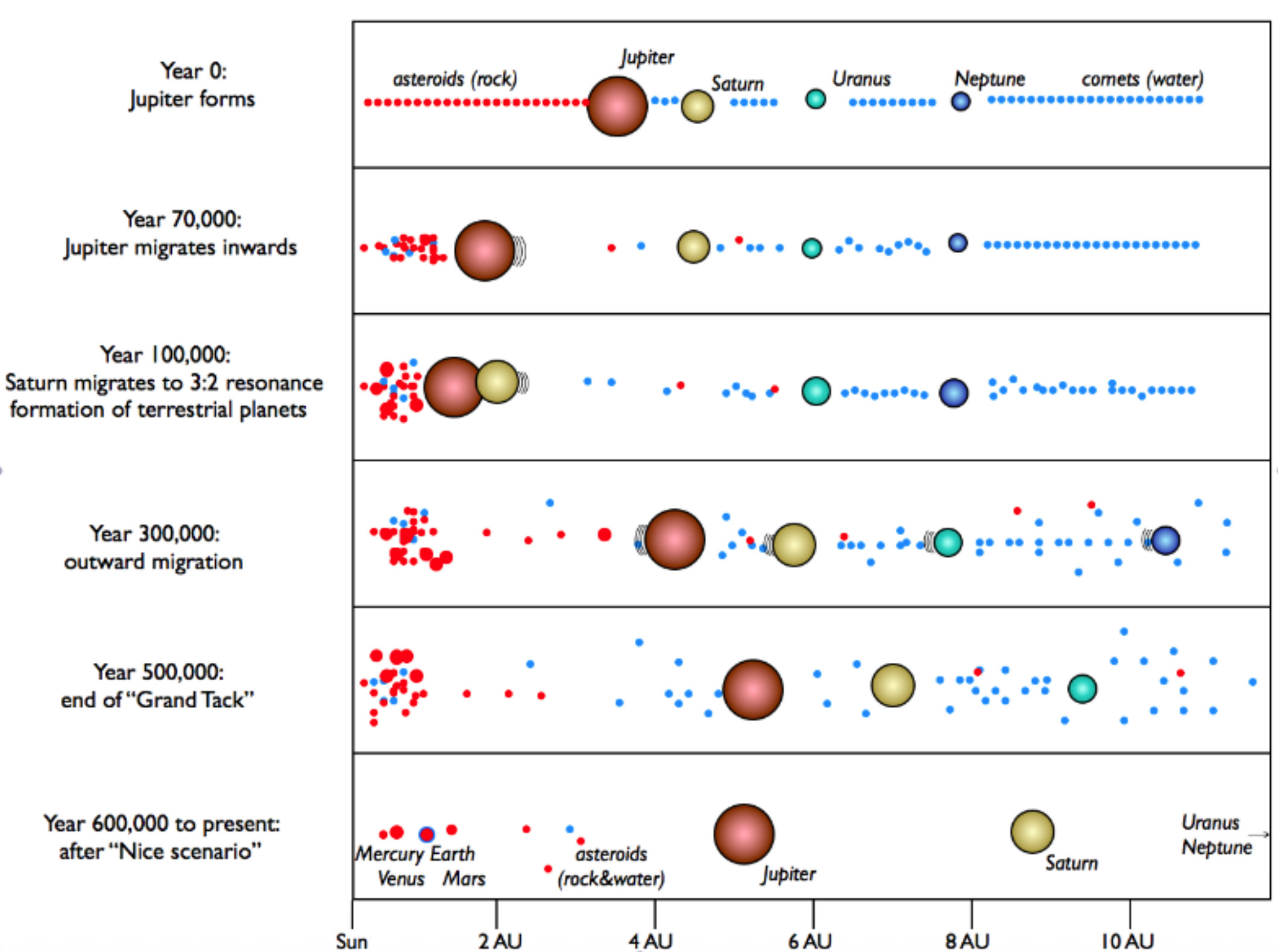
Based on calculations the most planets are formed between 0.7 - 1.0 AU. So one concept is that Jupyter is formed closer to the sun and then migrates first towards and then away again and movers the other planets with it.
Formation of cometary reservoirs