Overview the Solar System and the Moon
Universe & Galaxy Terminology
Fundamental Definitions
- Universe: Everything that physically exists.
- Origin: Big Bang (
).
- Origin: Big Bang (
- Observable Universe: The volume of space from which light has had time to reach us since the origin of the universe.
- Diameter:
( ). - Contents:
galaxies; stars.
- Diameter:
- Galaxy: A gravitationally bound association of stars.
- Milky Way (Our Galaxy): Diameter of
, containing stars. Centered around the supermassive black hole Sagittarius A*. - Galactic Structure:
- Galactic Nucleus: Composed of older, low-metallicity Population II stars.
- Outer Regions / Spiral Arms: Composed of younger, higher-metallicity stars. Our Solar System is located in the Orion Arm.
- Milky Way (Our Galaxy): Diameter of
Time & Distance Scales
- Age of Earth & Solar System:
( ). The gap between and represents the prehistory of the solar system. - Key Proportions:
(Distance from Earth to Sun) ( ). - Nearest Star: Proxima Centauri (
). - Nearest Major Galaxy: Andromeda (
).
The Solar System & Orbital Mechanics
Definitions
- Star (The Sun): Generates energy internally via nuclear fusion and radiates heat and light.
- Planet (IAU Definition):
- Is in orbit around a star (the Sun).
- Has sufficient mass for its self-gravity to overcome rigid body forces, assuming a hydrostatic equilibrium (nearly round) shape.
- Has cleared the neighborhood around its orbit.
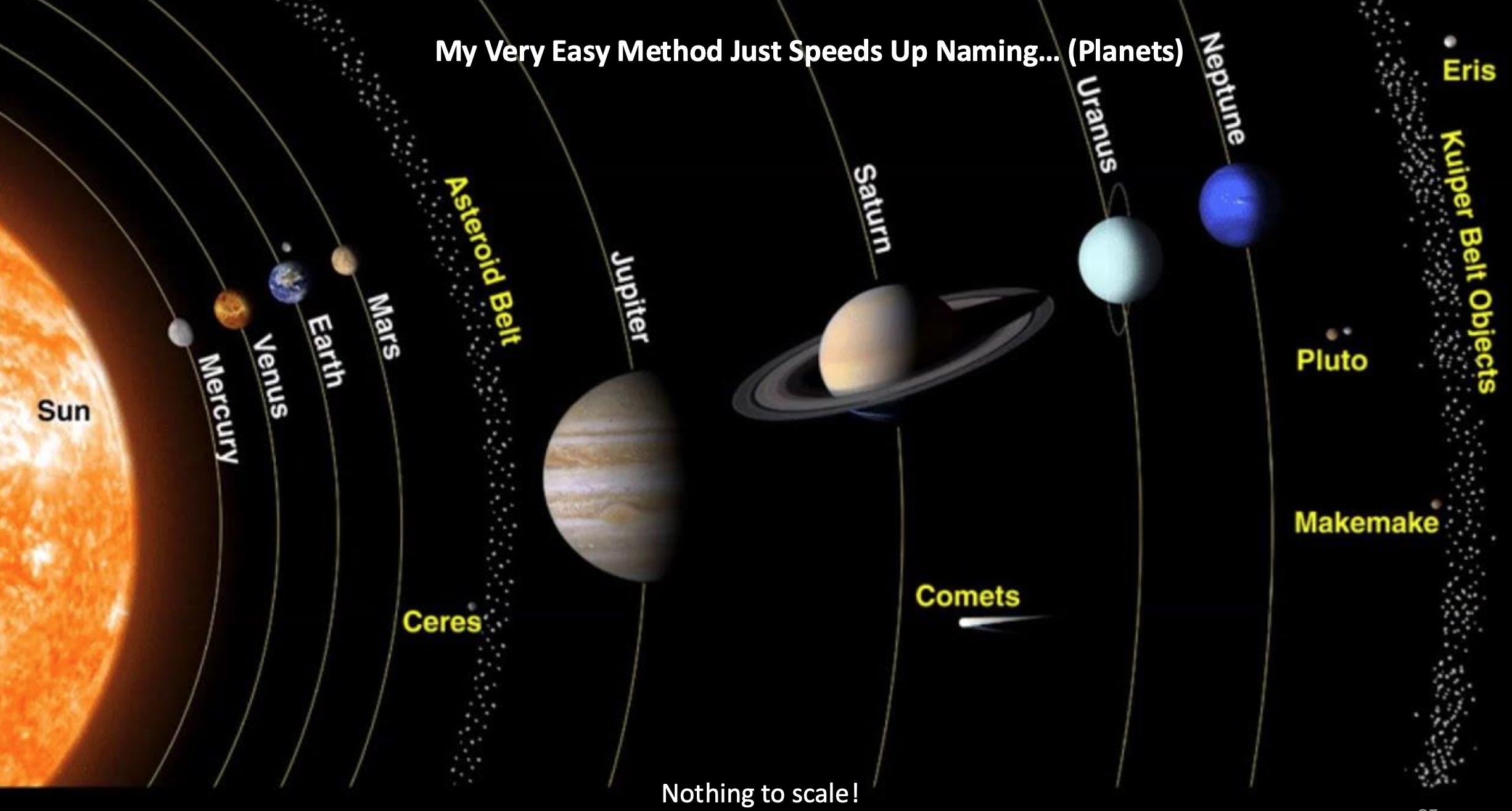
- (Note: Bodies that meet 1 and 2 but not 3—like Pluto, Ceres, Eris, Haumea, and Makemake—are classified as Dwarf Planets).
Orbital Characteristics
- Ecliptic Plane: All major planets orbit in roughly the same flat plane and in the same direction. This is a direct consequence of their formation from a flattened proto-planetary disk.
- Conservation of Angular Momentum:
(where = angular momentum, = mass, = orbital speed, = distance from center). As distance ( ) decreases, orbital velocity ( ) increases. - Orbital Periods: Increase with distance from the Sun (e.g., Mercury:
; Earth: ; Mars: ; Jupiter: ; Neptune: ). - Dwarf Planet & Comet Orbits: Often highly eccentric and inclined relative to the ecliptic plane (e.g., Pluto, Eris).
- Planetary Proximity: Due to orbital geometry, Mercury spends the most time closest to Earth (and is on average the closest neighbor to every other planet in the Solar System).
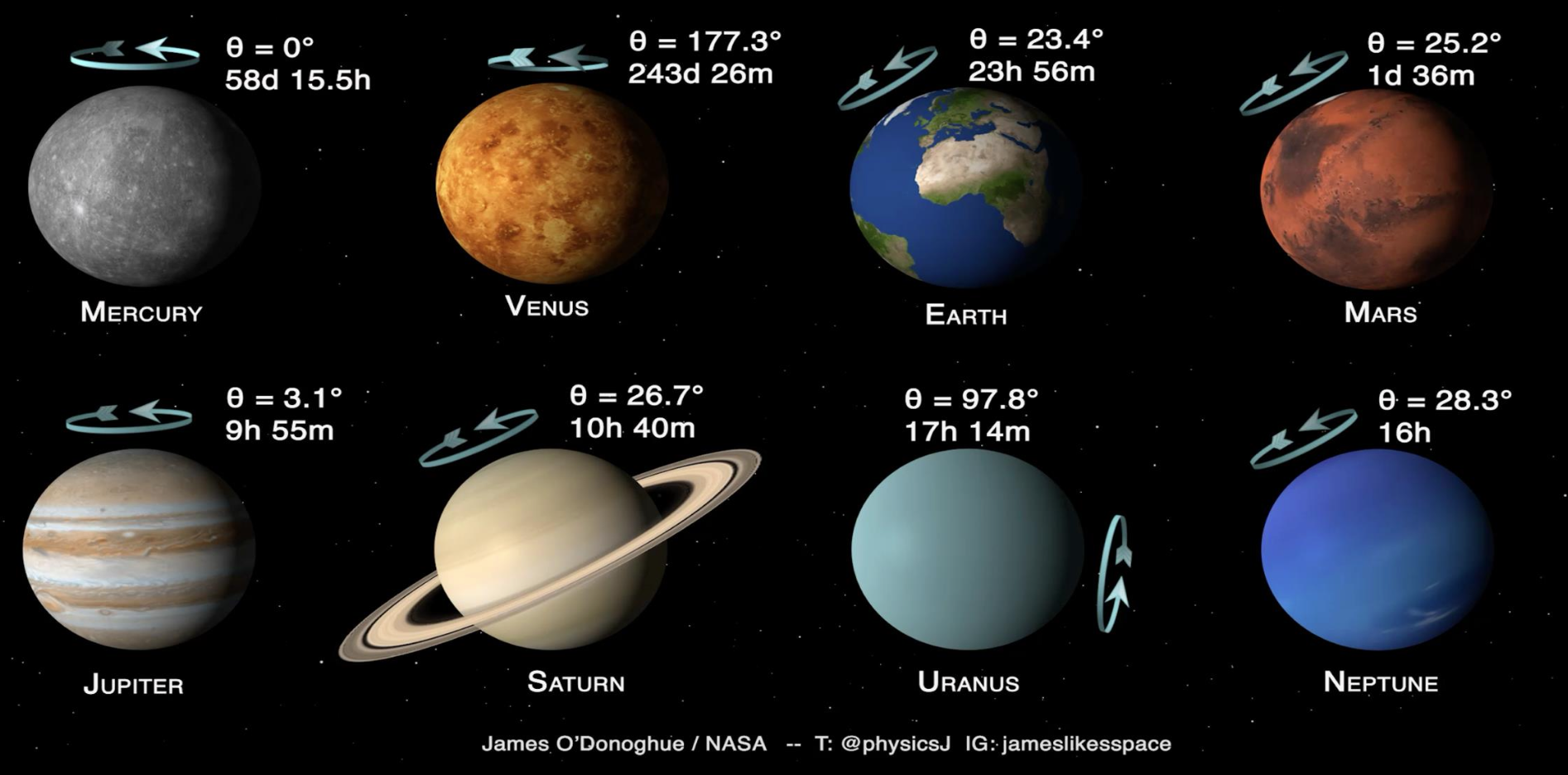
- Axial Tilt (
) & Rotation: - Most planets rotate prograde (same direction as orbit) with moderate tilts (Earth:
, Mars: ). - Exceptions: Venus rotates retrograde (
, very slow rotation of ) and Uranus is tilted onto its side ( ).
- Most planets rotate prograde (same direction as orbit) with moderate tilts (Earth:
Uncompressed Density
- Concept: Gravity compresses larger planetary bodies, increasing their measured bulk density.Two bodies made of the exact same material will have different bulk densities if their sizes differ.
- Uncompressed Density: The theoretical density of a planetary body's material with the effects of gravitational compression removed. This metric is essential for comparing the true bulk chemical composition (e.g., metal-to-silicate ratios) of different planets, though calculating it requires knowledge of the planet's internal structure.
The Sun
- Energy Generation: Powered by nuclear fusion in the core via the Proton-Proton Chain:
- Sunspot Cycle:
- Follows an
period driven by variations in the Sun's magnetic field. - Drives "Space Weather" (solar flares, coronal mass ejections).
- Climate Link: The Maunder Minimum (circa 1645–1715), a period of virtually no sunspot activity, coincided with the "Little Ice Age" in Europe.
- Follows an
Planets, Satellites & Small Bodies
| Body | Distance ( | Radius ( | Mass ( | Bulk Density ( | Uncompressed Density ( | Bulk Composition / Core | Atmosphere & Moons |
|---|---|---|---|---|---|---|---|
| Mercury | Exosphere ( | ||||||
| Venus | |||||||
| Earth | |||||||
| The Moon | None; Largest moon relative to host planet | ||||||
| Mars | Thin ( | ||||||
| Jupiter | — | Rocky core is | Massive ( | ||||
| Saturn | — | Rocky core is | |||||
| Uranus | — | Icy mantle + rocky core ( | |||||
| Neptune | — | Icy mantle + rocky core ( | |||||
| Pluto (Dwarf) | — | Thin ( |
Key Takeaways on Specific Bodies
- Jupiter: Its mass is
that of all other planets combined, making it the dominant gravitational player in Solar System evolution. - Asteroid Belt (
): - Total mass is only
that of the Moon. of the belt's mass is concentrated in just four bodies: Ceres, Vesta, Pallas, and Hygiea. - 4 Vesta: Differentiated asteroid (
, ); source of the HED (Howardite, Eucrite, Diogenite) meteorites.
- Total mass is only
- Lagrange Points (
): - Positions in space relative to two massive orbiting bodies where gravitational and centrifugal forces cancel out.
and : Stable points ahead of and behind a planet's orbit; host trapped asteroids such as Jupiter's Trojans and Greeks. : Metastable points along the line connecting the two masses; ideal for space telescopes (e.g., JWST at Earth-Sun ) because they require minimal fuel for station-keeping.
The Moon: Surface Features & Orbit
Albedo & Surface Dichotomy
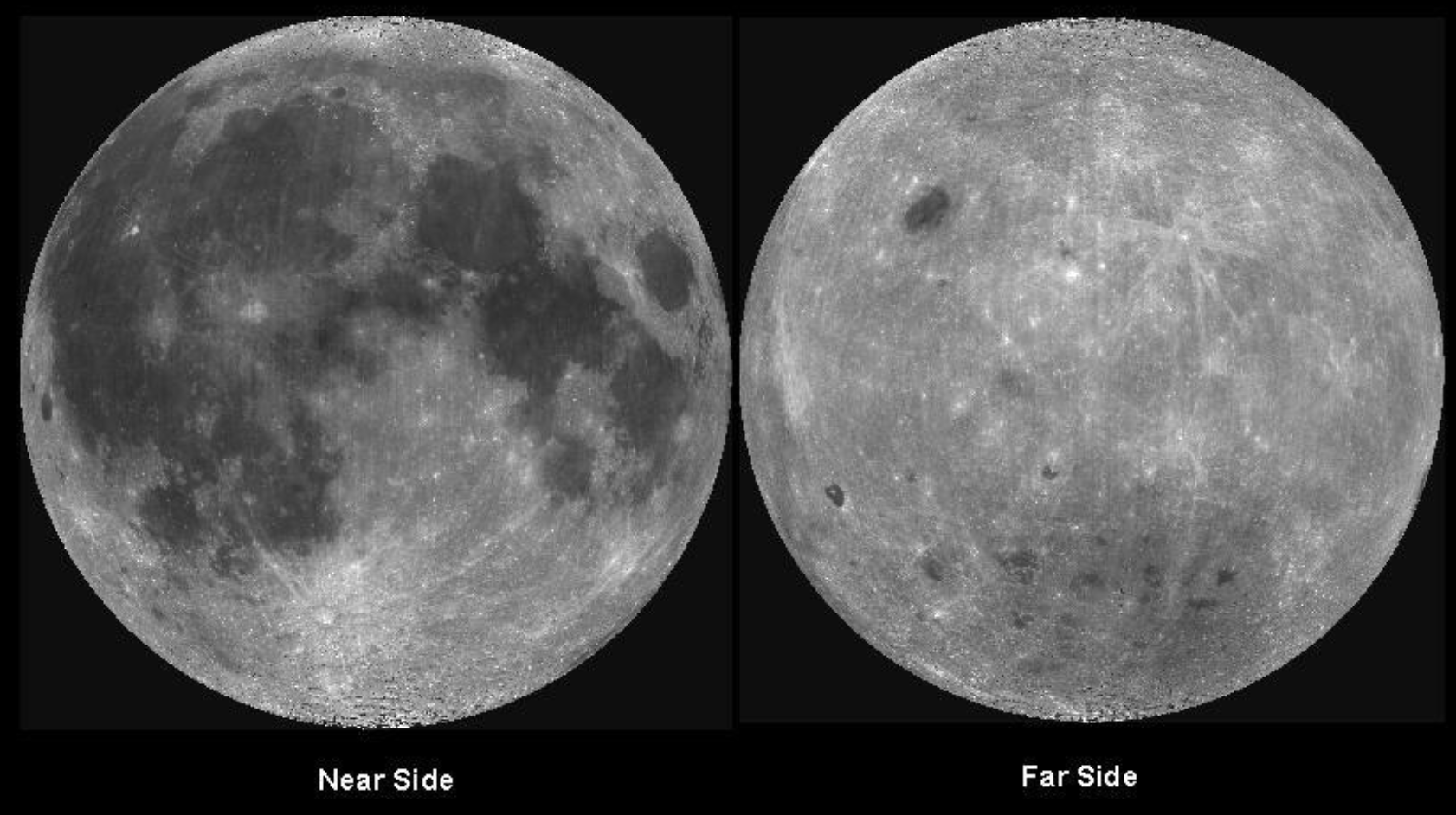
- Albedo: A measure of how efficiently a surface reflects light. Variations in albedo indicate differences in surface mineralogy and composition.
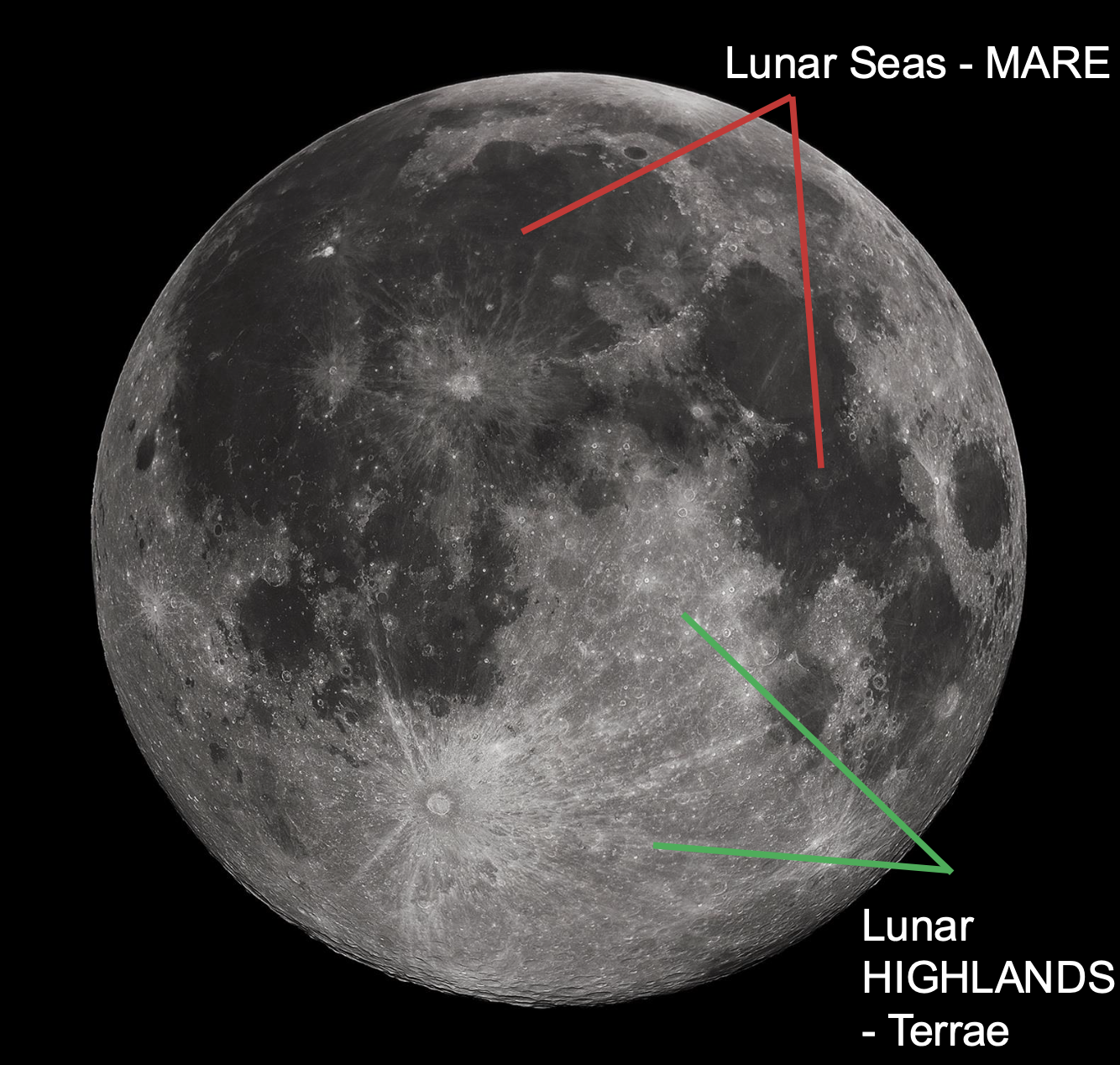
- Lunar Maria ("Seas" / Mare): Low-albedo (dark), flat, low-elevation plains. Formed by ancient basaltic lava flows that filled giant impact basins. Cover a large portion of the Near Side but are scarce on the Far Side.
- Lunar Highlands (Terrae): High-albedo (bright), rugged, heavily cratered, high-elevation regions composed primarily of anorthositic (feldspar-rich) crust.
Relative Chronology & Crater Features
- Crater Density: Heavily cratered surfaces (Highlands) are older than smoother surfaces with fewer craters (Maria).
- Crater Rays: Bright streaks of excavated ejecta radiating from craters (e.g., Tycho, Copernicus, Kepler). Rays indicate younger craters because they darken and fade over time due to space weathering.
- Lunar Mountain Chains (Montes): Unlike terrestrial tectonic mountains, lunar mountain ranges (e.g., Montes Apenninus, Montes Caucasus) are actually the surviving rims of massive impact basins.
- Illumination Angle in Imaging:
- Perpendicular illumination (Full Moon): Best for observing albedo and compositional differences.
- Oblique illumination (Near terminator): Casts shadows, making it ideal for observing topography and crater morphology.
Orbital Libration (How much of the Moon do we see?)
- The Moon is in synchronous rotation (tidally locked), rotating on its axis in the exact same time it takes to orbit Earth (
). - At any single instant,
of the surface is visible from Earth. However, due to Libration, we can observe a total of of the lunar surface over time: - Longitudinal Libration: The Moon rotates at a constant speed, but its orbital velocity varies along its elliptical orbit (faster at perigee, slower at apogee per Kepler's 2nd Law), allowing us to peek around the east and west edges.
- Latitudinal Libration: The Moon's orbital plane is slightly inclined relative to the ecliptic, allowing us to alternately see slightly past the north and south poles.
- Diurnal Libration: Caused by the geometric parallax of the observer being on Earth's rotating surface (off the central axis) between moonrise and moonset.
The Lunar Far Side
- Dominated almost entirely by rugged, heavily cratered Highlands with very few Maria (exceptions include Mare Moscoviense and Mare Orientale on the limb).
- Features the South Pole-Aitken (SPA) Basin, the largest, deepest, and oldest recognized impact basin on the Moon.
History of Lunar Exploration
- 1950s (Early Soviet Pioneers):
1957: Sputnik 1 (first satellite) & Sputnik 2 (Laika, first animal in space).1959: Luna 1 (first flyby), Luna 2 (first impact), Luna 3 (first photographs of the Far Side).
- 1960s–1970s (The Space Race & Apollo Era):
1961: Yuri Gagarin (Vostok 1, first man in space); JFK announces Apollo goal.1963: Valentina Tereshkova (Vostok 6, first woman in space).1966: Luna 9 (first soft landing & surface photos); Luna 10 (first lunar orbiter).1966–1968: US Lunar Orbiter 1–5 (mapping) and Surveyor 1–7 (landing site evaluation).1968: Apollo 8 (first crewed lunar orbit).1969–1972: Apollo 11, 12, 14, 15, 16, 17 (6 crewed landings, returning samples).1970 & 1976: Soviet Luna 16, 20, 24 (robotic sample return missions).
- 1990s–2000s (Global Remote Sensing):
1994: Clementine &1997: Lunar Prospector (global compositional and gravity mapping).2008: Chandrayaan-1 (India; detected water ice at the lunar poles).2009: Lunar Reconnaissance Orbiter (LRO) (high-resolution topography and mapping).
- 2010s–Present (Renewed Landings & Private Sector):
2013: Chang'e 3 (China; first soft lander since 1976).2018: Chang'e 4 & Yutu-2 rover (first landing on the Far Side).2020: Chang'e 5 (first sample return since 1976).2023: Chandrayaan-3 (India; first landing near the South Pole).2024: Chang'e 6 (first sample return from the Far Side / SPA Basin); IM-1 Odysseus (first private lander).2025: Private landers Blue Ghost M1 (success), Hakuto-R M2 (crashed), IM-2 Athena (landed on side).Future (2020s–2030s): Lunar Gateway, International Lunar Research Station, and crewed landings planned by the US, China, Japan, and Russia.
Global Lunar Geochemistry & Geophysics
Global datasets from Clementine, Lunar Prospector, LRO (LOLA), and GRAIL reveal a profound hemispherical asymmetry between the Near Side and Far Side:
- Topography (LRO LOLA) & Crustal Thickness (GRAIL):
- Near Side: Lower average elevation; significantly thinner crust (
, particularly thin beneath large impact basins). - Far Side: Higher average elevation; significantly thicker crust (up to
), with the notable exception of the deeply excavated SPA Basin (where the crust is thinned to ). - Olivine-rich exposures (representing upper mantle or deep crustal material) are concentrated in rings around thinned-crust impact basins on the Near Side and within the SPA Basin.
- Near Side: Lower average elevation; significantly thinner crust (
- Chemical Terranes (Iron & Thorium Maps):
- Procellarum KREEP Terrane (PKT): Located on the Near Side encompassing Oceanus Procellarum and Mare Imbrium. Characterized by high
( , from mare basalts) and a strong enrichment in Thorium ( , up to ) and other incompatible heat-producing elements (KREEP = Potassium , Rare Earth Elements , Phosphorus ). The radioactive decay of in this region provided the thermal energy driving prolonged Near Side mare volcanism. - Feldspathic Highlands Terrane (FHT): Dominates the Far Side and southern Near Side. Characterized by thick, ancient anorthositic crust with very low
( ) and low ( ). - South Pole-Aitken (SPA) Terrane: Massive Far Side basin showing moderate enhancements in
( ) and ( ) due to impact excavation into the lower crust/upper mantle.
- Procellarum KREEP Terrane (PKT): Located on the Near Side encompassing Oceanus Procellarum and Mare Imbrium. Characterized by high
Crater Morphology & Formation
Volcanic vs. Impact Craters
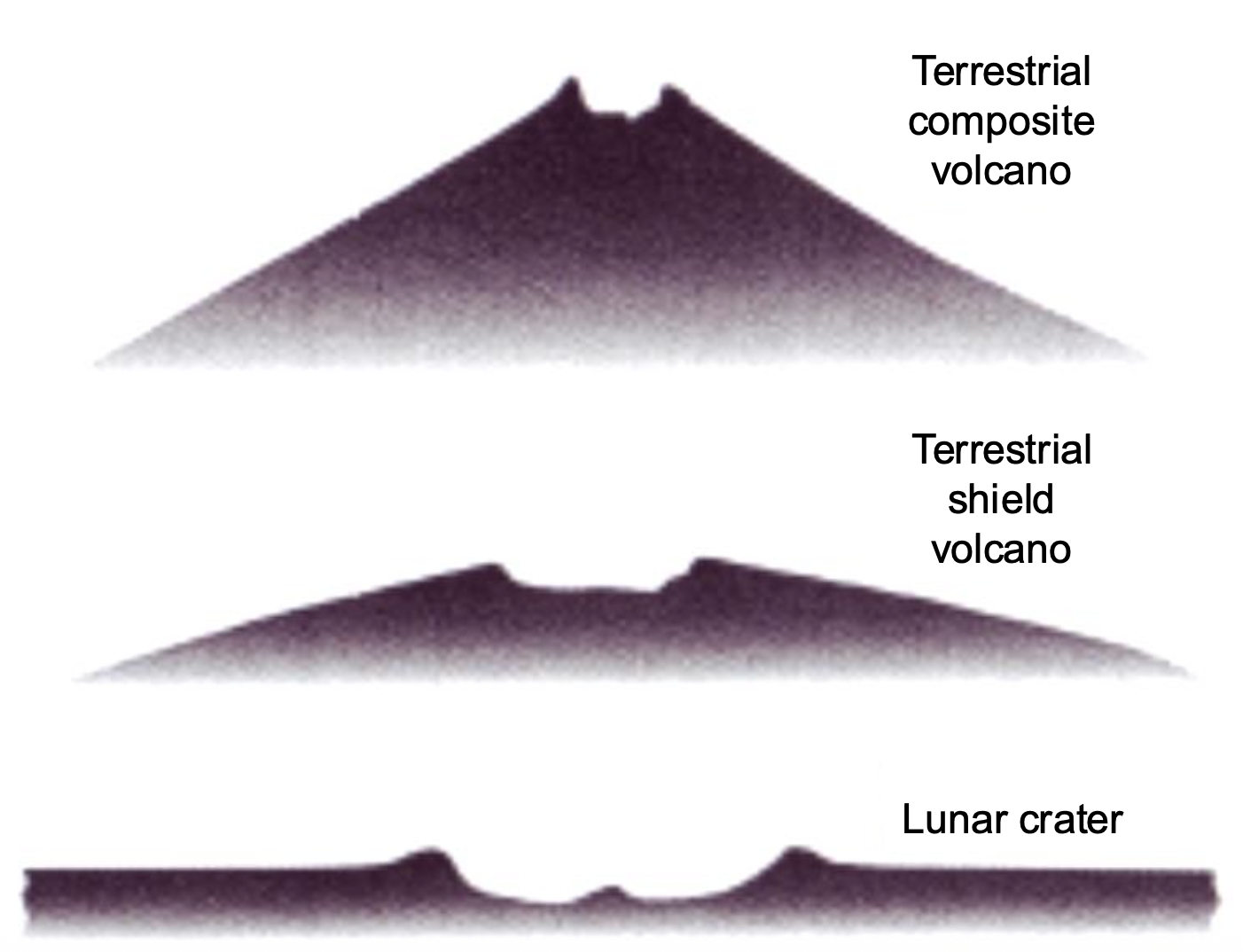
- Volcanic Craters (e.g., Shield/Composite Volcanoes): Built up by extruded material; the crater floor typically sits higher than the surrounding terrain, with long sloping flanks.
- Impact Craters (e.g., Barringer Crater, Lunar Craters): Excavated down into the surface; characterized by a raised rim, steep inner walls, surrounding ejecta blanket, and a crater floor that sits lower than the surrounding flat terrain.
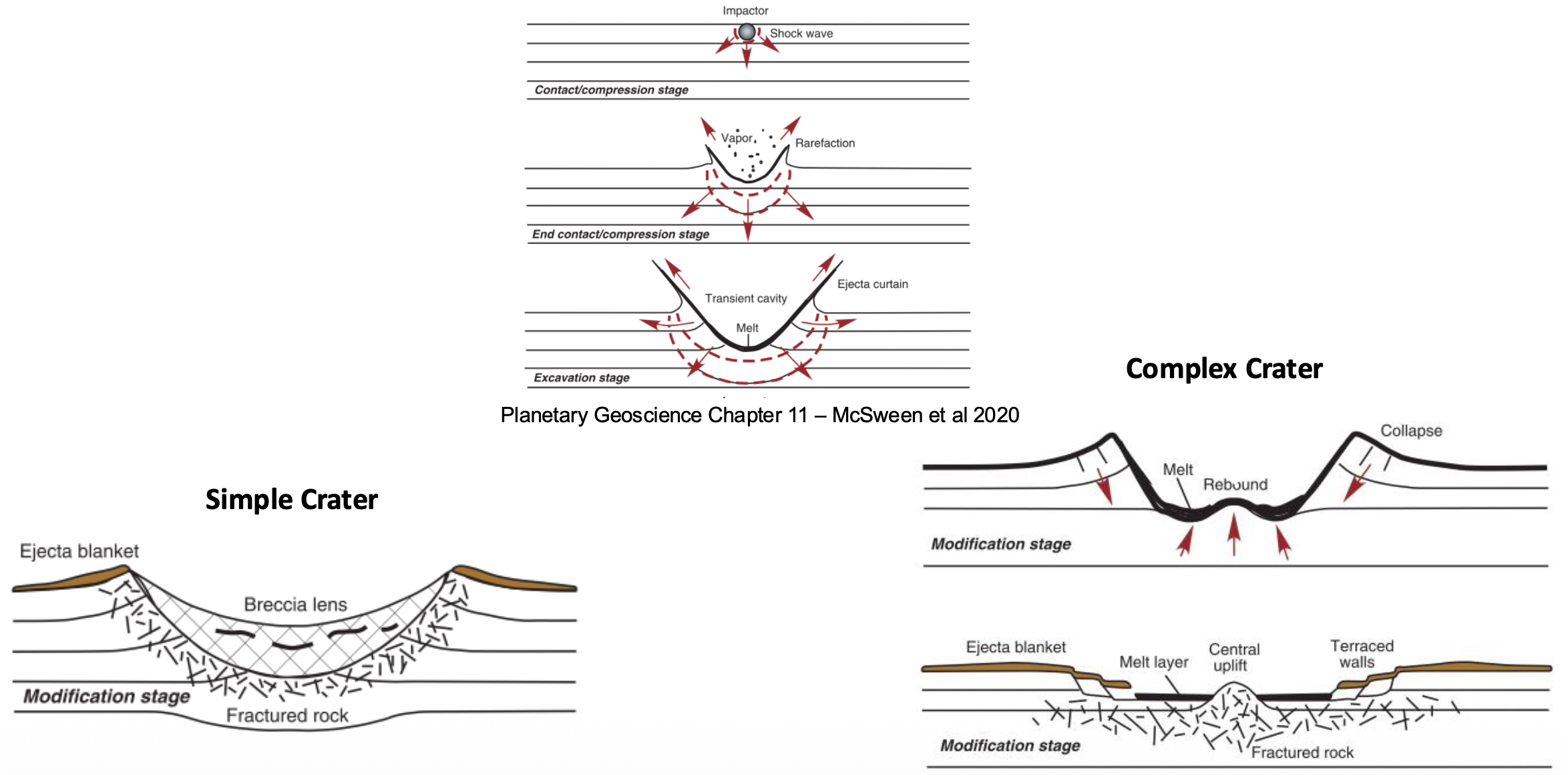
Stages of Impact Crater Formation
- Contact / Compression Stage:
- The projectile (impactor) strikes the surface at hypervelocity, transferring kinetic energy into the target rock via a powerful shock wave.
- Pressures and temperatures skyrocket, melting and vaporizing the impactor and target rock. A decompression (rarefaction) wave follows, initiating upward jetting of vapor and debris.
- Excavation Stage:
- The shock wave expands hemispherically, excavating a bowl-shaped transient cavity.
- Material is driven upward and outward along the cavity walls, forming a conical ejecta curtain that deposits an ejecta blanket around the rim. The bottom of the cavity is lined with impact melt.
- Modification Stage (shown on subsequent slides):
- Gravity causes the unstable transient cavity to collapse.
- Simple Craters (Small): Walls slump inward, forming a bowl-shaped depression underlain by a lens of broken rock (breccia lens).
- Complex Craters (Large): Elastic rebound of the compressed target floor creates a central peak (uplift), while the steep outer walls collapse downward along faults to form terraced walls and a flat floor.