The Bizarre Rotation of Mercury (Orbital Dynamics focus)
How do we know the inner of Mercury without ever touching it?
The Spin
First people believed Mercury was in a one to one spin-orbit resonance, it is really hard to see, because it is near the sun, this also would increase the assumption that a one to one spin-orbit resonance was plausible, the gravitational impact of the sun is so strong that the tidal forces would have slowed down the spinning of Mercury and locked it onto resonance.
This was correct by the introduction of delay Doppler radar astronomy.
Delay Doppler Radar Astronomy
When a radar pulse hit a planet, not everything comes back at the same time. The reflection from the center, the subradar point, comes back first because it is closer. The reflection from the edges of the planet gets received later, this is the delay part. Now from these edge-reflections, on one side the edge is rotating towards Earth and the other one is rotating against it, this leads to a Doppler shift of the signal coming back.
With this one can measure the rotational speed of planets. For Mercury this meant the measured rotational speed was much faster than currently expected one with the one to one spin-orbit resonance. Instead of rotating every 88 days it is actually rotating every 58.46 days. This results in an 3 to 2 spin-orbit resonance.
Locking a planet in a spin-orbit resonance
In the beginning the rotational speed of Mercury was a lot faster, about 10 hours per rotation. It got slowed down by primarily gravitational tides. The gravity of the sun deforms the planet and generates a bulge. This bulge rotates with the planet away from the sun, and the sun has to pull it back. This slows down the rotation of the planet.
So why the 3 to 2 and not 1 to 1 resonance? Here the elliptical orbit of Mercury comes into play. In a 1 to 1 resonance, the rotation speed needs to match the orbital speed, but in an elliptical orbit the orbital speed changes. Because of the
Assuming, no obliquity and principal axis rotation, from the Louisville equations only the z-component is important, which reduces down to:
: solar torque : Distance between Sun and Mercury : angle between the direction of mercury's axis of smallest moment of inertia (long axis) and the direction of the Sun. : true anomaly : the rotation angle between the long axis of Mercury and the major axis of Mercury's orbit.
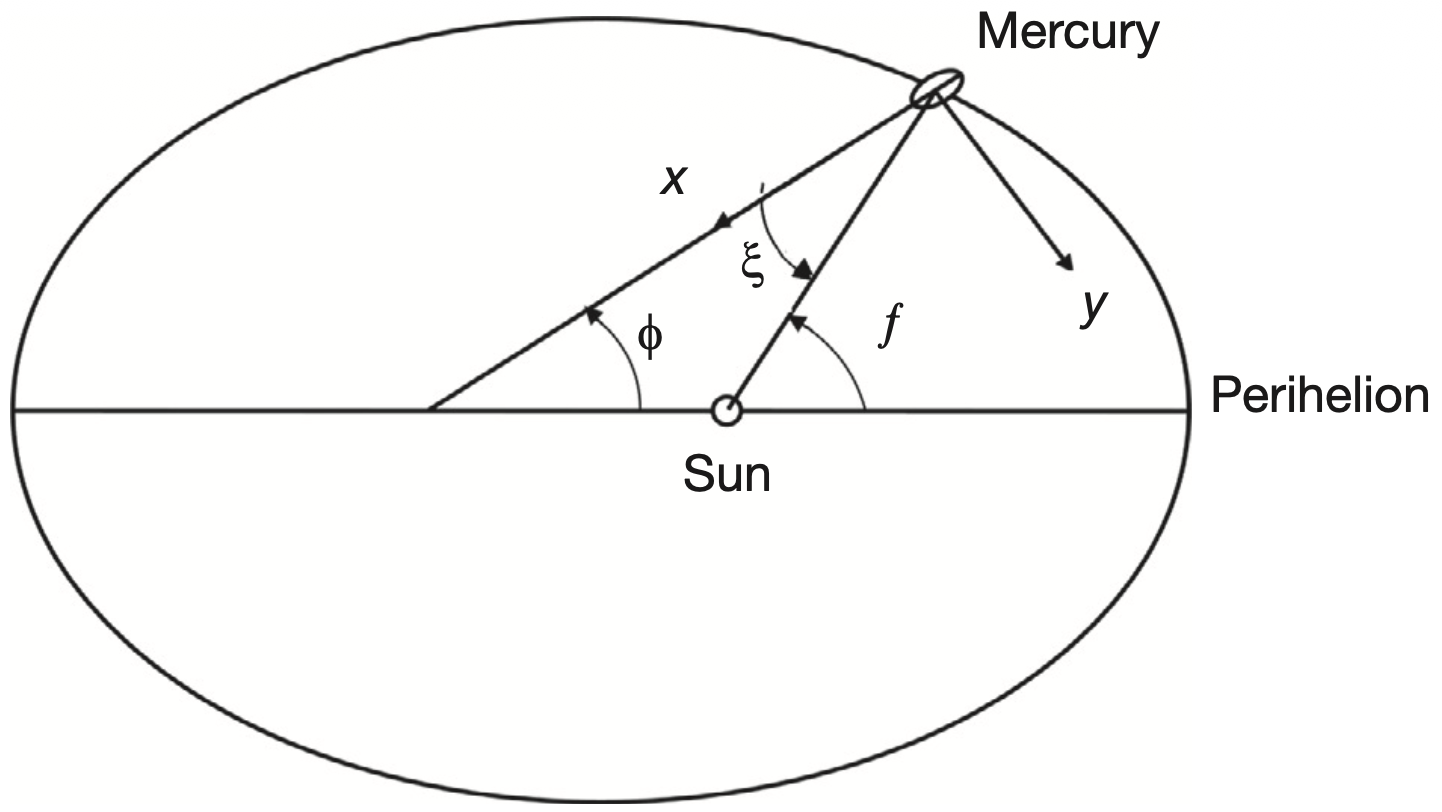
After the math the actual optimal rotational resonance must not be 3/2, but it is just a local minima Mercury got caught in. Some estimations set the probability for this to only 6.7% if the eccentricity of 0.206 would have been fix. But this is not true, because the solar system is an N-body system the eccentricity changes over time, if it was higher during a time Mercury slowed down, the 3/2 becomes much more possible.
The Cassini state
A rotating mass, like a gyroscope precesses, it traces out a cone shape. Planets also do this, and this is the wobble. Driven from the torque of the sun pulling on the equatorial bulges. Not just this, the plane of Mercury's orbit around the sun is also precessing due to gravitational tugs of the other planets.
For a planet that is highly affected by tidal dissipation, the axis is forced to settle into an equilibrium configuration, known as a Cassini state. Mercury occupies Cassini state 1, this means the spin-axis, the normal to the orbit and the normal to the Laplace plane (the average gravitational plane of the solar system), become coplanar. This is a state of minimum energy dissipation. This also moves the obliquity
The measurement of the polar moment of inertia
The obliquity is not fully zero, the gravity of the sun tries to pull the equatorial bulge flat, therefore tries to set
- J2: represents the planets polar obliqueness, also called polar flattening
- C22: represents the equatorial ellipticity (how oval the equator is)
These were more precisely measured by the messenger spacecraft in 2011. This measured the gravity by sending a constant continuous radio signal to earth, the change in gravity made it speed up and slow down, which could be measured as a Doppler shift in the signal.
With these measurements one can calculate the polar moment of inertia
What's inside of Mercury?
The polar moment of inertia of a homogeneous sphere is always 0.4. The measured polar moment of inertia for Mercury is 0.346, which means the mass in more condensed to the middle of the planet, which leads to the theory that Mercury has also an iron core. This in turn tells us not, if the core is liquid or solid.
A difference in liquid and solid cores can be seen in the reaction to being shaken. A specific type of planetary wobble helps here known as libration.
At perihelion the long axis of mercury does not point directly at the sun, it drifts. The sun's gravity applies a torque and tries to pull it back, the distance is also changing. Before perihelion the gravity grabs the bulge and accelerates the rotation, after the perihelion tries to pulls it back and decelerates it again. This is forced libration in longitude.
How can we measure small librations on other planets?
For this a simple Doppler radar is not precise enough, one needs millimeter-level precision to see this wobble.
To measure something like this, radar speckle tracking is used. Here the reflected waves interfere with each other and creating a chaotic random pattern. This pattern sweeps across earth as mercury rotates. With two or more receiving dishes on earth, these pattern's movement can be measured and tracked.
With this the libration was measured, to be 38.5 arc seconds or 455 meters over the 88-day orbit. Nearly 500 meters of deviation from the normal rotation.
Back to the Louisville equations.
To now calculate if this could be with a solid or liquid core we have to come back to the Louisville equations.
If the core would be solid, the sun would have to turn the whole of Mercury, but the gravitational influence we know, and it is way too weak to do this. So the core of mercury has to have a liquid shell that decouples the core mechanically form the shell, and therefore during the librations only the shell is moved back and forwards.
Viscous coupling is weak because of the low viscosity of liquid iron. Electromagnetic coupling occurs, but the time span in which this happens is much higher than the 88 days of one orbit. Topographic or pressure coupling also occurs but can not overcome the inertia o the core.
The mantel's moment of inertia comes out to 0.148. This means that only under half of the rotating mass is actually moved by the librations, which leads to the majority of mercury's heavy material is hidden in the core, decoupled from the surface.
The layers of Mercury
By utilizing these measurements, one can make an estimation about the size of the core. The liquid outer core has a radius of roughly 2'000 km. Which is a lot, considering the total radius of mercury is only 2'439 km.
What's inside the insides of Mercury?
The forced librations showed the liquid decoupling of the core, but free librations can show us what is in the center of the liquid ocean.
Free librations is the natural intrinsic wobble of the planet itself. The natural frequency Mercury wants to wobble at. This also can be measured with the gravity measurements, and the period is measured to be roughly 11.4 years.
This free wobble dies down due to damping on a timescale of about 100'000 years, so remanence librations of the forming of Mercury have died out until now and the current librations have come from other massive injection of energy. Jupiter and Venus chaotically tug on Mercury's orbit. Especially Jupiter exerts a periodic orbital force on roughly 11.86 years, which is close to the 11.4 years free libration. This resonance amplification increases the free librations.
How the inner core changes things
An inner solid core would also have an equatorial bulge, which would interact with the equatorial bulge of the solid outer mantle. This would lead to an extra coupling between core and mantle, and would change the frequency and slower the swing.
If Mercury had a sizable inner core, the free libration period would change from 11.4 years to 17.4 years. This means the liquid core goes all the way to the center.
One more long-term wobble
The liquid core itself can act as an active engine and introduce a wobble by convecting, boiling and churning of the liquid metal that generated the magnetic field of Mercury.
The changing magnetic fields can grip and move the inner solid core. And because of the coupling between inner and outer core the mantle would also be moved.
The problem
The measured J2 and C22 values are bigger than predicted. It is to bulgy for the current rotation. A theory for this is that this is a remanence, bulge from the time it was rotating much faster before tidal friction slowed it down.
Also at some point, a gigantic asteroid slammed into Mercury, creating the 1'500 km wide Caloris impact basin. This might have fractured the crust, releasing the interior heat in freezing the planet's shape in place.